
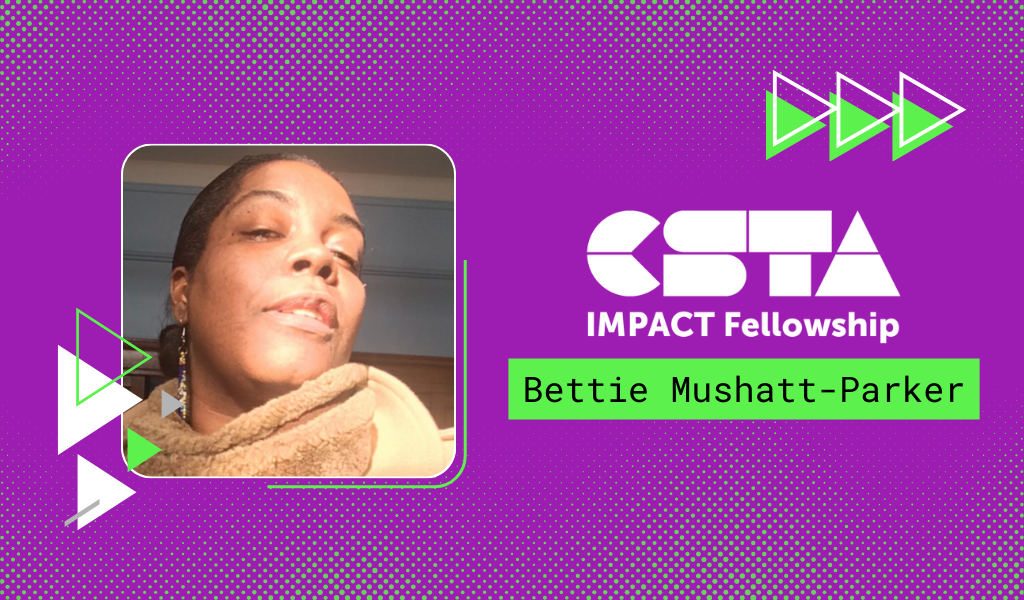
Bettie Mushatt-Parker is a CS and STEM teacher at the Isaac Pitkin School (District 19) in Brooklyn, NY. Her students have presented class projects at an American Museum of Natural History event (Expedition AI: Demystify Artificial Intelligence) and at a NYC Department of Parks event to Dr. Jane Goodall. Bettie has collaborated with other schools to expand computer science programs, developed workshops for CS4ALL, and created curricula in partnership with NYU’s Tandon School of Engineering and many preservice and in-service teachers. Currently, she is working to establish opportunities for HBCU and CUNY undergraduate student teachers to integrate computing technologies into their K–12 curricula.
Bettie’s teaching practice centers the joy of creative critical thinking. She allows her students to be collaborators in their learning, choosing from plugged and unplugged activities to build their own unique pathways to understanding the concepts Bettie teaches. Her students take a pre-assessment that tells Bettie more about their past access to and interest in computer science, enabling her to go the extra mile to meet them where they are.
She’s helped students gain access to computers and internet at home, worked with colleagues to adapt CS projects for neurodivergent learners, and shared student work in public spaces. By providing the proper tools for each student, Bettie encourages her students to feel successful, find their voices, and be proactive in overcoming the challenges that arise in the learning process. As they grow in CS understanding, Bettie’s students develop a stronger sense of joy, self-esteem, and confidence—not just in computer science, but in tackling other subjects too! Bettie says, “The time is more than overdue to support access, engagement, and achievement in excluded and marginalized communities.”
Bettie believes in the power of computer science to push people to gain new skills and overcome obstacles. A student who had been notorious for getting into trouble flourished in Bettie’s CS classes, becoming one of the school’s top programmers. Her confidence blossomed as fellow students came to know her as a gifted coder, rather than a troublemaker, and Bettie recognized her further by making her a CS student ambassador. “Students and teachers alike were surprised at her amazing creativity and whole-child accomplishments,” says Bettie.
Like her students, Bettie has been challenged by her time in CS to grow beyond her comfort zone. After facing some setbacks and adjustments in her teaching style, Bettie challenged herself to do more to grow her leadership skills and invite parents and students into CS. After a colleague recorded Bettie at an interactive CS event she had organized for kids and families, a community education leader saw the video and requested Bettie to run an AI workshop. It was a resounding success and cracked open the door for Bettie to participate more fully in the CS education community. She won a grant from the Kapor Center to extend her responsible AI unit across the district and city, and the unit then became a classroom showcase at Expedition AI, a program of New York City Public Schools CS4ALL.
Bettie meets with her district’s CS teachers several times a month to share ideas, discuss problems they’ve faced, and learn from each other—so she knows firsthand the power of collaboration. During her time as an IMPACT Fellow, she’s excited to learn from her fellow educators. “I have much to offer,” she says, “and much more to learn.” She hopes to build on the success of her responsible AI curriculum, and she knows that she’ll gain invaluable insights from her cohort to bring back to her school, district, and city.
Recognizing that her cohort comes from different types of school districts and educational backgrounds all across the country, Bettie dreams of establishing a program to connect CS students from vastly different school contexts. The students could learn about each other’s communities and find common ground in a shared problem that they might address, together, using computer science. As they collaborate, students will grow their CS skills as well as their understanding about other places, communities, and ways of living.
“We might be worlds apart, separated by culture, but connected with similar problems,” says Bettie. She believes that the IMPACT Fellowship offers the perfect opportunity to share those problems with like-minded educators and, more importantly, to help each other to uncover solutions.