State leaders and policymakers can use CSTA Standards when enacting statewide policies around computer science education, including legislative initiatives and funding opportunities. This information may help mitigate unintended consequences when developing and implementing state policies.
We have designed the following guidance and resources to support you.
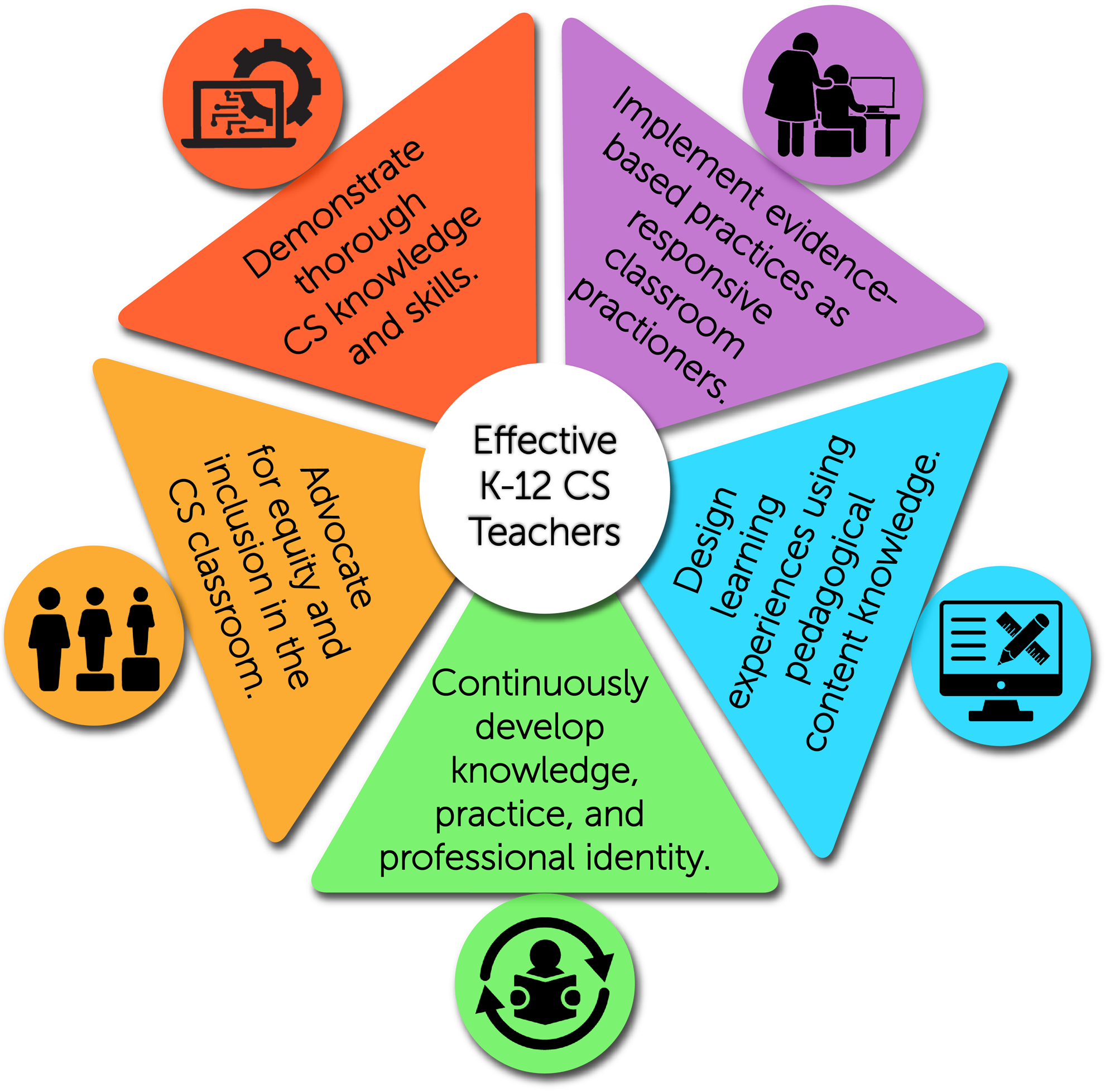
The CSTA Standards for Computer Science Teachers are designed to provide clear guidance around effective and equitable CS instruction in support of rigorous CS education for all K–12 students. The Standards:
Explain what CS teachers should know and be able to do
Establish benchmarks for CS professional learning
Provide goals to guide teachers’ professional learning and continuously develop their teaching practice from novice to master CS teachers
CS teachers enter the field from many different areas of specialization, and their preparation varies significantly. Each indicator is a roadmap to support teachers from multiple entry points as they identify their strengths and areas for growth.
The Standards represent a collaborative effort to provide a vision of CS teaching and learning based on the latest research. They were designed to complement the outcomes for student learning delineated in the K–12 CS Framework (2016) and CSTA K–12 CS Standards (2017).
The CSTA K–12 Computer Science Standards, released in 2017, delineate a core set of learning objectives designed to provide the foundation for a complete CS curriculum and its implementation at the K–12 level. To this end, the CSTA Standards:
Introduce the fundamental concepts of computer science to all students, beginning at the elementary school level
Present computer science at the secondary school level in a way that can fulfill a computer science, math, or science graduation credit
Encourage schools to offer additional secondary-level CS courses that will allow interested students to study facets of computer science in more depth and prepare them for entry into college or the workforce
Increase the availability of rigorous computer science offerings for all students, especially those who are members of underrepresented groups
The Standards align to the K–12 CS Framework (2016) and were written by educators to be coherent and comprehensible to teachers, administrators, and policymakers.
Read the annual report on K-12 CS education in the U.S., which provides an update on national and state-level CS education policy, including policy trends, maps, state summaries, and implementation data.
View the biannual landscape report to learn about who teaches K-12 CS education in the U.S. and what they need to promote equity. Use the interactive data dashboard to learn about the CS teachers in your state.
Follow the ECEP Alliance’s five-step process toward state-level CS education reform, to meet the unique context of your state’s education systems and policies.
Develop a strategic plan to provide coherence to the overall effort of implementing K–12 CS, involve stakeholders, and create a vision that can be publicly communicated.
Include all five CS Teacher Standards in the requirements for teachers to earn CS certifications or endorsements, with a balance of content, pedagogy, and inclusive practices.
Provide funding to support districts and schools in CS implementation, including initial and ongoing professional development aligned to the CS Teacher Standards. Prioritize schools serving higher concentrations of students underrepresented in CS.
Fund ongoing professional development, including intermediate and advanced learning sessions, local professional learning communities (PLCs), and coaching, in order to support the continued growth of CS teachers.
Create requirements to ensure universal CS participation beginning in elementary grades and continuing through high school (e.g., one required course or integrated experience per grade band, graduation requirements, etc.).
95% of K–12 CS teachers in the US support universal CS learning. 86% believe that CS should be a high school graduation requirement. Learn more, and view the data from teachers in your state.