
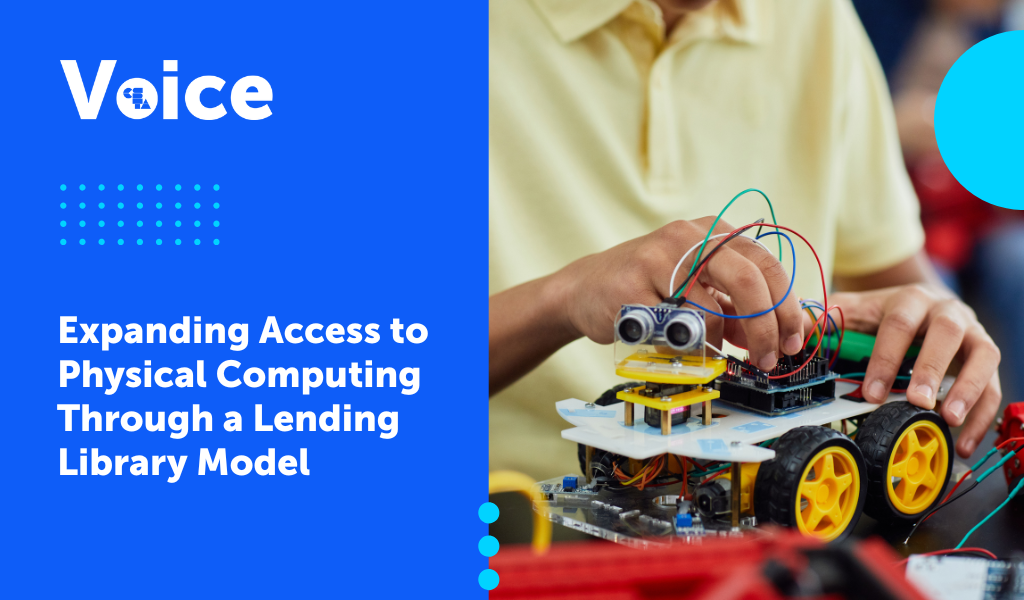
As computer science education expands across K–12 settings, access to physical computing tools has become increasingly important. Robotics, microcontrollers, and sensor-based devices allow students to explore computational thinking in concrete, interactive ways. However, for many schools, the cost of purchasing class sets and the uncertainty of selecting appropriate tools remain significant barriers.
A physical computing lending library offers one way to address these challenges. The Chicago Public Schools CS4ALL Physical Computing Lending Library provides a district-supported system that allows educators to borrow class sets of devices, integrate them into instruction, and make informed decisions about long-term use. This model offers valuable insights for computer science teachers, district leaders, and CSTA members looking for scalable and equitable approaches to hands-on CS instruction.
Why Physical Computing Matters
Physical computing connects code to the real world. Students use sensors, motors, lights, and microcontrollers to design systems that respond to physical input. These experiences make abstract concepts visible and support core computational thinking practices such as decomposition, pattern recognition, abstraction, and algorithmic thinking.
Just as importantly, physical computing offers multiple ways for students to engage with computer science. Hands-on interaction, visual feedback, and collaborative problem solving can support learners with different strengths and access needs. Because of this flexibility, physical computing is used across grade levels, from early elementary exploration to more advanced middle and high school applications.
Despite these benefits, physical computing tools are often expensive and difficult for teachers to evaluate before purchase, which can limit adoption, particularly in schools with fewer resources.
The Lending Library as a Strategy for Access
The CPS Physical Computing Lending Library was designed to respond to two persistent challenges. First, the growing number of available devices makes it difficult for teachers to know where to start. Second, schools are hesitant to invest in costly robotics tools without knowing whether they will work well for their students and instructional goals.
Through the lending library, teachers can borrow class sets of devices for a defined period, typically six to eight weeks, and use them within authentic classroom instruction. This approach reduces financial risk while allowing teachers to see how tools function in their specific contexts, including how students with varying needs interact with the devices.
Rather than positioning physical computing as enrichment, the lending library embeds it into everyday teaching and learning.
Devices for Diverse Classrooms
The CPS lending library includes a wide range of physical computing devices, including Bee-Bots, KIBOs, Dash and Sphero robots, micro:bits, Makey Makey kits, Edison Robots, Cubelets, Ozobots, and VEX platforms.
This variety allows teachers to select tools that align with their students’ developmental levels and learning needs. Screen-free robots support tactile and collaborative learning in early grades, while devices with flexible input and output options can be adapted for a range of learners. By offering multiple entry points into physical computing, the lending library supports more inclusive classroom experiences.
Scale and Reach
During the 2024–25 school year, the CPS lending library served 108 schools across the district, including elementary schools, high schools, charter schools, and specialized programs. The library loaned 407 class sets of devices to 138 teachers, placing more than 4,100 individual robots into classrooms across Chicago.
Centralizing these resources at the district level reduces reliance on individual school budgets and helps ensure that access to physical computing is not limited by funding or location.
Supporting Inclusive Instruction
Accessibility is reflected not only in device selection but also in how the lending library is supported. The CPS Computer Science team has partnered with the Office of Diverse Learner Supports and Services, Google Chicago, and researchers such as Maya Israel to inform professional learning and instructional practices connected to physical computing.
Professional learning opportunities emphasize instructional strategies and technologies that support a wide range of learners, including students with disabilities. Teachers are supported in adapting physical computing tools to address needs related to vision, dexterity, and cognition, reinforcing accessibility as part of everyday instructional design. Over the past two years, this work has included targeted professional learning that has reached more than 100 special education teachers.
Lessons for the CS Education Community
For CSTA members and computer science educators beyond Chicago, the lending library model highlights several transferable lessons:
- Centralized access can reduce inequities tied to school funding
- Short-term borrowing supports instructional experimentation
- Offering multiple types of devices supports accessibility and choice
- Pairing tools with professional learning strengthens implementation
While the structure of a lending library may vary by context, the underlying principles can be adapted to support broader participation in computer science.
Looking Ahead
The CPS Physical Computing Lending Library continues to expand through grant funding, educator input, and ongoing professional learning. As participation grows, the library functions not only as a collection of devices, but as shared infrastructure that supports inclusive instruction and equitable access to computer science.
For educators and leaders seeking practical ways to broaden participation in CS, lending libraries offer a scalable and impactful strategy.Interested in learning more about CPS’s Lending Library? Check out the documentation.

This material is based upon work supported by the National Science Foundation under Grant No. 2434586. Any opinions, findings, and conclusions or recommendations expressed in this material are those of the author(s) and do not necessarily reflect the views of the National Science Foundation.
About the Author

Portia Morrell is CSTA’s Research and Innovation Program Manager. In her role, she serves as Project Manager for the MENTORS in CS program and the UDL4CS-2 initiative, supporting K–8 educators in designing accessible CS learning for every student. She also leads resource development, manages the Teacher Inquiry Groups (TIG) program, and supports affinity groups through professional learning events.
With more than a decade of experience in computer science education, Portia has served as a curriculum developer, computer science teacher, and STEM program coordinator. She has designed professional development experiences for educators nationwide and is passionate about fostering inclusive and creative pathways that help teachers and their students thrive in computer science.