
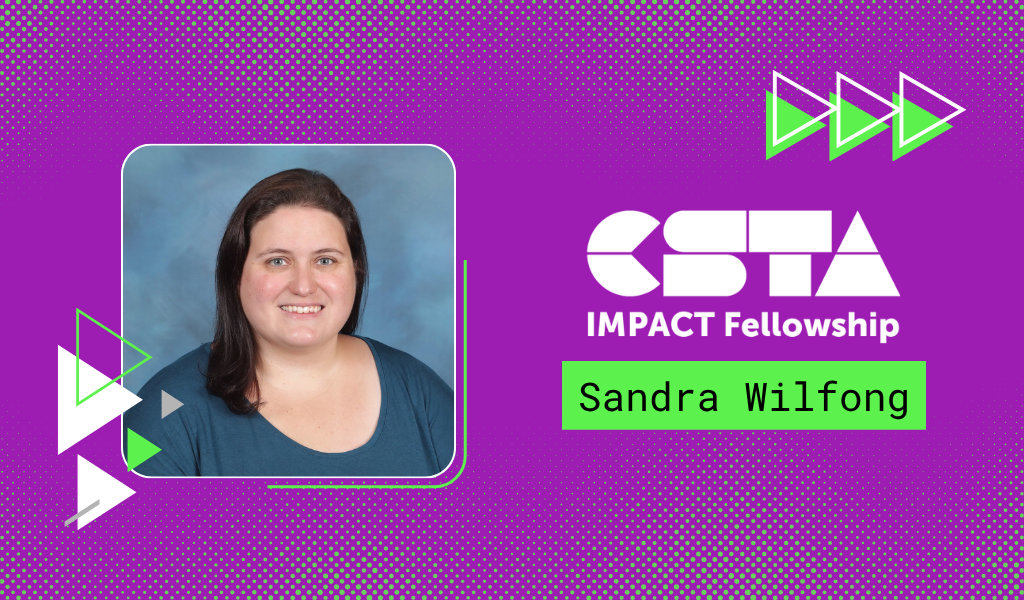
A dedicated educator of 21 years and former first- and second-grade classroom teacher, Sandra Wilfong is currently the elementary technology innovation coach for Chesapeake Public Schools. Sandra holds a BA from the College of William and Mary and a master’s degree from Old Dominion University. She has been named a 2023 Amazon Future Engineer Teacher Ambassador, the 2024 VSTE Coach of the Year, and the 2025 VDOE Computer Science Champion. Sandra lives in Chesapeake, VA, with her husband, their three children, and their dog.
Sandra has dedicated herself to countering the stereotypes about what kinds of students can or should pursue computer science. When she began her position as technology innovation coach with Chesapeake Public Schools, she quickly noticed that schools were failing to invite certain populations—special education students, English-language learners, and students who struggled academically—into computer science.
But Sandra was certain there was a place in CS for all those kids. She revamped the district’s approach by integrating CS into core instruction to ensure that all students would have the chance to learn it. Sandra remembers a special education student with limited English language proficiency who discovered a natural gift for computer science. “Once classmates recognized her talent,” says Sandra, “they began seeking her help with debugging programs, and her confidence soared.”
Recognizing that family support is as crucial as classwork for students in computer science, Sandra hasn’t limited her efforts to the classroom. She partnered with the nonprofit Little Light Ministries to bring a fully accessible CS camp to children in government-subsidized housing. In collaboration with local organizations, she began hosting family coding nights to invite parents and caregivers to learn about computer science alongside their children, thereby further enhancing the culture of CS learning and engagement in her district.
Sandra knows that it’s not enough to simply open a door to computer science. Rather, educators must actively work to remove the barriers that prevent students from getting started. To counteract unconscious preconceptions that might lead teachers to channel girls into arts classes and boys into tech, she shared data and provided training on implicit bias. These conversations helped teachers reshape their thinking and make more equitable decisions about placement in CS clubs and enrichment groups. She has helped teachers who are new to computer science feel more comfortable with the subject by providing anchor lessons, co-teaching, modeling instruction, and inviting teachers to observe computer science clubs.
Equitable CS instruction requires breaking down structural barriers, as well as individual ones. Recognizing that afterschool CS programs were excluding those students who lacked adult supervision in the afternoons or reliable transportation, Sandra advocated—successfully—to make those programs part of the regular school day. She designed inclusive schedules that would give special education students access to computer science education, as well.
For Sandra, the signs of success go well beyond test scores. “I value less tangible, but deeply meaningful indicators,” she says, “such as a once-disengaged student now eager to attend school, the pride in a completed project, or the quiet confidence of a child who realizes they truly belong in computer science.” She cites the example of a student who had faced multiple suspensions and struggled to believe in himself. When he began to learn computer science, she says, “he quickly emerged as the class expert.” His confidence blossomed, and soon his enthusiasm for learning in this one subject area spilled over into others.
As an IMPACT Fellow, Sandra is eager to expand her network of partners and collaborators while learning more about industry needs and emerging technologies. She hopes to grow as a leader and mentor, discover new paths to implement inclusive CS programs, become a stronger advocate with policymakers, and open up more pathways for her students to pursue computer science education and careers.
Drawing on her own experiences with making CS accessible to kids and families, Sandra would love to put together toolkits for unplugged CS classroom activities and event guides to support educators in developing community CS nights like the ones she’s organized in her district. She feels energized at the prospect of finding ways to welcome families into their children’s education and introduce CS in a friendly, engaging setting that wouldn’t require access to specific devices.
Sandra says, “Together, we can develop innovative solutions that break down barriers and provide every student with access, engagement, and achievement in computer science.”