
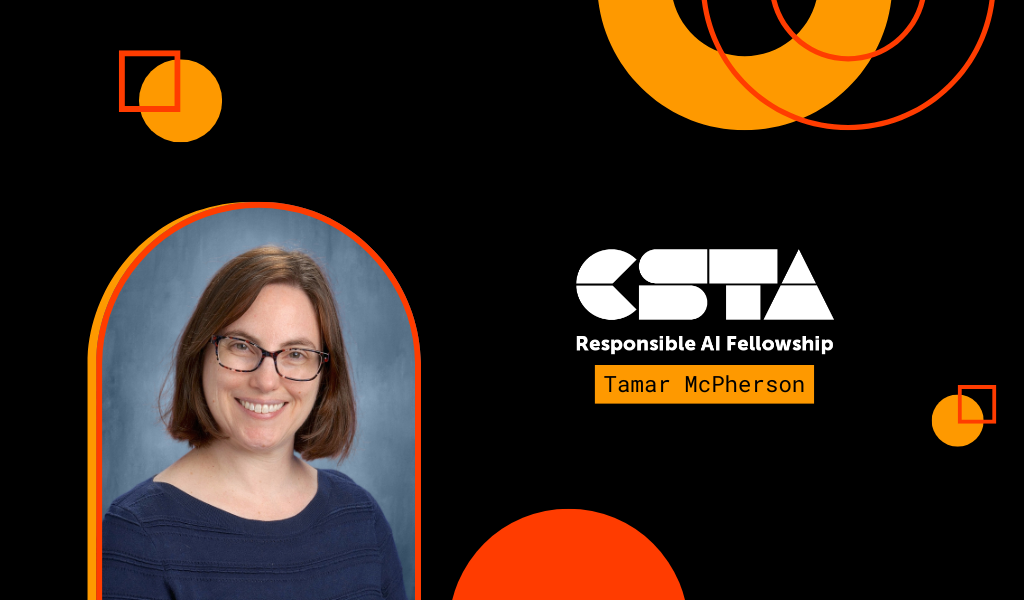
Tamar McPherson is the K-12 CS, Business, Technology Education/STEM department leader for the Plum Borough School District in Pittsburgh, Pennsylvania, where she also teaches high school computer science. She serves as President of CSTA Pittsburgh and mentors teachers across the state as they prepare for the CS Praxis exam. She has supported national computer science education through previous roles as a pedagogical expert for GenCyber at the University of Pittsburgh and as a facilitator for Cyber.org’s 9-12 Cybersecurity Cohort. Her work has been recognized with honors that include the CSforAllPA Exemplary Educator Award and the Carnegie Science High School Educator Award. Through these experiences, she champions responsible, inclusive, and future-ready approaches to AI and computer science instruction.
Tamar transitioned into education after working in research and development as a mechanical engineer. The problem-solving, iteration, and real-world feedback that shaped her engineering work continue to influence her classroom practice. She treats her learning environment as a space for inquiry and experimentation where students explore ideas, test solutions, and refine their thinking. Her teaching reflects a belief that AI literacy must grow from clear explanations, hands-on experiences, and an understanding of both the capabilities and the limits of intelligent systems.
“I treat my classroom as a living laboratory,” Tamar explains. “By breaking down complex systems into hands-on and approachable experiences, students gain insight into how AI works, where its limits lie, and how to question the assumptions built into the technology. This helps students develop the curiosity and critical thinking needed to engage with AI as informed and ethical creators.”
Tamar began integrating AI into her courses four years ago during a time when high-quality K-12 AI curricula were difficult to find. She introduced students to foundational concepts by comparing their initial ideas about AI with real functionality, then guided them through activities with Google’s Teachable Machine to explore model training. As students gained confidence, she expanded into neural networks, natural language processing, and discussions about algorithmic bias. Throughout this work, her focus has been to help students understand how AI systems behave, why they make certain decisions, and how to work with them responsibly.
Sharing her learning with other educators has always been central to her practice. As President of CSTA Pittsburgh, Tamar helped organize AI-focused professional development in partnership with Code.org and collaborated with Pennsylvania CSTA chapters to host a statewide unconference that addressed a range of computer science topics, including responsible AI integration. She recently led district-wide professional development for teachers of grades 4 through 12 that focused on instructional shifts, classroom norms for AI use, and strategies that support student learning with transparency and intention. Across all of these efforts, Tamar helps educators integrate computer science and AI in ways that prioritize inclusion, access, and rigor.
As she looks ahead to her time as a Responsible AI Fellow, Tamar hopes to deepen her expertise while contributing to work that supports educators and instructional leaders across grade levels. Her project team is developing professional learning resources that help teachers build confidence with responsible AI use, no matter their entry point or experience level. The goal is to reach skeptical educators, enthusiastic educators, and everyone in between through clear guidance, practical strategies, and a focus on intentional and ethical classroom integration. Her fellowship work reflects a commitment to supporting diverse perspectives and building the capacity of school communities to engage with AI in thoughtful and meaningful ways.
“I hope to engage in collaborative ideation and human-centered design with other fellows,” Tamar says. “By learning from one another’s approaches to the opportunities and challenges of AI in education, we can create solutions that are thoughtful, inclusive, and grounded in sound pedagogy.”