
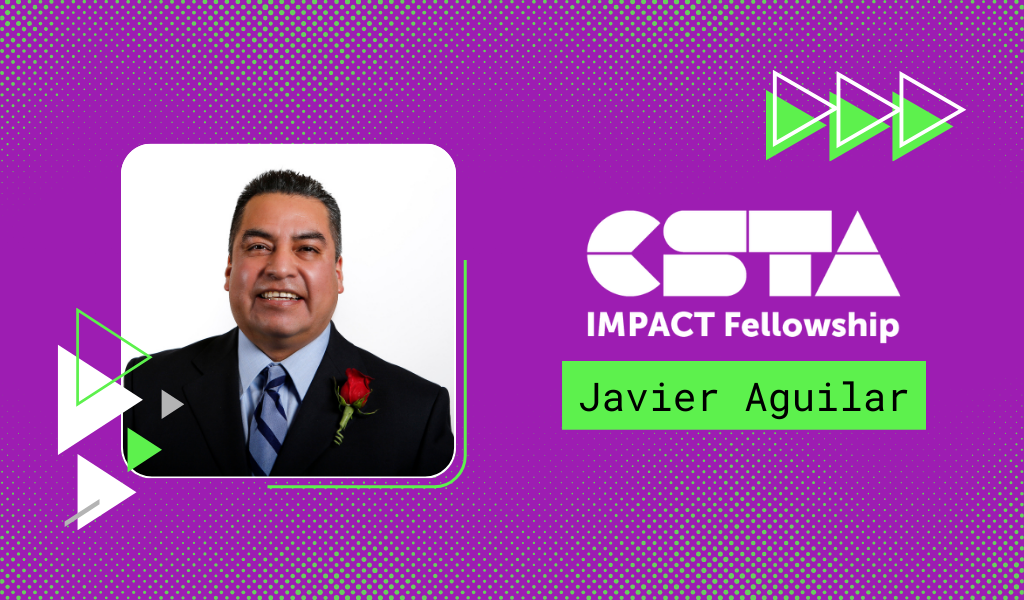
Javier Aguilar (he/him) is in his fourteenth year of working at East Fort Worth Montessori Academy as a bilingual technology applications/computer science teacher and robotics coach for preK–5 students. His school was recognized by Google CSFirst and participated in a promotional video in 2023. Javier holds an M.E. in educational technology from the University of Texas, Rio Grande Valley, and he’s a Google Certified Educator with Level 1 and 2 certifications. He is also a communications lead for CSTA Dallas Fort Worth. In his free time, Javier loves to read, go to the movies, run, swim, and spend time with his family and pets.
Javier’s passionate about bringing coding to the youngest students, establishing a strong foundation for them to continue learning CS throughout their education. He visits the lower-grade classrooms (preK, kindergarten, and first grade) at least once a week to teach ScratchJr and encourage students to use their creativity and develop their passion for coding. “We want to pursue the idea that any student can start learning programming at any age,” he says. “Practice, curiosity, and creativity are vital aspects when the students use Scratch and ScratchJr. More importantly, they have fun when learning coding.”
In one ScratchJr encounter, Javier helped second-graders create simple games where their characters could move and interact. From there, they moved on to Scratch, creating more complex animations and interactive stories. One student told him, “I never thought we could write with real code before!” Another student designed a maze game, where players have to solve puzzles in order to escape. Javier loves seeing the kids advance from simple block-based coding into writing JavaScript commands, gaining confidence as they go. Because many of the introductory CS curriculums focus on older students, Javier has taken the initiative to adapt middle school resources for his younger learners. In collaboration with middle school teachers and curriculum specialists, he developed age-appropriate materials for his elementary students and helped build a cohesive CS education pathway from elementary to middle school.
That spirit of collaboration has served Javier well in all aspects of his work. His school’s Big Brothers Big Sisters at EFWMA program pairs older robotics club students (grades 3–5) with students in preK to second grade. Twice monthly, the older students provide mentorship and support to their younger classmates as they learn basic coding concepts and program Bee-Bot robots to navigate mazes and complete tasks. The younger students get introduced to coding in a safe and supportive environment, while the older ones learn teamwork and leadership skills. Javier’s been thrilled to see the program’s success in sparking early interest in technology among young female students, in particular. “By creating an encouraging and supportive environment,” he says, “I empower young women to explore computer science without fear of stereotypes or biases.”
In his own practice, Javier has prioritized building a network of collaborators and support among other CS educators, via participation in professional organizations and educational conferences. He has presented at conferences organized by—among others—Code.org, CSTA, WeTeachCS, TCEA, ISTE, Cyber.org, Scratch Foundation, GoogleCS, and Amazon Future Engineer. Since 2015, he has hosted and participated in Edcamps, unconference-style events aimed at fostering collaboration among educators who care about CS and tech integration. “These experiences have not only expanded my knowledge base but also allowed me to build a robust network of like-minded educators,” he says.
Javier hopes to continue building that network in his time as an IMPACT Fellow. The fellowship offers a new opportunity for continuous learning and growth, sharing of best practices, and enhancing professional development. “I’m eager to learn from fellow educators and experts about successful strategies they’ve employed in their classrooms,” says Javier, “and how I can adapt these approaches to suit the unique needs of my diverse student population.” He’s excited to sharpen his skills in project-based learning and learn about new curricula and methods for teaching CS to the youngest learners. In particular, he hopes to deepen his knowledge of how to recruit, retain, and support students from groups underrepresented in computer science.
“I have cultivated a generation of confident, curious learners who understand that technology is a medium for personal expression, not an insurmountable challenge,” Javier says. “Early coding exposure is a journey of continuous discovery, and every child deserves an invitation to that adventure, regardless of their background, ethnicity, and gender.”