
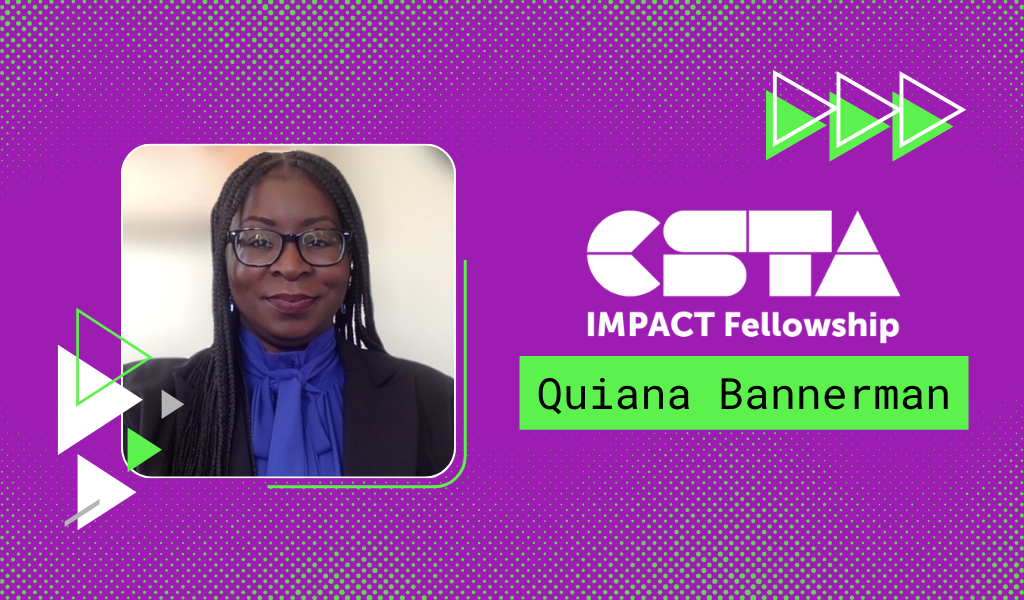
Quiana Bannerman recently joined the Maryland State Department of Education as a Coordinator of School Support in the Division of College and Career Pathways, where she will also lead the state’s computer science education initiatives. She previously served as the Director of the Maryland Center for Computing Education (MCCE) at the University System of Maryland, where she led statewide efforts to provide free professional learning, training, resources, and grant opportunities to school districts and higher education preservice programs.
With 20 years of experience in education, Quiana has taught at both the K–12 and post-secondary levels. She previously held leadership roles within a school district, overseeing multiple CTE pathways and elective programs. She played a key role in implementing computer science education across PreK–12, organizing training and support to equip local educators to teach courses in information technology and computer science.
Quiana is an experienced curriculum developer and actively contributes to local, state, and national committees focused on advancing computer science education. Her expertise includes writing and reviewing computer science standards, and ensuring high-quality and equitable learning experiences for all students.
From her perspective as a state-level CS leader, former district leader, and former classroom teacher, Quiana has expertise in creating and scaling systems-level CS capacity. At MCCE, she coordinated free professional development for Maryland public school teachers, leveraging partnerships with Code.org, CodeHS, and others to support middle and high school teachers to meet state mandates for computer science. She partnered with Maryland state universities to integrate CS into preservice teacher programs, so that future educators reach classrooms already equipped with foundational CS skills.
Quiana has also contributed to writing CS standards at the state and national level, serving on the Maryland State CS Standards committee and the Reimagining CS Pathways national committee. She says, “By aligning curriculum, professional development, and policy through collaboration, I’ve built sustainable systems that empower educators and prepare students for success in a tech-driven future.”
Those sustainable systems would not be possible without robust, supportive communities. Through MCCE’s mentoring and facilitator training programs, Quiana has built a statewide community of educators who can share best practices to foster inclusive classroom environments. During her time as an instructional supervisor in Prince George’s County Public Schools (PGCPS), she provided professional development on CT and CS to over 200 middle and high school teachers. In this role, she trained teachers with little to no CS background, mentored educators monthly, and created district-wide pipelines that ensured all middle school students met computational thinking requirements before entering high school.
Community also formed the cornerstone of Quiana’s initiative to launch the PGCPS TalentReady Early Middle College Program, where students began college coursework in grade 9 and graduated with both a high school diploma and an associate degree in IT. To foster engagement with this new program, she designed culturally responsive learning experiences and organized community outreach events like the Annual Family Night of Code, which drew over 900 families. Under her leadership, students improved their technical skills and pass rates in CS and IT certifications.
Quiana views the IMPACT Fellowship as an unmissable opportunity to connect with visionary leaders who share her commitment to equitable CS education. Over the course of her career, she’s learned the importance of being able to adapt and evolve continuously in response to changes in the educational landscape and the tech industry. Way back in 2005, long before CS education became a central part of the national conversation, Quiana built a CS curriculum from scratch—an experience that instilled in her the creativity and resilience that continues to guide her work. As an IMPACT Fellow, she plans to learn with her cohort, strengthen her ability to lead cross-sector collaborations, refine her approach to advocacy and systems-level change.
In particular, Quiana would love to work on projects that support sustainable, peer-led professional learning communities and equitable access to CS education. Knowing the importance of affirming student identity, she’s eager to build a repository of inclusive, affirming CS lessons that can help teachers tailor instruction to the specific needs of their diverse learners. In alignment with her past work with preservice teachers, she also hopes to develop a toolkit to enable teacher prep programs to incorporate CS into their coursework.
Quiana says, “I want to ensure that every student, regardless of background, has access to transformative CS learning, and that every teacher feels confident and supported. This fellowship would help me sharpen the tools I need to make that vision a reality.”