
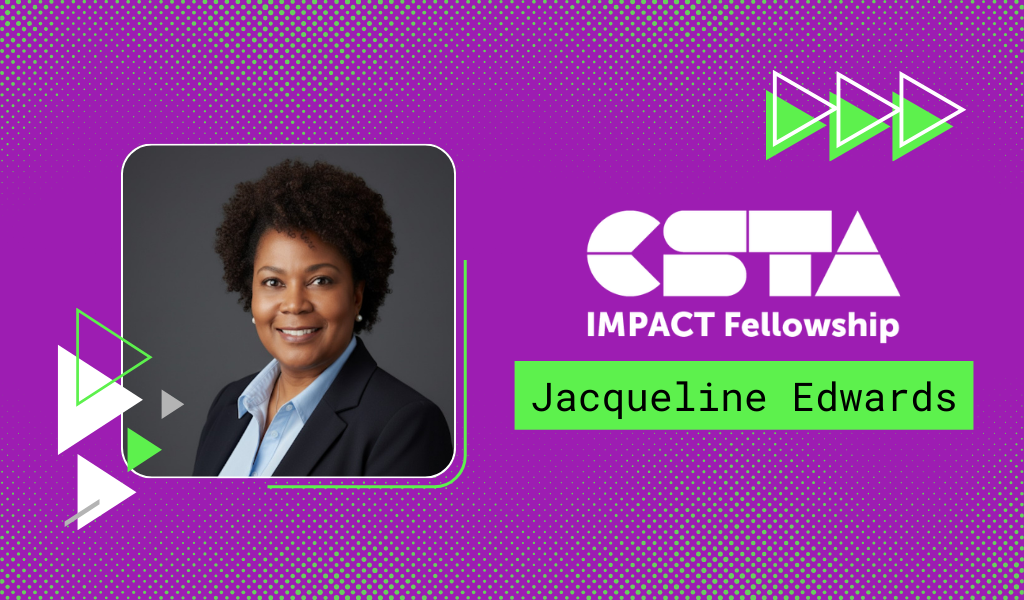
Jacqueline Edwards is the 9–12 programming instructor at the East Baton Rouge Career and Technical Education Center. She holds a bachelor’s degree in information systems and a master’s degree in computer science, along with a diverse portfolio of industry certifications in software design, game design, and web technologies. An active CSTA member, IMPACT Fellow, and contributor to Louisiana computer science standards review efforts. Jacqueline is profoundly committed to professional excellence. She creates dynamic learning experiences, leveraging her comprehensive expertise to inspire her students and support the growth of her fellow educators. She is also engaged in graduate-level research focused on instructional design and the development of independent student judgment in AI-supported computer science classrooms.
In Jacqueline’s experience, she says, “engagement comes from letting students take ownership of their learning.” To that end, she helps her students find the projects and platforms that best align with their interests, whether that’s designing a personal website, simulating a dice roll for tabletop gaming, or building a to-do list app to help them stay on top of their busy lives. As her students pursue the Certiport IT Specialist Python certification, Jacqueline breaks down the lessons’ complex concepts into approachable tasks that connect to the students’ lives. Rather than confining themselves to studying syntax, her students build real-world projects like games and calculators, “which helps them,” Jacqueline notes, “to see the ‘why’ behind the code.” She also makes sure to choose platforms and IDEs that will work, free of charge, on the devices her students already have access to. Her students currently maintain a 100% pass rate on the Python certification exam, reflecting both strong instructional alignment and consistent student preparation.
One of Jacqueline’s favorite projects was a choice-based capstone project that brought everything together for her students. Her students selected the tools they wanted to use, designed a project that solved a problem or created something meaningful, and then presented their work using visual and interactive formats. Instead of simply repeating what they had practiced, the students were able to apply their skills in a way that reflected real-world creative and technical workflows. The project gave her students ownership of their learning and they were able to demonstrate what they truly understood by building, explaining, and sharing something they had created themselves. “It gave them a genuine sense of what it’s like to be part of a real development team,” says Jacqueline. “Watching the students’ creations come together was truly inspiring.”
That ability to translate classroom skills into career contexts is crucial to Jacqueline’s practice. For example, she built a partnership with a local tech company where her students received mentorship from working developers on a real project. “That kind of mentorship—seeing their classroom skills applied in the real world—completely changed how they viewed their own potential,” says Jacqueline. She continues to expand industry partnerships to provide students with exposure to professional workflows, career pathways and technical mentorship.
Many of the students enrolled in her dual enrollment computer science courses are pioneering college-level coursework within their families, stepping into new academic opportunities and setting a precedent for future generations , and nothing makes Jacqueline as proud as seeing those students thrive. Her students continue to maintain a high passage rate in the applied associate’s degree path for software development. Similarly—and Jacqueline’s careful to say that she doesn’t take this for granted—she intentionally structures her courses to blend certification readiness, dual enrollment rigor, and project-based learning so students experience both academic and industry success.
She also helps prepare students to participate in SkillsUSA competitions, where they’ve had several winners, and she sees the students’ growing confidence and sense of accomplishment, whether they win or not. Her coaching emphasizes professionalism, technical precision, and communication skills alongside competition readiness. While Jacqueline does keep a sharp eye on metrics like grades and pass rates, the true measure of her success is the students who continue to sign up for more CS work, or who return after graduation to tell her that they plan to continue in tech. “That’s when I know I’m making a lasting impact,” she says.
In her time as an IMPACT Fellow, Jacqueline is working to build on her classroom work to become a better leader at the school and district levels. She hopes to strengthen her ability to guide and empower educators who are stepping into computer science teaching for the first time. She is currently developing standards-aligned instructional toolkits designed to support new and transitioning computer science teachers with flexible, grab-and-go lesson structures. Further, as she studies for her Unity game development and C# certifications, she’s excited to learn more about game design as a tool for classroom CS learning. “The fellowship’s focus on peer-led development would be the ideal environment for me to learn and grow,” she says, “and I am confident I can contribute a unique, cross-disciplinary perspective.”
Jacqueline is focused on building integrated computer science pathways that reflect how technology functions in the real world. She strives to ensure students understand not only individual tools, but how those tools interact within larger systems and projects. She is actively working alongside her cohort to build the TeachReady Toolkit, an integrated curriculum framework that equips new and transitioning CS educators with flexible, ready-to-implement lesson structures.Her long-term vision includes building cohesive CS pathways that connect programming, web development, databases, game design and emerging technologies into unified learning experiences.
“One of the things I value most as an educator is the power of collaboration,” says Jacqueline, “both within my school and in the wider community. I’ve seen firsthand how partnerships can open doors, spark creativity, and make computer science feel more real and relevant.” She’s eager to build such partnerships with her new cohort over the coming year. Through classroom innovation, research, leadership, and mentorship, Jacqueline continues working to expand equitable access to rigorous, career-connected computer science education.