
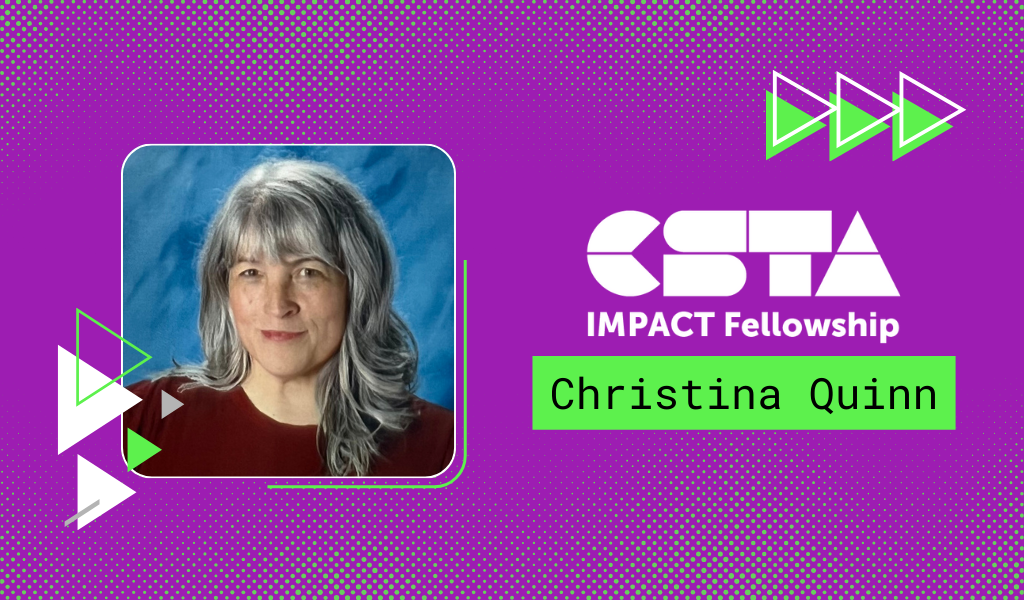
Christina Quinn is a computer science teacher at Sierra Vista High School in Las Vegas, NV. In her 29 years as a teacher, she has been lucky enough to teach an array of K–12 CS courses, including web design, Java, introductory CS, computer science literary, cybersecurity, and AP CS A. She runs afterschool clubs for Girls Who Code, the CS Honor Society, and a new chapter of the Technology Student Association. Her passion is empowering girls and minority students to get a seat at the table and solve problems using code.
Christina makes it a point to invite students from all different backgrounds to see themselves in tech. “My school district has students from all over the world,” she says, and she believes that every kid deserves the chance to find their CS identity. She has created flowcharts to encourage school counselors to place under-represented students in CS classes, and she’s intentional about using inclusive language and showcasing female, BIPOC, disabled, and ESL role models in her classes. She keeps a close eye on her students to make sure that they’re thriving, and she celebrates successes of all kinds—not just writing perfect code.
Because many of her students are new to the country and/or English-language learners, Christina provides translated materials, visual- rather than reading-based instruction, and bilingual peer support. She uses a Universal Design for Learning framework that allows students to access the course content via the pathways best tailored to their learning style. Many of these don’t require advanced English proficiency. Further, she collaborates closely with ELL and special education teachers at her school to design inclusive, scaffolded lessons that work for those students.
Even as she lowers barriers to entry, Christina encourages students to stretch themselves and take on new challenges. She teaches Scrum and agile project management strategies, giving students early exposure to industry-standard practices that will serve them well in future tech careers. Although K–12 students rarely have the chance to learn these strategies, Christina has found them invaluable in helping her students develop their leadership and collaboration skills. It serves them well as they offer peer code reviews, plan shared sprints, and track team progress throughout the year.
Christina encourages her CS students to have ambitions beyond the classroom, too. From her Girls Who Code and NCWIT afterschool clubs, she had 15 winners in 2025, and her chapter of the Technology Student Association competes at the state and national levels. She also sits on the TSA state board. At conferences for AWS and Verizon, Christina’s students regularly serve as panelists to represent youth voices in tech, which builds their confidence and introduces them to some of the many industries and career opportunities for their future. “Achievement is more than a test score,” she says. “It’s about growth, confidence, and the ability to apply skills in meaningful ways.”
As an IMPACT Fellow, Christina can’t wait to become part of a new community of CS educators. She’s always on the hunt for new ways to build community and industry partnerships, and she’s excited to learn from a cohort that comes from a wide array of locations and backgrounds. She knows that everything she learns in the fellowship will unlock ideas for how to serve her own multilingual, multicultural Las Vegas school. She says, “I hope this fellowship gives me the tools and space to reflect, innovate, and sustain the work I love. Teaching CS isn’t just about syntax; it’s about unlocking potential.”
She’d love to work with her cohort to bring Scrum training and student-friendly certifications to more CS students. Having seen firsthand the benefits this training has brought her own students, she’s eager to build on that success. In her experience, she says, “integrating Scrum prepares students for real-world CS careers while building essential soft skills like collaboration, communication, and iterative problem-solving.” Christina envisions robust partnerships with universities, CTE departments, and industry professionals to find ways to create and recognize student proficiency in agile workflows.
“I am a firm believer in the saying, ‘If you can’t see it, you have a harder time being it,’” says Christina. “As a woman in tech, I act as a visible advocate for equity in STEM.”