
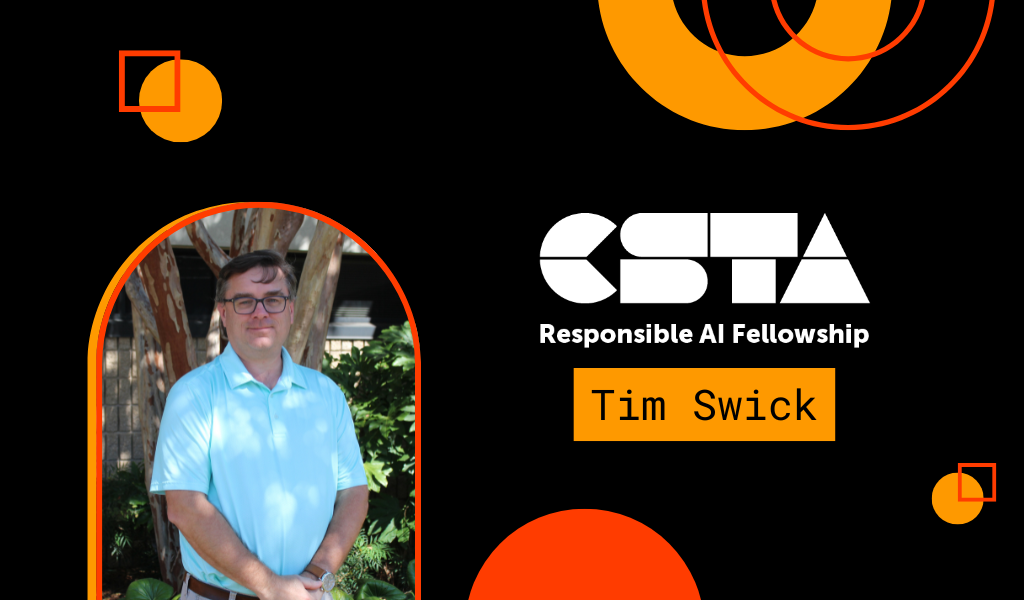
Tim Swick is a teacher for Lexington Richland School District 5 in South Carolina, where he is currently developing an innovative middle school program that blends computer science, design thinking, and artificial intelligence. At CrossRoads Middle School of Innovation, he is helping to develop Innovation Studio: Engineering Solutions for the Future, a pioneering elective that introduces students to robotics, makerspaces, and AI fundamentals while aligning with state computer science graduation requirements. Tim has built partnerships with educators and state leaders to expand equitable access to CS education, and he regularly shares his expertise through CSTA and other professional organizations. His work focuses on creating inclusive pathways that prepare all students to engage critically and responsibly with emerging technologies.
As AI begins to transform the educational landscape, Tim has placed a premium on developing AI lessons that promote equity and adapt easily to a variety of classrooms, schools, and contexts. He’s currently developing a program to embed AI and CS fundamentals in specialized electives, where students will create their own AI models and apply them to real-world problems. For instance, sixth-graders might build a micro:bit–enabled environmental sensor network, train AI models to classify local plant species, or design a chatbot to help new students navigate campus life. The program aims to incorporate multiple subject areas and provide tiered entry points for differing levels of student experience and tech access levels. “Our approach is designed to be both transformative for our students and adaptable for other schools,” says Tim.
Back in 2022, Tim led a team at his school to incorporate AI and project-based learning in K–12 classrooms. The initiative took place within a schoolwide immersion model Tim had previously developed for computer science education. Students used free and low-cost tools like Teachable Machine and micro:bit boards to learn core AI concepts such as image recognition, natural language processing, and machine learning. The project-based units gave students the chance to apply their learning to real-world problems, like creating AI models to sort recycling or developing chatbots to answer frequently asked questions about their schools.
The results were impressive. Students from diverse backgrounds became leaders on their project teams, while scaffolded support and differentiated instruction ensured that everyone could participate. Student interest in STEM increased, project completion rates soared, and standardized test scores improved as students applied the same computational thinking skills they had used with AI tools to other subject areas. “Most importantly,” says Tim, “students saw themselves as creators.”
This kind of transformative student learning is only possible when students have capable, confident teachers to educate them, so Tim has prioritized sharing his expertise as a leader in CS and AI learning. Before the advent of AI technologies into everyday life, Tim led Code.org workshops to create microcredential pathways aligned with CSTA standards, and he aims to use those same skills now to build AI teaching capacity. As lead teacher for Lexington Richland School District’s AI elective, he supported his colleagues to include AI education in the classroom, creating lessons, assessments, and strategies for equity that every teacher could use. He also led an AI education workshop for teachers across the state at South Carolina’s Computer Science Professional Development Week.
While Tim is a longtime leader in CS and AI education, he brings a sense of humility and a deep enthusiasm for collaboration to his time as a Responsible AI Fellow. “I believe ongoing growth comes from learning alongside peers who are solving similar challenges in diverse educational settings,” he says. He knows that his cohort’s varying experiences of teaching AI will help him develop new strategies for integration, become familiar with a range of different AI tools, and ensure that ethical, responsible use lies at the heart of every lesson.
“Collaboration with other fellows will allow me to study effective program models, compare equity-driven approaches, and adapt proven strategies for teacher capacity building, community engagement, and resource sustainability,” says Tim. “By the end of the fellowship, I envision having an expanded professional network, refined pedagogical and technical strategies, and a portfolio of scalable, equity-centered AI learning.”