
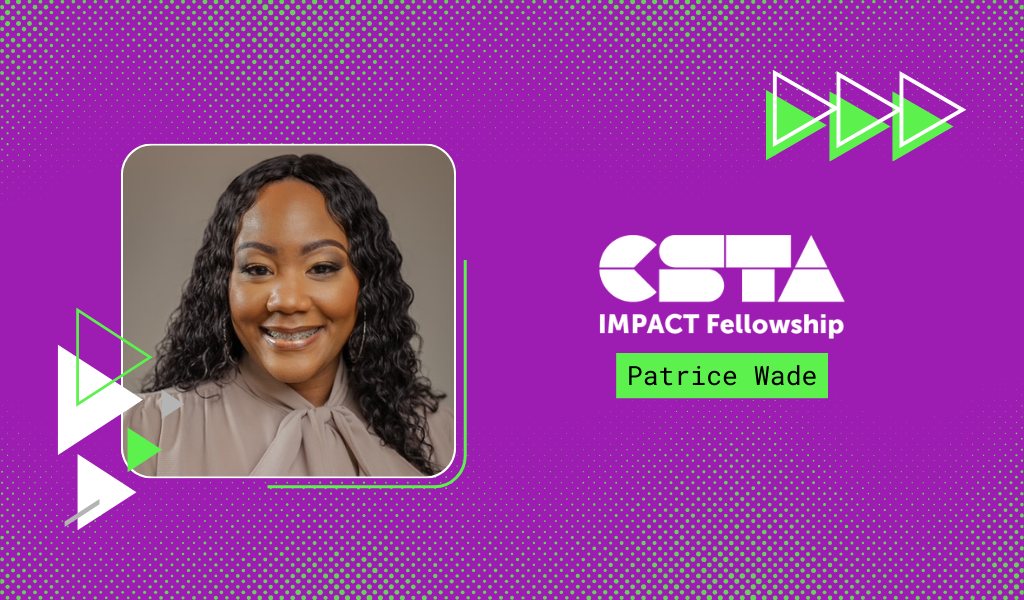
Patrice Wade (she/her) has been teaching technology at Guilford Preparatory Academy, a K–8 Title I public charter school in Greensboro, NC, for nearly four years. She is a nationally recognized Technology Educator, the 2024–25 CS Teaching Excellence Award winner, and the 2025 Guilford Preparatory Academy Teacher of the Year. Patrice also serves as the school’s director of technology and leads Girls Who Code to expand opportunities for student creativity, leadership, and innovation.
Patrice is an Amazon Future Engineer Teacher Ambassador, Common Sense Ambassador, Everfi Champion, Apple Certified Educator, Google Certified Educator, and North Carolina Teaching Fellow. Recently named a 2025–26 EdSurge Voices of Change Writing Fellow and a 2025 NC Learning Happens Here Ambassador, she is pursuing her MAT in special education and technology at North Carolina A&T State University. Her mission is to leave every child better than she found them.
“At my school,” says Patrice, “they say, ‘If you need something, go ask Mrs. Wade. She probably knows somebody.’ They are correct. I build bridges because I believe access is power, and I never want my students to walk this journey alone.” She’s determined to connect her students to the resources they need, no matter what. This includes working with AT&T to provide 25 Chromebooks for her students each year, fundraising and contributing her own money to support free summer STEM camps for middle schoolers who passed their end-of-year exams, and partnering with a local university to help her get a planned esports team off the ground.
All of Patrice’s work centers around making sure that her students are supported and held by their communities. “I believe every student deserves a team, not just a teacher,” she says. She hosts Family Coding Nights to welcome the community into student learning, offering multilingual support, loaner devices, and live demonstrations to over 120 families. Patrice passes on that philosophy of community support to her students as well: When a student lost his arm in a car accident, the robotics team rallied around him. With permission from his mother, and a lot of hard work, they built a robotic arm that could help him pick up objects and drink water.
That’s just one of Patrice’s innumerable efforts to connect her students’ work in tech to the everyday contexts of their lives. In a recent project, her students created an interactive storybook celebrating the lives of local heroes who overcame obstacles to make a difference in their community. Her Digital Citizenship unit invites students to reflect on ways to create online spaces that celebrate diversity and promote respect, culminating in the creation of a digital portfolio of their unique goals, cultures, and interests. She also takes care to introduce students to some of the ways their studies in tech might serve them in the future, by partnering with local restaurants, theaters, and government agencies to explore the behind-the-scenes role of technology in every business.
To ensure that her special education students have the same opportunities as students on the traditional track, Patrice adapts her lessons to meet their learning styles and abilities. One fifth-grader was nonverbal, so she introduced him to block-based coding with a platform that relied on visual cues rather than words. Using this tool, the student coded an animation about teamwork and presented it to his classmates using a speech device. He received a standing ovation, and Patrice has since continued to use this model for learning across multiple grade levels. “Representation, access, and equity are not just words in my classroom,” says Patrice. “They are my foundation.”
As the only CS educator at her school, Patrice feels the precarity of what she’s built. “Five years ago, before I arrived, my school had no technology program at all,” she says. “If I left tomorrow, everything I built would disappear. That should never be the case.” She has always been able to look to CSTA for community, support, and ideas for how to make her work more sustainable. Through this fellowship, she hopes to learn ways to grow as a leader and to expand CS programming and community in her school and district. “I want to be sharpened,” says Patrice. “I want to be stretched.”
During her time as a fellow, Patrice hopes to continue building community—not just among her cohort, but for teachers like her, those who are the only CS educators in their school or district, and who often feel isolated from the wider conversations around CS access. To change that, she envisions a network of peer support that meets regularly to share ideas, model lessons, and explore grant opportunities. She says, “I want every student and teacher, no matter where they are, to feel seen, supported, and part of the CS community. That is what IMPACT means to me.”
Most of all, she is eager to learn from her cohort. “I do not want to be the smartest person in the room,” she says. “I want to be surrounded by the smartest people in the room.”