
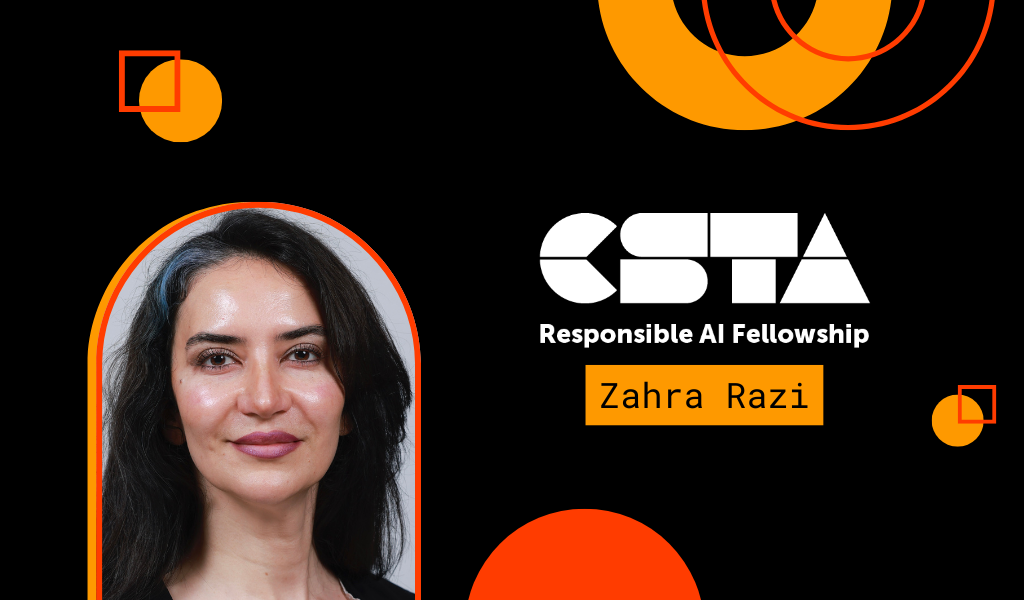
Zahra Razi is a middle school computer science teacher at the Fontana Unified School District in Fontana, CA. She specializes in integrating CS and educational technology into K–12 instruction, with expertise in curriculum design, interdisciplinary teaching, and teacher professional development. Drawing on her background in computer science and pedagogy, she has created a middle school computer science curriculum that incorporates programming, artificial intelligence, physical computing, robotics, cybersecurity, and data science into both core and intervention courses.
A frequent presenter at education and technology conferences, Zahra has also served as an educational technology coach, supporting teachers in implementing digital tools and emerging AI technologies. She is an Amazon Future Engineer Teacher Ambassador, a member of the California Department of Education AI Work Group, an ASU+GSV AI Innovator, and the recipient of the ISTE 20 to Watch Educator Award and the ISTE GenerationAI Award.
Zahra believes that the future of AI education will require peer support, interdisciplinary learning, and flexible, accessible learning platforms. In her AI work with students, she takes care to select free or low-cost tools like Scratch, Python, Google Teachable Machine, Thunkable, RAISE Playground, and ISTE’s AI project resources. Beyond their financial accessibility, these tools enable teachers to offer differentiated instruction; for instance, by allowing more advanced students to do their coding in Python, while CS beginners can use the block-based programming tools of Teachable Machine.
Her focus on interdisciplinary AI projects allows students to develop AI and subject area expertise while getting direct experience of the real-world applications of the AI tools. Zahra’s AI-integrated math projects, such as having students create a slope classifier AI model, are easily adaptable for other subject areas: classifying rocks in science class, pronunciation tools or storytelling projects in ELA, or historical photo classification in social studies. Finally, Zahra encourages peer support as a key element of CS and AI learning, and she leads a student mentoring model where students act as CS ambassadors to support their peers and help teachers integrate CS into other subjects.
Peer support has been one of the most valuable tools in Zahra’s toolkit when it comes to teaching AI. She began designing hands-on AI projects in 2020, like having students build AI-powered artifacts to practice and assess their math skills. For example, students designed and solved equations, trained a model in Teachable Machine with four answer choices, then programmed it in MIT’s RAISE Playground to receive spoken input (in the language of their choice) and check answers for accuracy. Then they swapped their artifacts with other students to test their models and reinforce their understanding of the lesson.
Not only did students gain mastery over the AI and math concepts, but Zahra said they felt special pride in seeing their work used to help others. “The classroom dynamics have shifted,” she says, “as students supported each other as co-creators.” On a broader scale, the model of peer mentorship can support scaling the work of AI learning, as more advanced students provide support to their peers and help teachers with less AI and CS experience to facilitate hands-on lessons.
Just as she encourages her students to help each other, Zahra aims to be a resource to her fellow teachers, within her school and beyond. She mentors colleagues locally and nationally to embed AI and CS into any subject area, using free or low-cost tools like Python and Scratch, and she creates lesson plans that can be implemented by teachers without a CS background. Using examples of real student projects, she has presented on AI and data science education at conferences and webinars including ASU+GSV, California Mathematics Council, California STEAM Symposium, CSTA, ISTE, and through the California Department of Education’s AI initiatives.
Recognizing the value of learning in community, Zahra’s thrilled to be setting out on her journey as a Responsible AI Fellow. She is eager to discuss the strategies and lessons her cohort have used to teach AI, so that she can build her knowledge of what works in different contexts, grade levels, and communities. Armed with this knowledge, she will be better equipped to create adaptable, interdisciplinary AI lessons that she can use in her own classroom and share with others, too. “I look forward to sharing my ideas with my cohort and collaborating to turn them into actionable resources and tools that make teaching with and about AI more accessible, equitable, and inspiring for all students,” she says.
She’d especially like to work with her cohort to design AI project templates that would teach basic AI literacy and would be usable by subject area teachers without previous CS or AI experience. Ideally, these could be placed in a resource hub where teachers could also access professional development and suggestions of adaptable activities, all aligned with CSTA standards.
“I want to grow my capacity to model AI use that is both innovative and responsible, and to help other educators do the same,” says Zahra. “I look forward to learning how to better support all students, especially those underrepresented in the CS field, so that everyone can participate in and benefit from AI-powered learning.”