
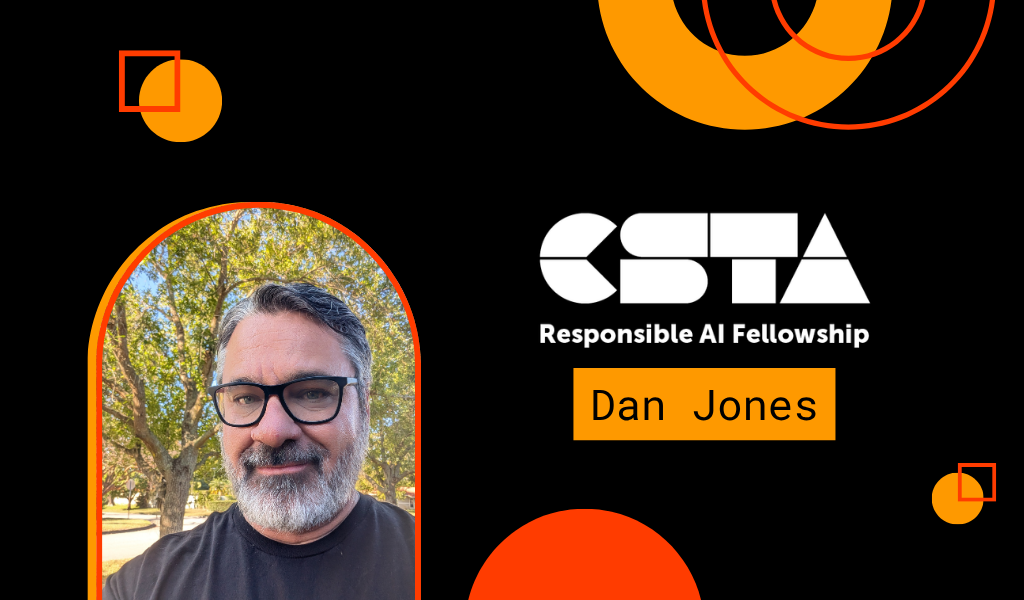
Daniel Jones is a CTE and computer science teacher for a large school district in South Florida. He also advises his school’s Computer Science Honors Society and serves as an esports, drones, and robotics coach. His ESports team recently successfully defended their World Championship title and are now the Two-Time NASEF Mario Kart 8 World Champions. Dan and the students used AI to develop game plans based on current world records and individual driving styles. A trailblazing educator and mentor, Dan is deeply committed to neurodivergent inclusion, and he continues to champion student growth, equity, and excellence across the tech landscape.
When Dan realized that AI would become an important part of his students’ day-to-day lives, he took the initiative to deepen his own understanding of its potential. He completed an intensive eight-week Microsoft Azure AI-900 certification course through the University of Florida, then followed it up with an additional AI training course at Florida Memorial University.
Armed with these new technical skills, Dan designed a schoolwide initiative to introduce AI concepts to his students. In one peer-led AI program, he trained high school students to become peer educators for AI literacy, using Minecraft AI to teach lessons to every grade level during the school’s Hour of Code. The lessons covered topics like ethical usage, datasets, and AI’s decision-making process, and the Minecraft environment made it easy for students to visualize AI behavior and abstract concepts. Participation and engagement in the Hour of Code improved, and Dan’s colleagues reported a marked increase in classroom discussions about the ethics and applications of AI in students’ lives.
As the coach for a district-wide app challenge, Dan supported his school’s team in creating a teacher-curated, AI-powered knowledge repository where students can search for academic answers, but only after answering comprehension questions. The app included accessibility features like simplified language and text-to-speech, and its design pushed students to engage in active learning, rather than passively using AI tools as a substitute for deep engagement with the subject matter. “The team won first place,” says Dan, “standing out for their thoughtful integration of responsible AI use and educational value.”
As a high school teacher of ESE (Exceptional Student Education), Dan is passionate about finding ways to make AI education accessible to students with learning differences. Using Minecraft AI as a platform for education was a notable success with these students in particular. The gamified environment makes the lessons fun and interactive, while the visual tools work well for visual learners and assist in making abstract concepts feel more concrete. He believes that the best model for AI education is one that empowers teachers and students as leaders and supports the diverse learning needs of the student population. Among his own students, Dan says, “I’ve seen firsthand how leadership and learning can go hand in hand. The student leaders in our initiative didn’t just absorb knowledge; they became ambassadors for responsible AI use.”
Dan has made it a priority to be an AI ambassador himself, too. He volunteered and was appointed as his school’s AI liaison, and he’s been educating himself and others ever since. He mentors fellow teachers to learn more about AI and co-teaches classes to incorporate AI concepts and tools into different subject areas. He has led professional development sessions to share what he’s learned about AI both in the university and in his classroom, including gamified learning strategies, ways to cultivate ethical AI usage, and accessibility tools. Drawing on his work as an ESE teacher, he also creates and shares resources that can align AI education with learning standards and IEP goals.
“I’m committed to being a lifelong learner and a role model for my students and colleagues,” says Dan. “I believe that when educators lead with curiosity and purpose, we can create transformative learning experiences that prepare students not just to understand technology but to shape it responsibly.”
Dan begins his time as a Responsible AI Fellow with an open mind and a profound eagerness to learn from his cohort and grow in his understanding of responsible AI. While his experiences so far have been valuable and generative, Dan knows there’s so much more to learn. “I’ve always believed that learning is a collaborative journey,” he says, and the fellowship offers the perfect opportunity for that kind of growth. Dan hopes to work with his cohort to create teacher- and student-led lesson plans that teach students about AI while promoting ethical use of AI tools. He’d also love to develop an AI-powered classroom app where teachers control the inputs, customizing the app with curated content to address their students’ specific learning needs.
Dan says, “I’ve had the opportunity to create a learning environment where students don’t just consume technology; they shape it. I believe that with the right support, this model can inspire a broader movement toward equitable and responsible AI education.”