
By Tamar McPherson, Responsible AI Fellow and President, CSTA Pittsburgh Chapter
At professional conferences and in-service days, many sessions about artificial intelligence in education focus on how to use the latest tools. Teachers are often shown which buttons to click or which prompts to try. While this can be helpful, it often misses a deeper question: How can AI meaningfully enhance teaching and learning?
Exploring Our Starting Points
In August, I led a professional learning session during my district’s in-service day for more than 100 educators. Teachers reflected on their experiences with AI and identified where they were on their own learning pathways. Some were experimenting regularly, while others were watching from the sidelines. What united them all was a willingness to learn.
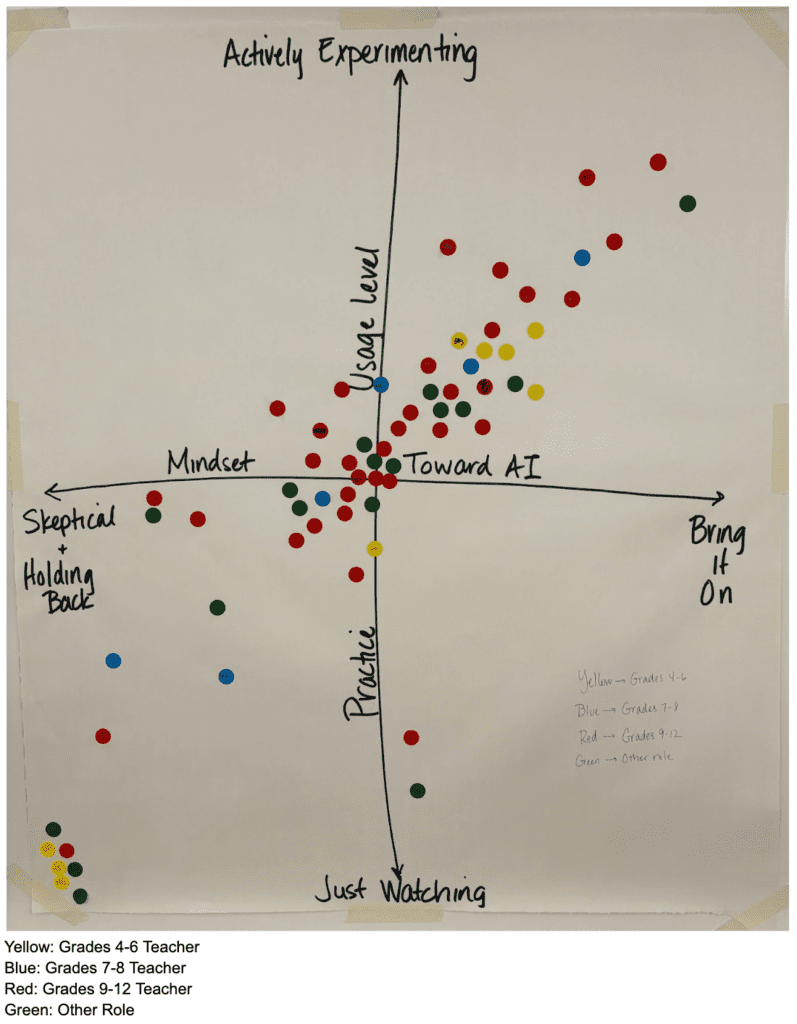
The conversations that followed were thoughtful and honest. We worked through scenarios that reflected common classroom challenges. In one instance, a teacher used AI to generate rubric-aligned feedback but felt the comments lacked authenticity. In another, AI helped draft parent emails that were clear and professional but sounded less personal. Teachers wondered whether these uses of AI truly benefited students or simply saved time. The conversation always came back to the same idea: Efficiency is not the same as effectiveness, and strong teaching still depends on professional judgment. These discussions raised important questions that teachers continue to explore today.
What Teachers are Asking
On the session’s exit tickets, teachers shared questions that reflect both excitement and caution:
“How can I use AI to teach and not just give answers?”
“How do I keep student creativity from getting lost?”
“Is it really helpful to the kids, and what is the right way to use it?”
These comments revealed a shared tension between eagerness to explore new tools and a desire to protect student voice and learning.
Connecting to Shared Frameworks
To ground this work, I used the OECD’s AI Literacy Framework and CSTA’s AI Learning Priorities for All K-12 Students. Both emphasize that AI literacy involves far more than understanding how systems function. It includes ethical awareness, critical thinking, and imaginative problem-solving. These resources shaped my thinking as I considered how to help teachers and students explore what AI is, how it works, and how it influences communities.
This perspective reflects a broader philosophy that guides my approach to computer science education. I believe AI should encourage students and teachers to explore ideas, question assumptions, and imagine new possibilities. When used in this way, AI becomes more than a productivity tool. It becomes a partner in learning that supports deeper understanding and human connection.
This same mindset applies to educators more broadly. Before we can teach with AI, we need to understand what it means to use it with care and intention. That involves examining how AI can support equity, expand access, and encourage innovative thinking. This approach places educators at the center. When teachers frame AI use around human insight and creativity, we ensure that technology serves learning rather than driving it.
Keeping the Human Element
When teachers first encounter AI, it is natural to focus on practical benefits such as faster grading, clearer communication, or smoother writing. These can be helpful starting points, but they represent only a small part of what AI can contribute. The real opportunity lies in helping students make their thinking visible, explore new ideas, and strengthen their ability to understand and communicate with others.
When students use AI to brainstorm or revise, and teachers use it to co-plan lessons or analyze feedback, both groups model adaptability and thoughtful decision-making. In these moments, AI becomes a collaborative partner rather than a shortcut. This approach also challenges the idea that creativity and computation are separate. When students use AI in design or problem-solving processes, they learn that logic and imagination work together. AI can support both when guided by intentional teaching.
Purpose, Pedagogy, and People
To guide this work, educators can reflect on three essential dimensions of teaching:
- Purpose: Does this use of AI support learning goals or simply increase convenience?
- Pedagogy: How does it strengthen analysis, feedback, or differentiation?
- People: How does it build relationships and support student agency?
These questions shift the conversation from whether we can use AI to how and why we should.
This work also aligns with the CSTA Standards for CS Teachers, which highlight the importance of intentional practice, inclusive design, and thoughtful instructional decision-making. Integrating AI with purpose reflects those same commitments. It challenges us to examine how technology shapes learning, promote equitable access, and guide students in using AI with responsibility and imagination.
Becoming AI-ready is not about mastering every new platform or feature. It is about developing professional habits that center on care, integrity, and purposeful decision-making. Teachers have always adapted to new technologies. What is different now is the pace of change. AI invites us to pause, reflect, and keep the human side of learning at the center of our work.
A Shared Responsibility
Whether you are just beginning to explore AI or already integrating it into your classroom, your role matters. Every thoughtful experiment, question, or instructional choice helps shape our shared understanding of what it means to teach responsibly in an AI-influenced world. Teaching beyond the tool means leading with what no algorithm can replicate: our ability to connect, to support students, and to help them find purpose in their learning.
About the Author

Tamar McPherson is the K-12 CS, Business, and Technology Education/STEM Department Leader for the Plum Borough School District in Pittsburgh, Pennsylvania, where she also teaches high school computer science. With a background in mechanical engineering, she brings a design mindset to education, building systems that expand equitable access to CS across all grade levels. Tamar serves as President of CSTA Pittsburgh and mentors teachers across Pennsylvania as they prepare for the CS Praxis exam. She has contributed nationally as a pedagogical expert for GenCyber@Pitt and as a facilitator for Cyber.org’s 9–12 Cybersecurity Cohort. Her work has been recognized with awards including the CSforAllPA Exemplary Educator Award, the Carnegie Science High School Educator Award, and the NCWIT SWPA Affiliate Educator Award. She champions responsible, inclusive, and future-ready AI and computer science education.