
Written by Bryan Twarek
Nearly 3,000 computer science (CS) teachers from across the United States took the time to complete the CS Teacher Landscape Survey just over a year ago. I suspect many of you reading this were among them. You answered detailed questions about your preparation, your classrooms, your professional learning, your frustrations, and your hopes. You shared what it actually feels like to teach computer science in a moment shaped by rapid advances in AI, shifting policies, staffing shortages, and evolving expectations for what students need to know.
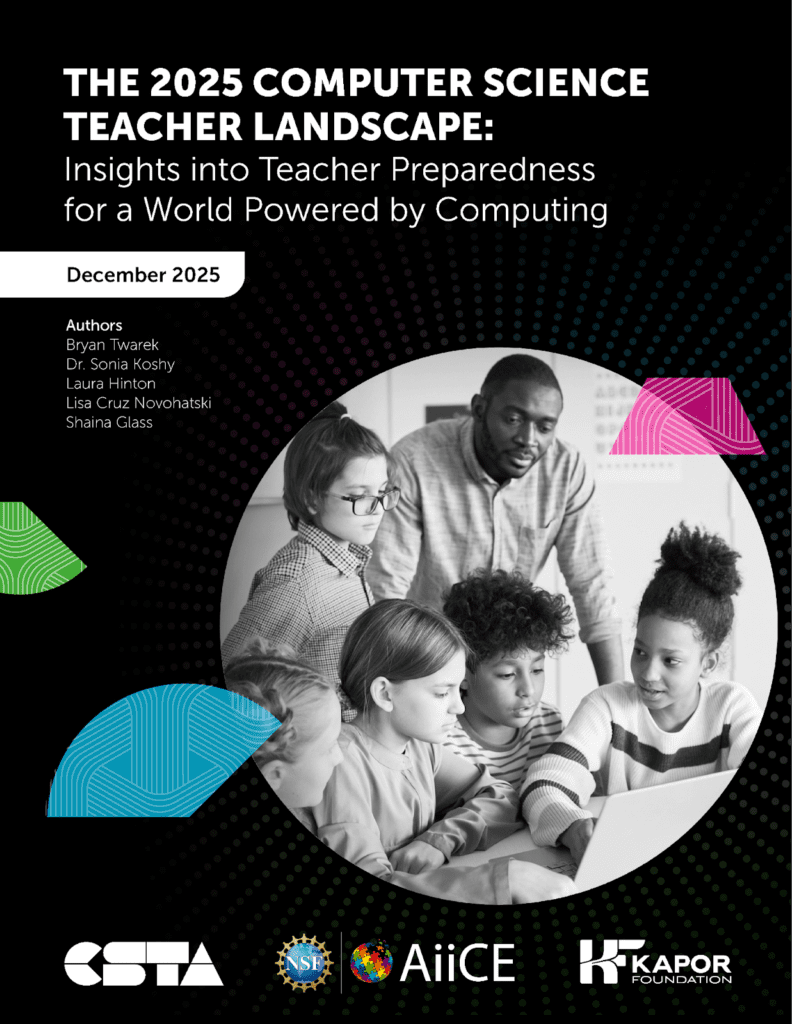
The resulting report, The 2025 Computer Science Teacher Landscape: Insights into Teacher Preparedness for a World Powered by Computing, is intended to inform policymakers and education leaders of the strengths, needs, and lived realities of CS teachers. As the lead author of this study, what I see most is a profession that is deeply committed, yet under-supported and carrying more than most people realize.
Tired, yet Remarkably Committed
Survey data reflect something many educators feel but don’t always say out loud: it is a truly exhausting time to teach. Across open-ended responses, teachers expressed frustration, fatigue, and the cumulative strain of expanding expectations. CS teachers are often building programs from scratch, teaching multiple preps, adapting to new technologies, advocating for enrollment, and updating curriculum, all while navigating broader pressures facing education today. The following quotes from elementary to high school teachers provide a small sample:
“We are constantly asked to do more with less.”
“The current strain on the profession is unsustainable. Without better support, educational outcomes will deteriorate over time.”
“Teachers hold professional degrees, yet we are considered less than, paid less than, and often blamed for things outside our control.”
The quantitative data supports what many described in their own words:
- 58% identify being underpaid as a major challenge.
- 46% cite being overworked.
- 43% believe the teaching profession is valued by society.
These numbers reflect real workloads, real time constraints, and real emotional labor. And yet, alongside that fatigue, something else emerges just as clearly.
- 96% say they enjoy teaching CS.
- 85% plan to continue teaching CS for at least the next five years.
That combination of exhaustion and sustained commitment speaks volumes. Many of you described feeling tired from the work. And in the very same responses, you described a deep sense of purpose. A commitment not only to shaping young people’s lives, but to strengthening your own professional craft. A belief that this subject matters and that all students deserve thoughtful, rigorous, human-centered CS education. It is possible to be tired and committed at the same time. The data suggests that many CS teachers are living exactly in that space.
Experienced Educators, New to CS
One of the clearest findings in the report is this: CS teachers are experienced educators, but many are still relatively early in their CS journey. In fact, 74% of respondents have more than ten years of classroom experience, yet only 26% have taught computer science for that amount of time.

Eighty-one percent of teachers did not enter CS classrooms with a background in computer science or other technical sciences. This is not a weakness in the workforce, rather a testament to it. Across the country, veteran educators stepped into CS — often by choice; 85% reported they chose to teach CS at their school — and built expertise in a field that continues to evolve rapidly. Elementary teachers, in particular, are far less likely to have formal CS preparation, yet elementary CS continues to expand, often integrated across subjects and reaching every student. The growth of CS education did not happen because there was a surplus of computer science graduates waiting to teach. It happened because teachers were willing to learn, adapt, and lead.
Alone in the Building, Connected Beyond It
The report confirms something many teachers have quietly known for years: CS can be an isolating role. Half of respondents report having zero other CS teaching colleagues at their school site, and another quarter have just one. That means many CS teachers are building programs without a department structure, without a hallway colleague who teaches the same content, and without built-in collaboration time focused on their subject.
Number of CS Teaching Colleagues at School Site

One high school teacher from Wisconsin captured this reality clearly:
“[I need] more community with other computer science teachers, mentors, and advocates. It can be a slightly lonely field, because there are often only 1-2 computer science teachers in a given school, and they are almost always overworked because of how many unique preps that they teach.”
While many teachers are locally isolated, they are nationally connected. In fact, 74% report feeling part of a community of CS teachers, and 67% say they have opportunities to collaborate with other CS teachers. This feeling of community is likely only possible because 84% of respondents are members of CSTA, allowing them to connect with others through chapters, affinity groups, and other CSTA communities and events. Professional community is not optional in CS education. It is structural support in a field where many teachers are otherwise alone. And, it leads to not only improved support but also sustained commitment to teaching computer science for years to come.
AI: Urgency and Uncertainty
Perhaps no finding captures the current moment more clearly than the data on artificial intelligence. An overwhelming majority of CS teachers believe AI should be included in foundational CS education, yet less than half feel equipped to teach it.

Teachers are not resistant to AI. In fact, it’s quite the opposite. About 70% of teachers are already teaching AI content, despite the lack of guidance and support. Even more of them—almost 90%—discuss societal and ethical impacts related to AI. However, the amount of instructional time is relatively limited, as 85% report they spend less than five hours on AI content across the school year.
The gap between belief and confidence signals something important. AI literacy, which includes a foundational understanding of data, models, bias, ethics, and societal impact, requires deep content knowledge and thoughtful pedagogy. It cannot be addressed through a single workshop or tool demonstration. Teachers are ready and willing to shift their curriculum, but they are also undersupported. Effective preparedness requires sustained investment in professional learning.
High Participation in, but Limited Capacity for, PD
Nearly all respondents (96%) reported participating in professional development (PD) in the past year. That level of engagement speaks to teachers’ commitment to growth. Yet the depth and duration of that learning tell a more complicated story. Almost half of elementary teachers and over a third of middle and high school teachers participated in fewer than 11 hours of PD across the year. Additionally, only 17% reported being able to participate in PD as needed. Most professional learning experiences are standalone sessions (78%) or independent curriculum work (80%). Far fewer teachers have access to sustained coaching or mentoring (39%). When asked about their greatest professional learning needs, teachers most frequently identified deepening CS knowledge and skills (48%), particularly in emerging technologies.
The challenge, then, is not teacher willingness. It is time, structure, and support. One secondary CS teacher from California wrote about challenges that many face:
“I teach 4 different preps every day. It’s hard to prepare lessons for each one. I need to constantly differentiate, and by the time I finish planning, there is no time left for PD. I would love more training, but I can’t add anything else to my schedule.”
Teachers need collaborative, job-embedded professional learning that is aligned to evolving standards and priorities. They need time during the workday and compensation for the investment they make outside of the workday. If CS—and AI within it—is foundational to students’ futures, professional learning must be treated as foundational to teachers’ work.
We Must Invest in Our Teachers
Teachers are already doing the work of advancing the next generation of CS education, but they cannot and should not be expected to do it alone. The report concludes with three recommendations for policymakers and education leaders:
- Invest in ongoing, high-quality teacher professional learning.
- Provide comprehensive, sustained support to retain teachers.
- Prioritize CS as a core subject with universal participation throughout PK–12 education.
While these recommendations may not sound complicated or novel, they are in direct responses to what teachers shared. When we listen to teachers, we gain clarity about what the field needs next. We need to better support the CS teachers who give so much and get so little in return. We need to create funding structures that allow for sustained professional learning and manageable course loads, while also better recognizing the complexity of teaching CS in today’s world.
The future of CS education depends on whether we invest in teachers not only as implementers of curriculum, but as professionals whose expertise, judgment, and leadership shape students’ pathways and possibilities. Valuing CS teachers means investing in the learning, time, recognition, and working conditions that allow them to continue doing what they do best: helping students thrive in a world powered by computing. By doing so, we ensure that CS education remains not just about technology, but about human potential and creativity. The readiness of the CS teaching workforce today will determine the opportunities available to every student tomorrow.
Thank You
To all of the CS teachers who completed the survey: thank you. Thank you for sharing your perspectives honestly, including the frustrations, the fatigue, and the realities of the work. Thank you for the often thankless labor of building programs, revising curriculum, mentoring colleagues, advocating for students, and continuing to grow professionally in a rapidly changing field.
It is an exhausting time to teach. And yet, the data makes something unmistakably clear: you all show remarkable dedication to your students and to your own professional craft. This report is stronger because you spoke. The field is stronger because you lead. This work is only possible because of you.
Learn More
Read the full report and interact with the survey data, including viewing results by state and grade band, at landscape.csteachers.org.
Acknowledgements
This study was a collaboration between CSTA, Kapor Foundation, and the Alliance for Interdisciplinary Innovation in Computing Education (AiiCE), with funding support from the National Science Foundation. Report authors include Dr. Sonia Koshy, Laura Hinton, Lisa Cruz Novohatski, and Shaina Glass. We thank the thousands of CS teachers who participated in the study, as well as the many collaborators at our organizations and the CSTA Policy Committee.
This material is based upon work supported by the National Science Foundation (NSF) under Grant No. 2118453. Any opinions, findings, and conclusions or recommendations expressed in this material are those of the authors and do not necessarily reflect the views of the NSF.