
Written by Bryan Twarek
Artificial intelligence is already reshaping work, civic life, and learning, and it is rapidly entering our classrooms. Yet many teachers have had limited structured support to understand how AI systems work, how they connect to foundational computer science, and how to design learning experiences where students can meaningfully create with AI rather than simply consume AI-generated outputs.
At the same time, one thing is clear: computer science teachers don’t just understand the moment; they’re equipped to lead it.
Across the country, CS teachers are already leaning into AI. About 70% of CS teachers report teaching AI content, and nearly 90% are discussing its societal and ethical impacts with students. They are redesigning assignments, experimenting with tools, and helping students make sense of rapidly evolving technologies.
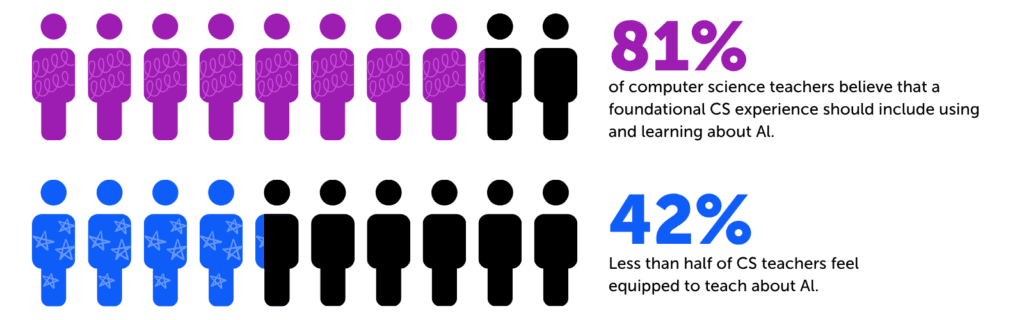
But there is also a clear gap. According to the 2025 CS teacher landscape survey, CS teachers believe AI belongs in foundational CS education, but less than half feel prepared to teach it, with even lower confidence at the elementary level (Twarek et al., 2025). Most teachers report spending only a few hours on AI across an entire year–not because of lack of interest, but because of limited time, resources, and support.
Teachers are ready. The system has not yet caught up.
A National Investment in Teachers
CSTA is proud to lead anew National Science Foundation-funded project to expand AI professional learning for K–12 educators. Through AI PD Weeks: CS Foundations for Creating with AI, we will support teachers at scale while staying grounded in what we know works.
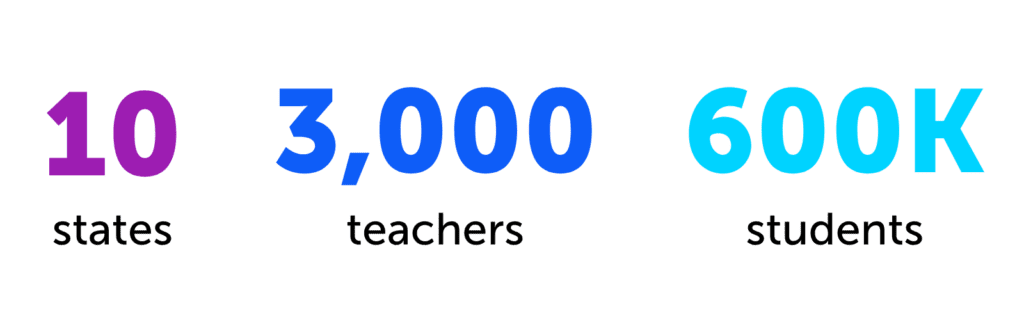
Over the next three years, AI PD Weeks will operate in 10 states, directly supporting 2,500–3,000 teachers and reaching an estimated 500,000–600,000 students.
This work is grounded in a simple premise:
Students cannot meaningfully and responsibly create with AI without understanding the computer science foundations that underlie AI systems.
Why Computer Science Matters for AI
As AI becomes more visible in classrooms, there is a risk that instruction focuses on tool use alone. Prompting systems or generating outputs can be engaging, but these experiences are not enough.
AI systems rely on core CS ideas such as data, algorithms, abstraction, and systems. Practices like decomposition, debugging, and iterative design are essential for understanding how AI systems behave—and where they can fail.
This is why the 2026 CSTA PK–12 Computer Science Standards integrate AI across concepts rather than treating it as a standalone topic. AI is part of foundational CS, not an add-on. AI PD Weeks aligns directly to these Standards and to CSTA and AI4K12’s AI Learning Priorities, helping teachers translate guidance into classroom practice.
Teachers at the Center
At the heart of this work is a clear belief:
(human) teachers are essential to high-quality AI education.
AI tools are powerful, but they do not design learning experiences, respond to student thinking, or guide ethical decision-making. Teachers do. They help students move beyond surface-level interactions with AI toward deeper understanding and responsible use.
And they are ready to take this on. Nearly all CS teachers engage in professional learning each year, yet only 17% say they can access the PD they need when they need it. Many are also the only CS teacher in their school, making sustained community and support even more critical (Twarek et al., 2025).
AI PD Weeks are designed to meet this need with structured, high-quality learning that extends beyond a single workshop.
Building on What Works
This project builds on CSPDWeek, a multi-state professional learning model that CSTA has implemented and refined over the past five years.
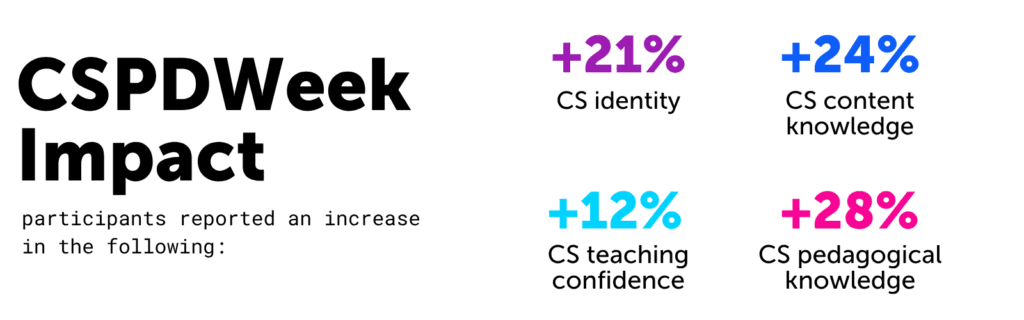
CSPDWeeks have reached over 1,400 teachers and more than 400,000 students, with strong evidence of impact. Teachers report increased content knowledge, confidence, and instructional practice, along with a stronger sense of identity and community.
That success is the result of sustained leadership from many CSTA chapters, teacher leaders, and partners across states. The growth of CS education in the United States has always been driven by educators who share their expertise, volunteer their time, and support one another.
AI PD Weeks extends this model by focusing on AI and its connections to CS. This program will pay teachers to engage in intensive, strand-based learning where they deepen their understanding of AI, examine classroom-ready examples, and design lessons and units they can implement immediately. That work continues through ongoing engagement with CSTA chapters and professional learning communities.
CSTA is deeply grateful to the community that has built this foundation and will continue to lead it forward.
From Policy to Practice
Across states, interest in AI is growing quickly. Policies and guidance are emerging, but teachers need support to bring these ideas into classrooms. AI PD Weeks is designed to bridge that gap by connecting standards, professional learning, and classroom practice.
The goal is not simply to introduce AI, but to shift how students experience it:
Students should not only use AI tools. They should understand how they work, question their impacts, and create with them intentionally.
Looking Ahead
Artificial intelligence is reshaping the world our students are entering. Preparing students for that world starts with strong computer science education and with teachers who are supported to teach it well. This is how we move from exposure to understanding, and from using AI to shaping how it is used.
Through AI PD Weeks, we are investing in teachers as the key to that future. This work is not just about individual classrooms, but about building a sustainable, national infrastructure for AI teaching and learning. This work begins, as it always has, with teachers.