
In a Springfield, Massachusetts kindergarten classroom, a five-year-old turned to her partner and said there was a bug in their algorithm. Then they fixed it together, smiling. Her teacher, Melissa Zeitz, didn’t write that sentence on the board. She built the conditions where a kindergartener could reach for it on her own.
That is what computer science education looks like when a teacher is doing it well. Not a curriculum delivered, but a way of thinking handed over.
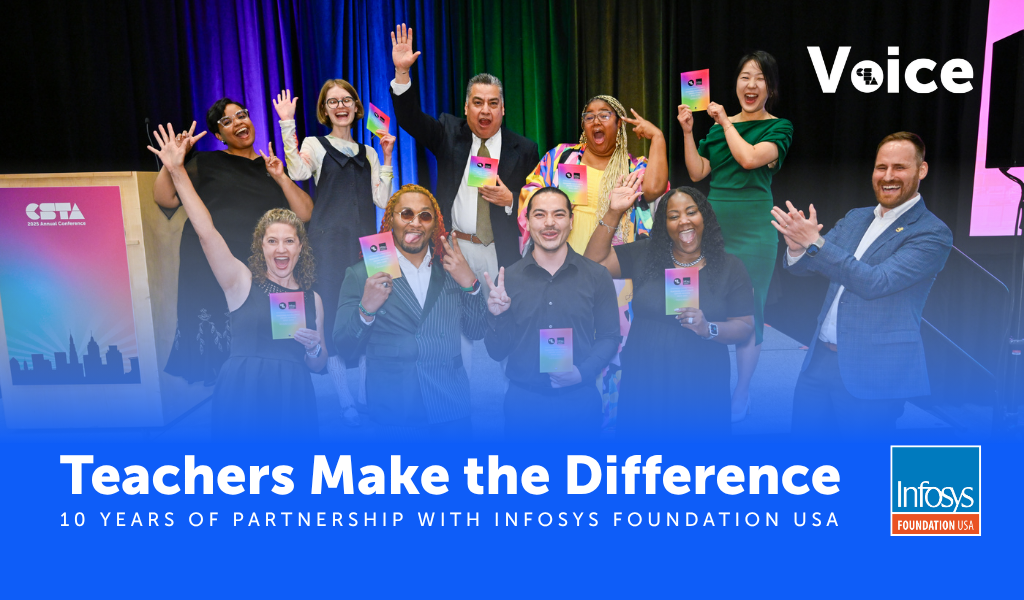
For Teacher Appreciation Week (May 4–8, 2026), Infosys Foundation USA and the Computer Science Teachers Association are marking ten years of partnership built on a single conviction: Teachers first.
Standards matter. Devices matter. Curriculum matters. Yet, none of them work without an educator who knows how to make computing feel possible for the student in front of them. Since 2016, the Teaching Excellence Awards have recognized more than 300 K–12 computer science educators doing exactly that work. What started as recognition has grown into a community, a leadership pipeline, and a national platform for the people who actually teach this field.
The recognition matters because the moments it points to matter. Patrice Wade, in Greensboro, ran a Girls Who Code session so full that students sat on the floor and one was heard saying, “So this means kids like us can do this too.” That sentence is a curriculum outcome. It’s also a recruitment pipeline, an equity intervention, and a workforce strategy, depending on which adult in the room is measuring it. For the student who said it, it was simply the first time a computer science classroom felt like hers.
Joshua Hans, in New York City, rebuilt AP Computer Science through a creative coding lens and watched a student tell visiting principals that coding had replaced soccer as his reason to come to school. That is what curriculum design at the classroom level can do when a teacher has the trust, the training, and the room to rebuild a course around the students actually taking it.
More recently, Joshua’s students shined in their first year of the PENCIL Infy App Design Challenge, where local NYC high school students work alongside Infosys mentors to design and code an app that meets a need in their community.
These are not anecdotes. They are the unit of measure for whether CS education is working.
Kate Maloney, Executive Director of Infosys Foundation USA, put it this way: educators are the ones “who courageously embrace technology and open doors for their students to thrive in a world powered by AI.” That courage is not abstract. It looks like a teacher learning a new tool over the summer so a sixth grader can use it in the fall. It looks like rewriting a unit because last year’s version left somebody out.
The next decade of CS education will be defined by a lot of things, including AI, but the focus needs to remain on what students need to understand, what they need to question, and what they need to build. None of that gets decided in a policy document. It gets decided in classrooms, by teachers who have been given the support to lead. That is the work ahead, and it is the work this partnership was built for.
Ten years in, the answer to “what changes a student’s relationship to computing?” is the same answer it was in 2016. A teacher does. Infosys Foundation USA and CSTA are spending the next ten years making sure more of them have what they need to do it.