


A Vision for PK–12 Computer Science Education
In a world powered by computing, students of all identities and career aspirations need high-quality computer science education to become informed participants in society and confident creators.
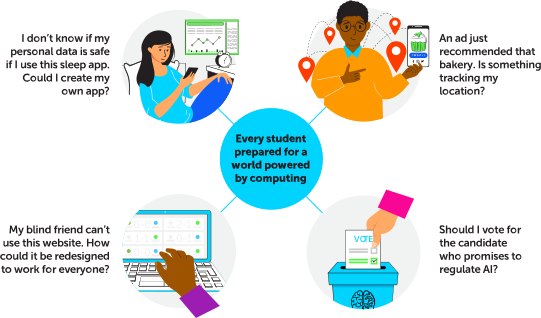
Our vision for PK–12 CS education is to ensure:
All students are engaged and supported in learning CS, including its impacts on individuals, societies, cultures, and economies.
Policies, pedagogies, and practices actively support all students in learning CS.
Standards align with the current and future needs for learning CS.
Students are empowered to responsibly shape the technology-driven world of tomorrow.
Defining Computer Science
Computer science is the study and human-centered practice of using data, algorithms, and computing systems to solve problems, make discoveries, and express ideas.
Computer Science Is:
- a scientific and creative discipline focused on understanding and designing algorithms, data, and computing systems.
- the application of computational thinking to develop both rules-based and data-driven solutions across a variety of disciplines and contexts.
- a collaborative discipline in which learners plan, communicate, test, and refine ideas to design solutions that serve diverse people and communities.
- an ethical, responsible, and human-centered practice, in which it is critical to examine impacts, identify potential harms and benefits, and design responsibly.
Computer Science Is Not:
- using technology tools like word processors, slide decks, or generative AI tools. These appear in CS and in every other subject too.
- limited to coding or programming. Programming is an essential part of CS, but CS is far broader.
- tied to one career path. CS has applications across every field and industry.
- being replaced by AI. CS is what powers AI.
About the 2026 CSTA PK–12 Standards

Foundational PK–12 Standards
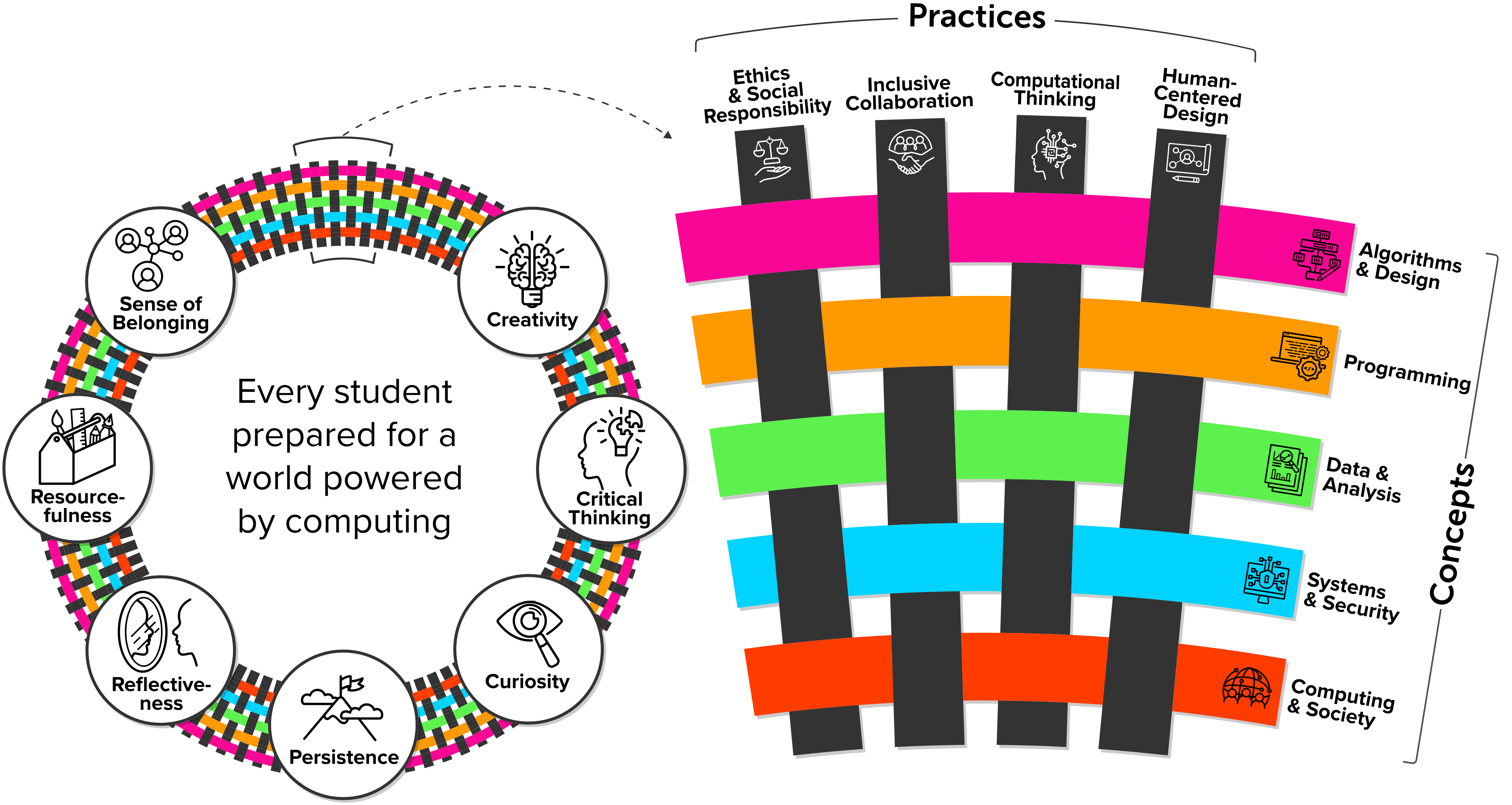
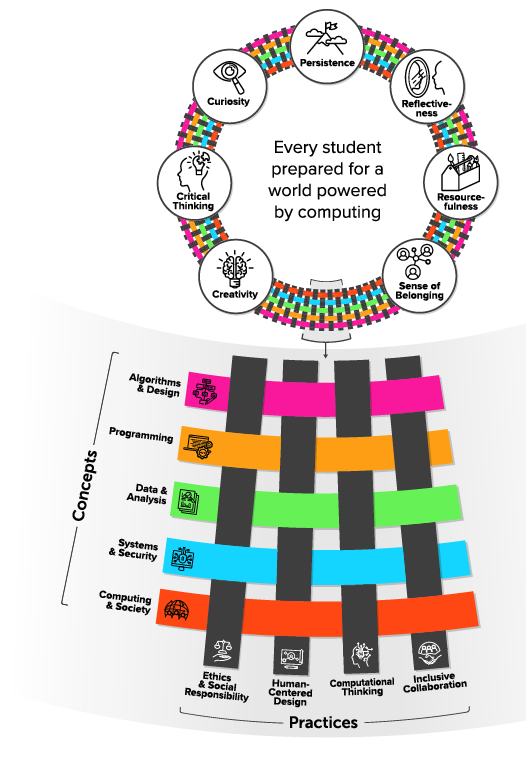
The Foundational PK–12 Computer Science Standards are designed to prepare every student for a world powered by computing, in which they demonstrate key dispositions (habits of mind): creativity, critical thinking, curiosity, persistence, reflectiveness, resourcefulness, and sense of belonging. This vision is realized through deliberate instruction that integrates both concepts and practices.
Concepts define the knowledge and content students learn and serve as the primary organizational structure. The five concepts are: (1) Algorithms & Design, (2) Programming, (3) Data & Analysis, (4) Systems & Security, and (5) Computing & Society. Artificial intelligence was identified as a priority during the standards revision process. AI-related content is distributed across the five concepts instead of being a discrete concept.
Practices define the skills and behaviors students develop as they learn CS. They cut across all concepts and describe how students engage in learning, or what students do. Twelve practices are organized into four categories: (1) Ethics & Social Responsibility, (2) Inclusive Collaboration, (3) Computational Thinking, and (4) Human-Centered Design.
The Foundational Standards define coherent learning progressions across the PK–12 continuum. They begin with a combined pre-kindergarten and kindergarten (PK/K) band, followed by grade-level expectations for grades 1–5. Middle school is organized as a single grade band, leading into a final band that represents foundational high school learning.
High School Specialty Standards
Specialty Standards extend foundational PK–12 computer science learning by defining advanced, domain-specific learning in key areas of computing. These standards are organized into two levels (Specialty I and Specialty II) across six high school specialty areas identified through the Reimagining CS Pathways project (CSTA et al., 2024):
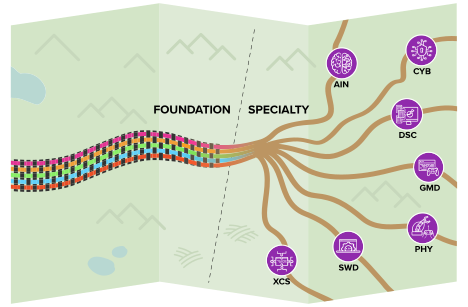
- Artificial Intelligence (AIN)
- Cybersecurity (CYB)
- Data Science (DSC)
- Game Development (GMD)
- Physical Computing (PHY)
- Software Development (SWD)
Specialty I standards introduce the knowledge and skills essential within a chosen area, serving as a student’s first focused learning experience in that domain. Specialty II standards describe more advanced study, preparing students for postsecondary coursework, industry certifications, or continued specializations.
Additionally, X+CS Standards support interdisciplinary learning by integrating foundational high school CS content into other subject areas, such as journalism, biology, and the arts.
Suggested Citation
Computer Science Teachers Association. (2026). 2026 CSTA PK–12 computer science standards.
https://csteachers.org/pk12standards/
DOI: https://doi.org/10.1145/3820482
ISBN: 979-8-4007-2780-1
License
Individuals and organizations are free to download, print, share, and adapt the materials in whole or in part, as long as they provide proper attribution, use for non-commercial purposes, and share contributions or derivations under the same license.
Contact standards@csteachers.org for other licensing inquiries.