


Research
The revision to the CSTA PK–12 Standards was a collaborative and research-driven process designed to ensure that the resulting standards reflect the latest insights and best practices in computer science education. This report documents the extensive research that informed the revision, resulting in updated standards that reflect the “grounded in research” value that underpins the process.
WestEd led a detailed literature review and analysis of related standards and frameworks, as well as a comparison with 12 other sets of instructional guidelines. The research was guided by key questions about alignment with learning progressions, the influence of emerging technologies such as generative AI, pedagogical practices promoting equity, and coverage across existing computer science curricula. WestEd developed design briefs and literature reviews for each standard concept, ensuring that writers had access to the most relevant and timely research as they drafted new standards. Additionally, the Amplifying Social Impacts of Computing Standards (ASICS) project provided recommendations related to impacts and ethics of computing, and the Identifying AI Priorities for All K-12 Students project, co-led by CSTA and AI4K12, developed recommendations related to artificial intelligence.
Research to Inform the CSTA PK–12 Standards Revision
This report summarizes the research base that informed the 2026 CSTA PK–12 Standards revision, including literature reviews, standards and framework comparisons, and expert recommendations. It highlights how key findings influenced the organization, content, and language of the updated standards. Individual research artifacts used by the standards writing team are available for download below.
Research Reports
Identifying AI Priorities for All K–12 Students
This report identifies foundational AI learning priorities for K–12 students, organized by grade band across five major categories. It also offers recommendations related to AI curriculum, instruction, future research, and updates to the AI4K12 Guidelines.
Reimagining CS Pathways: Every Student Prepared for a World Powered by Computing
This community-generated report reflects collaboration across K–12 education, postsecondary institutions, and industry to articulate foundational CS content that all high school graduates should learn and to outline possible pathways for continued study beyond that foundation.
Standards Alignment Review
This report analyzes how widely used K–12 CS curricula align with the 2017 CSTA K–12 Standards. It identifies patterns in curriculum coverage, areas of strong alignment, and standards or concepts that may receive less attention in commonly used instructional materials.
The 2025 Computer Science Teacher Landscape
This report examines the current state of the CS teaching profession, with attention to teacher preparedness, professional learning, support systems, and implementation conditions. The findings can help leaders understand what teachers need to bring a broader, more human-centered vision of CS education to life.
Computing Impacts and Ethics in the CSTA Standards: A Synthesis of Expert Perspectives
This report synthesizes expert recommendations for strengthening computing impacts and ethics throughout an early draft of the CSTA standards. It includes guidance on topics such as ethical frameworks, harms and power, and critical design practices.
Standards Comparison Reports
Comparison of CSTA Standards to Other Standards and Frameworks
This analysis compares the 2017 CSTA K–12 Standards and Reimagining CS Pathways report with other CS, STEM, arts, and humanities standards and frameworks. It identifies implications for standards structure, content organization, and areas where revised CS standards could be strengthened.
State K–12 Computer Science Standards Comparison Report
This report examines the similarities and differences between state-adopted K–12 CS standards and the 2017 CSTA K–12 Standards. This analysis includes basic information about the standards, such as counts by state and level, their cognitive complexity, and more detailed information about their relationship to the CSTA standards.
International Computer Science Standards Comparison Report
This report examines the similarities and differences between K–12 CS standards across seven international locations. This analysis includes background information on each of the locations included in the study, trends in content, and comparisons by topic area.
Literature Reviews
Algorithms and Programming Literature Review
This report synthesizes research on algorithms and programming learning progressions, including sequence, variables, control, modularity, and program development. It highlights where the 2017 standards remain well aligned with research and where updates may be needed, such as program comprehension and the growing role of AI.
Computing Systems and Security Literature Review
This report synthesizes research on student understanding of computing systems, networks, the internet, hardware, software, and cybersecurity. It highlights common student conceptions and misconceptions that can inform more developmentally appropriate standards and instruction.
Data and Analysis Literature Review
This report summarizes research related to data collection, preparation, investigations, and impacts. It can help standards writers and curriculum developers understand how students develop increasingly sophisticated ways of collecting, preparing, analyzing, visualizing, and communicating with data.
Computing and Society Literature Review
This review focuses on the history of computing as an emerging priority within the Standards. It draws on social studies and history education approaches to recommend how students can explore computing’s relationship to society, beginning with local and familiar contexts and expanding toward broader historical and global perspectives.
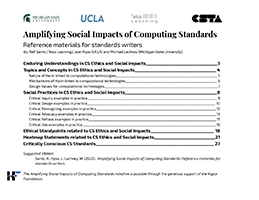
Amplifying Social Impacts of Computing Standards Reference Materials
This resource provides concepts, practices, ethical standpoints, and example language related to computing impacts and ethics, based on a literature review. It is intended to help standards writers more intentionally foreground the social, ethical, and systemic dimensions of computing.
Design Briefs
Structure Design Brief
This brief translates findings from standards and framework comparisons into concrete recommendations for the structure of revised CS standards. It addresses grade-band organization, standard length, integration of concepts and practices, and the role of supplementary materials.
Computing Systems and Security Design Brief
This brief provides recommendations for Computing Systems and Security standards based on the literature review and related cybersecurity learning standards. It addresses grade-band expectations for hardware and software, networks, internet concepts, data flow, security practices, and cybersecurity.
Data and Analysis Design Brief
This brief provides grade-band recommendations for Data and Analysis standards based on related learning progressions in statistics, mathematics, science, and data science education. It emphasizes a developmental progression from familiar, small datasets to larger, more complex investigations using computational tools.
Artificial Intelligence Design Brief
This brief connects AI-related learning outcomes from Reimagining CS Pathways with the AI4K12 Framework. It provides recommendations for incorporating AI concepts across grade bands, including representation, machine learning, societal impacts, ethical design, and the use of generative AI in programming.