



About the Standards
The CSTA PK–12 Computer Science Standards (the Standards) define the essential knowledge, skills, and dispositions to prepare all students for a world powered by computing. Specifically, the Standards delineate coherent progressions of student learning outcomes from pre-kindergarten to grade 12 (PK–12). Together, they form the strong foundation for a rigorous and comprehensive computer science (CS) curriculum that is driven by research and informed by teacher practice. The Standards describe what students should know and be able to do in CS, but they do not prescribe specific curriculum, instructional materials, or assessments.
Written by teachers for teachers, the Standards offer flexibility and guidance to support state and local adaptation while also promoting instructional coherence across the United States and globally. Grounded in research and equity, the Standards emphasize creativity, ethics, data, and human-centered design. They integrate emerging technologies like artificial intelligence while reinforcing foundational computing concepts and inclusive practices that make computer science relevant for every learner. The Standards are a primary resource for state and local education agencies when determining what PK–12 students need to know and be able to do in CS. Widespread adoption impacts millions of students by promoting consistency in state policy, curriculum development, teacher certification, teacher preparation, and professional development across the United States and beyond.
About the Standards
The 2026 CSTA PK–12 Standards are designed for broad adoption and implementation:
- PK–12 CS teachers use the Standards to design rigorous and relevant learning experiences for all students.
- Other PK–12 teachers use the Standards to plan how they can integrate CS across subject areas.
- PK–12 administrators use the Standards to establish and support district- and school-level policies that enable implementation and increase participation.
- Curriculum providers use the Standards to develop new, or refine existing, curriculum and associated tools that guide student learning.
- Professional development (PD) providers use the Standards to design in-service professional learning programs that prepare teachers to effectively teach CS across a variety of contexts.
- Schools of education use the Standards to ensure pre-service teachers have appropriate knowledge and skills to teach foundational CS to their future students.
- State leaders use the Standards to adopt and revise state CS standards, teacher certification, and other CS education policy decisions.
- Researchers use the Standards as a framework to guide study design, define constructs, and investigate the teaching and learning of computer science across diverse contexts.
- Parents and community members use the Standards to understand what PK–12 CS education includes and advocate for high-quality CS education in their communities.
Priorities for the 2026 CSTA PK–12 Standards
The 2026 CSTA PK–12 Computer Science Standards maintain core disciplinary foundations while responding to advances in computing, research on CS learning, and lessons from scaled implementation. The priorities below highlight areas that remain central to computer science education as well as areas that have been newly emphasized or expanded.
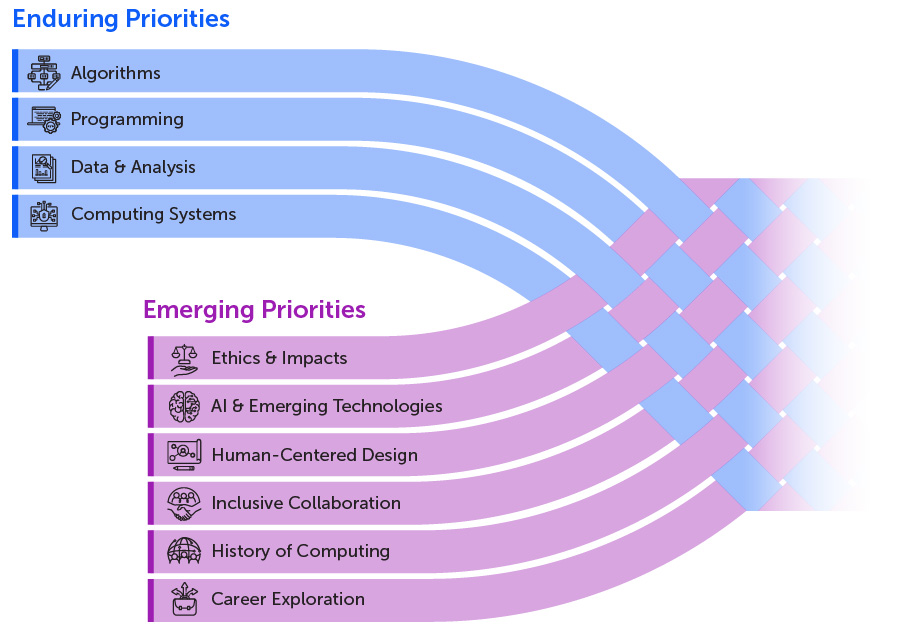
Enduring Priorities
Core disciplinary concepts that remain central in the updated Standards include Algorithms, Programming, Data & Analysis, and Computing Systems.
Algorithms
Algorithms receive increased emphasis in the 2026 CSTA PK–12 Standards. To reflect this shift, Algorithms & Design is defined as a distinct concept rather than being combined with Programming as in previous versions. This emphasis is reinforced through the designation of Computational Thinking as a category of practices woven throughout instruction.
Programming
Programming is still prioritized, and the value of learning to program remains a core aspect of foundational CS. However, the updated Standards represent a shift from focusing primarily on writing code toward a more balanced approach that also emphasizes reading, evaluating, modifying, and debugging programs.
Data & Analysis
Content related to data and its analysis is also a priority, reflecting the growing role of data in daily life and the central role data plays in technologies such as AI. This trend also acknowledges data science as a burgeoning and increasingly important field with strong foundations in CS.
Computing Systems
The 2017 CSTA K–12 Standards included Computing Systems and Networks & the Internet as two distinct concepts. In the updated Standards, these areas are combined into a single concept, Systems & Security, to reflect their interconnected nature and highlight the increasing importance of security in the responsible use of computing technologies.
Emerging Priorities
The following areas represent new or expanded priorities in the 2026 Standards as compared to previous versions.
Ethics & Impacts
Ethical practices and the societal impacts of computing are central priorities in the updated Standards. The Ethics & Social Responsibility practices emphasize responsible computing behaviors such as using computing for social good and respecting creators. Impact-related content appears throughout the Standards, including areas such as Impacts of Algorithms & Design, Impacts of Computing Systems, Impacts of Data Science, and Computing & Society. Together, these elements aim to develop learners who are responsible creators and critical consumers of technology, aware of its impact on their lives and communities.
Artificial Intelligence and Other Emerging Technologies
To ensure the Standards remain relevant over the next decade, they address foundational ideas related to artificial intelligence and other emerging technologies. AI-related learning is integrated across all concepts, and a distinct Emerging Technologies progression within the Computing & Society concept creates space for students to explore both current innovations and future developments in computing.

Human-Centered Design
Human-Centered Design practices are crucial for the ethical development of computing technologies. The level to which a variety of potential user needs, abilities, and contexts are considered in the design process can either remedy or exacerbate equity issues in implementation and profoundly impact the benefits and harms experienced by users. Human-Centered Design practices are woven throughout all CS concepts.
Inclusive Collaboration
The prioritization of Inclusive Collaboration as a category of practices highlights equity as a core value. It emphasizes key skills like effective communication, collaborative problem-solving, and navigating computing projects. The practices that define Inclusive Collaboration are integrated across all CS instruction.
History of Computing
To fully grasp their sociotechnical world, students must explore the evolution of computing technologies, from early developments to modern innovations, and recognize the key contributors. This priority area is integrated within the Computing & Society concept.
Career Exploration
Computing is foundational to nearly every industry and field of study. As such, it is critical for students to connect computing to their personal interests and career goals. Career-related standards are included in the Computing & Society concept.