


About the Standards
Development
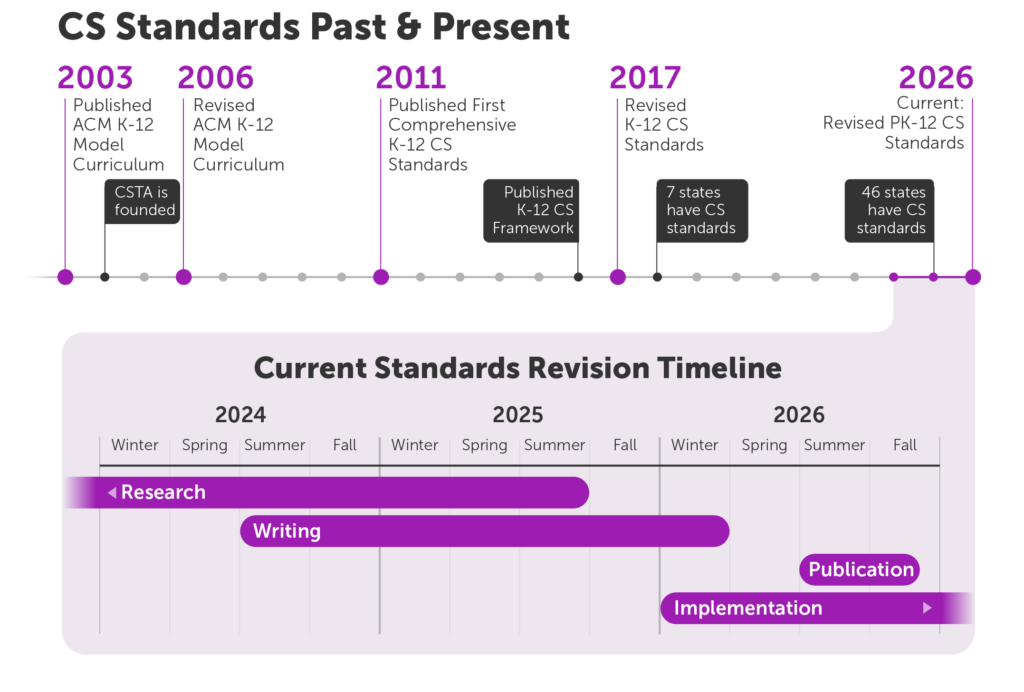
The CSTA PK–12 Computer Science Standards build on more than two decades of work by the computer science education community. Early model curricula were published by ACM in 2003 (Tucker, 2003) and revised in 2006 (Tucker et al., 2006), laying the groundwork for the first comprehensive CSTA K–12 Computer Science Standards released in 2011 (Seehorn et al., 2011). A revised set of Standards was published in 2017 (Seehorn et al., 2017) to align with the K–12 Computer Science Framework (2016), further strengthening coherence across CS education efforts.
The Standards required an update as both the field of computer science and the landscape of CS education have evolved significantly. Since the previous revision, CS implementation in schools has expanded dramatically, the body of CS education research has grown, and rapid advances in areas such as artificial intelligence and cybersecurity have raised new questions about what students should learn.
Values
CSTA defined the following values to guide the revision process and provide a lens for reflecting on and refining project outputs:

Equity-centered: Promotes broad and equitable access, participation, and experiences in CS education among all students.

Community-generated: Meets the needs of the community, including PK–12 educators, postsecondary institutions, students, parents, and industry.

Future-oriented: Anticipates future needs of current learners, and prepares them for a future that is increasingly reliant on computing.

Grounded in research: Reflects the evolving body of knowledge of how students learn CS.

Flexible in implementation: Considers multiple pathways for meeting individual needs of learners, including regional, cultural, ability, social, and economic factors.
People
The standards revision process involved the coordinated efforts of three main groups.
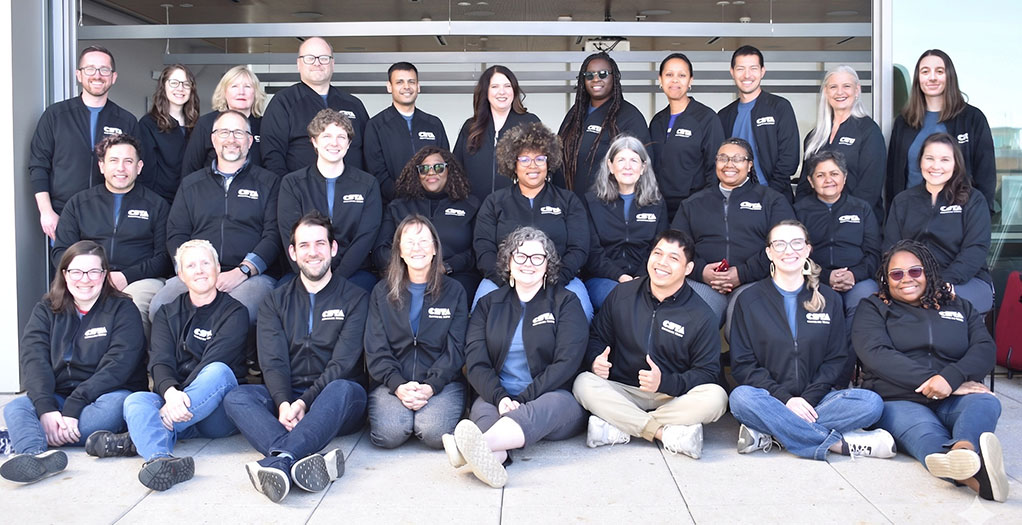
- Standards Writing Team: Included 25 individuals representing 18 states that serve in a variety of roles, including CS teacher (44%), state CS specialist (16%), teacher preparation (32%), and researcher (8%). The writing team collectively had over 400 years of teaching experience, more than 250 of those years specifically teaching CS. Writers took the lead on drafting standards and made key decisions throughout the writing process.
- Advisory Board: Composed of approximately 70 accomplished individuals from across the CS education community, including state CS supervisors, district leaders, curriculum and PD providers, nonprofit leaders, global partners, researchers, school of education faculty, and industry partners. Advisors provided additional insight and perspective that helped to ensure a useful, viable, and accessible final product.
- Asynchronous Reviewers: Approximately 450 asynchronous reviewers validated directionality and provided feedback at key intervals to inform the writing process.
Process
The Standards revision process was organized around three distinct and overlapping phases: Research, Writing, and Implementation.
The development of the Standards reflects the collaborative nature of the computer science education community. This revision builds upon a growing body of work developed by many organizations that have contributed research, frameworks, and instructional resources that inform how CS is taught and learned. Examples include the K–12 CS Framework (2016), AI4K12 Guidelines (2022), K–12 Data Science Learning Progressions (Data Science 4 Everyone, 2025), K–12 Cybersecurity Standards (CYBER.ORG, 2021), QISE K–12 Framework (National Q–12 Education Partnership, 2023), Justice-Centered Computing Education Framework (Scott et al., 2023), and CS2023 (Kumar et al., 2024).
Research
The research phase began with the Reimagining CS Pathways project (CSTA et al., 2024), which developed community definitions of foundational
CS content for all high school graduates and pathways for continued learning. This project laid the foundation for identifying priorities for the
Standards
Additional research efforts informed the structure and content of the Standards, including:
- Comparing state and global CS education standards (CSTA & IACE, 2024, 2025)
- Conducting literature reviews of core concepts (CSTA, 2026a, 2026d, 2026f, 2026h)
- Comparing the 2017 CSTA Standards to other standards and frameworks (CSTA, 2026c)
- Analyzing the alignment of curricula to the 2017 CSTA Standards (CSTA, 2026i)
- AI Learning Priorities for All K-12 Students (CSTA & AI4K12, 2025)
- Amplifying Social Impacts of Computing Standards (Santo et al., 2025)
Writing
The writing phase began in September 2024 and included six in-person convenings and regular virtual meetings with the writing team. Writers primarily worked in grade-band teams during drafting sprints, and concept teams and cross-grade groups collaborated to ensure logical progressions across grade levels. Advisors, researchers, and technical writers provided regular feedback throughout the process to support key decisions and refine drafts. Three public drafts of the Standards were released during this phase, allowing educators and community members to provide feedback at key points in the revision process. A high-level timeline of the writing process is shown below.
Fall 2024
Established the organizational structure of the standards.
Winter 2024–2025
Released Draft 1.0 of the standards and collected community feedback on the organizational structure and writing approach.
Spring 2025
Completed draft progressions across all five concepts.
Summer 2025
Released Draft 2.0 for feedback on coherence and clarity of progressions.
Fall 2025
Developed clarifications for each standard, including boundary statements and practice alignments.
Winter 2025–2026
Released Draft 3.0 for feedback on clarity, granularity, and placement of individual standards.
Spring 2026
Finalized the standards and developed supplementary resources.
Summer 2026
Published the 2026 CSTA PK–12 Computer Science Standards.
Implementation
The CSTA PK–12 Computer Science Standards are designed not only to define what students should learn, but also to help the CS education community translate that vision into classroom practice. Educators, curriculum developers, professional learning providers, and state and district leaders all play a role in bringing the Standards to life through rigorous learning experiences that prepare students to understand and shape a world powered by computing.
The Standards were written with practical implementation in mind. They assume that students experience a coherent progression of computer science learning across grade bands. In elementary school (grades PK–5), students engage in approximately 20–40 hours of CS learning per year. In middle school (grades 6–8) and high school (grades 9–12), students experience the equivalent of a yearlong course at each grade band. These learning opportunities may occur through dedicated computer science courses or through thoughtful integration across subject areas. Because schools and districts vary widely in their schedules, resources, and instructional models, the Standards are designed to support flexible implementation across diverse school contexts while maintaining coherent learning progressions for students.
Implementing the Standards will require sustained collaboration across the CS education community. As curriculum, professional learning, and policy increasingly align with the Standards, schools will be able to offer more coherent and accessible computer science learning opportunities. Over time, these efforts will help ensure that all students develop the knowledge, skills, and dispositions needed to participate in and shape a world powered by computing.