


About the Standards
Artificial Intelligence as Part of Computer Science
AI increasingly shapes students’ daily lives, yet many cannot explain how these systems work, why they fail, or how data influences their behavior. Without intentional learning opportunities, this knowledge gap will continue to widen. CS classrooms provide a natural context for students to understand how AI systems are built, how they make decisions, and how they affect society.
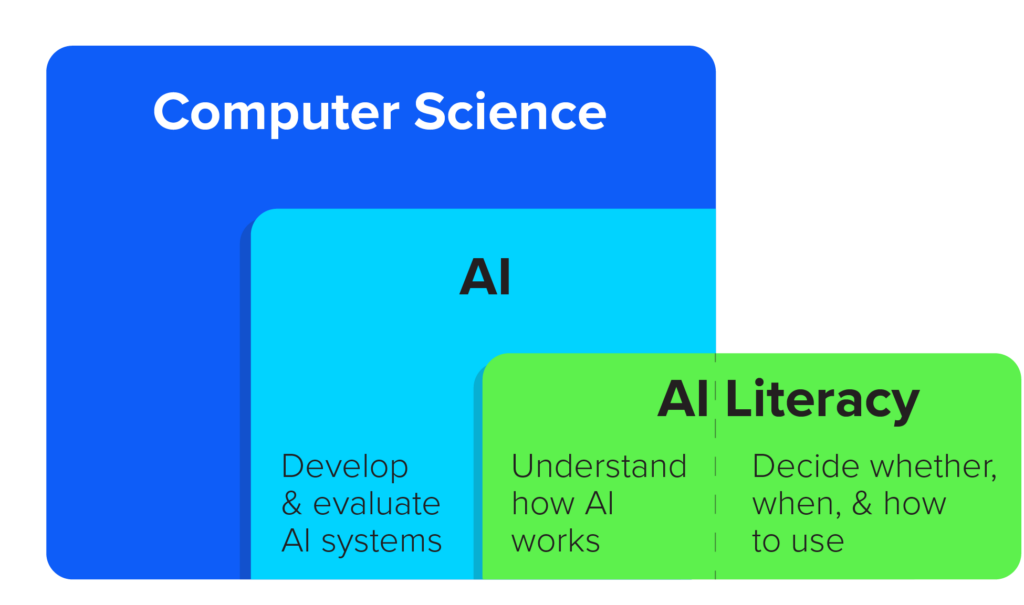
Including AI learning outcomes within foundational computer science learning experiences strengthens students’ ability to become critical consumers, responsible creators, and informed participants in society.
Critical Consumers
From the media they consume to the jobs they pursue to their doctor’s visits, students encounter AI systems throughout their daily routines. They must recognize when AI is being used, question whether it is appropriate for a task, evaluate if outputs are trustworthy, and assess whether decisions are fair.
Responsible Creators
Regardless of career path, most students will use AI tools in some professional capacity. They need to understand when human judgment should override AI, recognize limitations and harms, and apply ethical frameworks to make decisions.
Informed Participants in Society
Students need to consider the real benefits and risks of AI in their communities, when and how to leverage outputs from AI tools in daily tasks, and what the future might look like as AI systems continue to permeate society. They need to understand how bias in training data creates biased outcomes, why AI makes mistakes, who bears responsibility, and the environmental costs of AI systems.
Without knowledge of how AI works, students cannot fully and meaningfully participate in evaluating consequential technologies nor shape their future iterations.
When students learn that AI systems are created by humans, trained on human-collected data, and shaped by human decisions, their understanding of computing changes:
- Mistakes are recognized as predictable consequences of gaps in training data
- Bias is understood as the result of human choices about data and design
- Students see themselves as potential shapers of AI’s future, rather than passive users
AI in the CSTA PK–12 Standards
Because AI technologies are built upon foundational computer science principles, the writing team chose to integrate AI learning throughout the Standards rather than define AI as a separate concept. AI content in the standards serves two primary purposes: (1) to help students understand how AI works and (2) to encourage students to grapple with real impacts and ethical issues related to AI technologies, their creation, and their deployment.
Specifically, AI content is represented across the standards in the following ways:


To clarify where AI learning appears across the Standards, relevant standards are tagged as “AI-related” when they meet one or more of the following criteria:
- The standard or the boundary statement explicitly references AI.
- The standard closely aligns with a learning outcome from AI Priorities for All K–12 Students.
- The standard includes content that is foundational to AI literacy.
The writing team also defined AI as a high school specialty area to inform the development of pathways for students who wish to continue learning about AI after they complete a foundational CS learning experience.
PK–12 students deserve to understand the systems shaping their futures. Learning experiences aligned with the AI content in the 2026 CSTA PK–12 Standards help students understand how AI systems work and prepare them to examine their broader impacts on society.