

Resources
Explore resources to help you understand and implement the 2026 CSTA PK–12 Standards. Download the standards and progression charts in a variety of formats. Access implementation guidance and professional learning, and explore development materials, related frameworks, and graphics.
Downloads
Standards at a Glance
Progressions Charts
- PK–12 Foundational Progression Charts (letter / legal / tabloid)
- AI in the Foundation
- High School Specialty Progression Charts
Previous Versions of Standards
Getting Started
2026 to 2017 CSTA Standards Crosswalk
This crosswalk supports practitioners in identifying curricular adjustments when transitioning from the 2017 to the 2026 CSTA K–12 Standards. Rather than a one-to-one mapping, it highlights stable content, where new learning experiences may be needed, and where prior content has been deprioritized or removed.
Online Professional Development Courses
These asynchronous online courses help educators interpret and apply CSTA Standards to their classroom contexts. Through self-paced learning, reflection, and collaboration, participants explore the "why" behind the standards, understand their structure, and translate this knowledge into effective, standards-aligned teaching and curriculum.
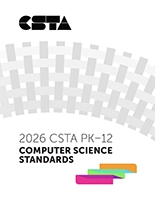
Order a Printed Book
Want a high-quality printed version of the standards? You can order one at cost (about $20 plus shipping) through the CSTA Mimeo Marketplace. The book is printed in an 8.5” × 11” letter-size format with perfect binding, making it a convenient reference for planning and implementation.
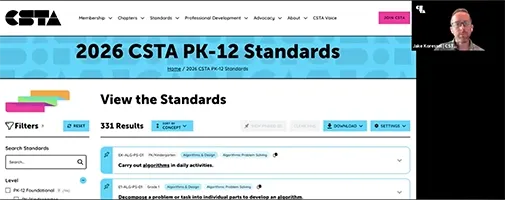
Interactive Web Display Walkthrough
This video demonstrates how to use the interactive web display to explore the 2026 CSTA PK–12 Standards, clarification components, and related resources. Viewers learn how to search, filter, pin, sort, and customize the display, as well as download selected standards in CSV or PDF formats for planning, curriculum alignment, and implementation.
Implementation Guidance by Topic
Exploring Ethics, Values, and Impacts in CS Classrooms: A Sociotechnical Approach
This resource explains the sociotechnical vision behind the 2026 CSTA PK–12 Standards, detailing how technology interacts with social and cultural contexts. It provides teacher-facing guidance, aligned standards, and examples for helping students examine techno-myths, analyze impacts, and act ethically in computing.
Fostering Dispositions in PK–12 Computer Science
This resource explains seven dispositions that support meaningful CS learning: creativity, critical thinking, curiosity, persistence, reflectiveness, resourcefulness, and sense of belonging. It provides educators with guidance, observable behaviors, and strategies to foster these dispositions across all grade levels.
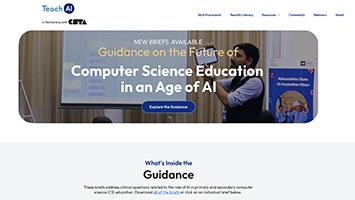
Guidance on the Future of CS Education in an Age of AI
TeachAI and CSTA’s guidance addresses the role of AI in K–12 CS education, covering why students should learn to program, how to teach with and about AI, and how to foster critical, responsible usage. It helps educators, curriculum developers, and leaders make thoughtful decisions as AI becomes increasingly integrated into computing and society.
Implementation Guidance by Grade Band
Elementary Implementation Guidance
This guidance helps elementary schools implement the 2026 CSTA PK–12 Standards through hands-on, age-appropriate CS learning. It includes flexible models for integrating CS into general education, special classes, or standalone instruction, with examples across PK–5.
Middle School Implementation Guidance
This guidance helps schools plan coherent CS learning across grades 6–8 through flexible models, including grade-level progressions, topic-based courses, and interdisciplinary integration. It supports decisions about scheduling, staffing, standards coverage, and equitable access.
High School Implementation Guidance
This guidance helps schools implement high school CS across foundational and specialty standards through multiple course types, including standalone, integrated, and specialized options. It also offers support for developing pathways aligned to specialty areas, along with planning guidance and AP framework crosswalks.
Implementation Guidance by Role
Implementation Guidance for PK-12 Administrators
This guidance helps district and school administrators make the system-level decisions needed to support effective standards implementation. It focuses on adoption planning, coherent CS programs and pathways, staffing and professional development, scheduling, participation data, and strategies for expanding equitable access.
Implementation Guidance for State Leaders
This guidance helps state leaders adopt, interpret, and implement the 2026 CSTA PK–12 Standards while preserving local flexibility. It outlines actions related to transition planning, coherent CS pathways, system alignment, educator capacity, and equitable access across districts and student groups.
Implementation Guidance for Curriculum & PD Providers
This guidance helps curriculum developers and PD providers translate the 2026 CSTA PK–12 Standards into high-quality materials and educator learning experiences. It emphasizes preserving standards integrity, supporting flexible implementation, building educator capacity, and designing coherent, inclusive, and aligned materials and PD.
Development Resources
CSTA PK–12 Standards Style Guide
This guide documents the writing conventions used to promote consistency, clarity, and usability across the CSTA PK–12 Standards. It provides guidance for standard language, identifiers, capitalization, formatting, examples, and related editorial decisions so writers and reviewers can apply a shared style throughout the standards development process.
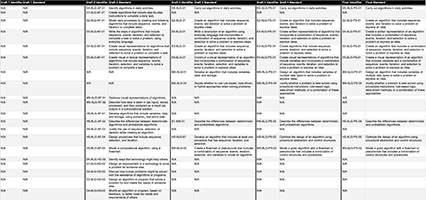
Revised CSTA PK–12 Standards: Drafts 1–4 vs. Final
This comparison spreadsheet documents how individual standards changed across four interim drafts of the 2026 CSTA PK–12 Standards revision process. It can help writers, reviewers, and implementation teams trace changes in identifiers, wording, concept organization, and final standard language.
Guidance for Standards Developers
This chapter from the K–12 CS Framework offers recommendations for developing high-quality CS standards that are rigorous, focused, equitable, clear, coherent, measurable, and usable by educators and system leaders, with criteria and examples to help translate framework concepts and practices into student-facing expectations.
Related Standards & Frameworks
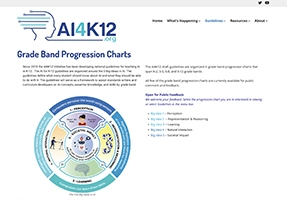
AI4K12 Guidelines
The AI4K12 Guidelines define essential AI knowledge for K–12 students through five big ideas: perception, representation and reasoning, learning, natural interaction, and societal impact. They directly informed the standards' AI content and provide detailed guidance on comprehensive AI education across grade levels.
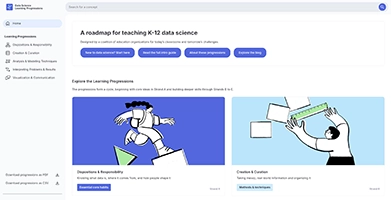
Data Science Learning Progressions
These progressions provide a framework for integrating data literacy and science across K–12 learning. They help educators build student capacity to work with data, use tools, interpret results, communicate findings, and consider ethics. They also informed the Data & Analysis Foundational Standards and Data Science Specialty Standards.
K–12 Computer Science Framework
This framework provides a shared vision and conceptual foundation for K–12 computer science education, including core concepts, practices, and implementation guidance. It informed the development of the 2017 CSTA K–12 Standards by helping define what all students should know and be able to do in computer science across grade bands.
K–12 Cybersecurity Learning Standards
These CYBER.ORG standards define what K–12 students should know and be able to do in cybersecurity, with flexible guidance for adoption, integration, and curriculum development. They informed the development of the Systems & Security Foundational Standards and Cybersecurity Specialty Standards.
QISE K–12 Framework
This Quantum Information Science and Engineering (QISE) framework introduces quantum concepts across K–12, linking computer science, physics, chemistry, math, and STEM. It helps educators, developers, and standards writers find age-appropriate entry points and connect emerging technologies to existing learning goals.
Graphics
CS Vision
Download now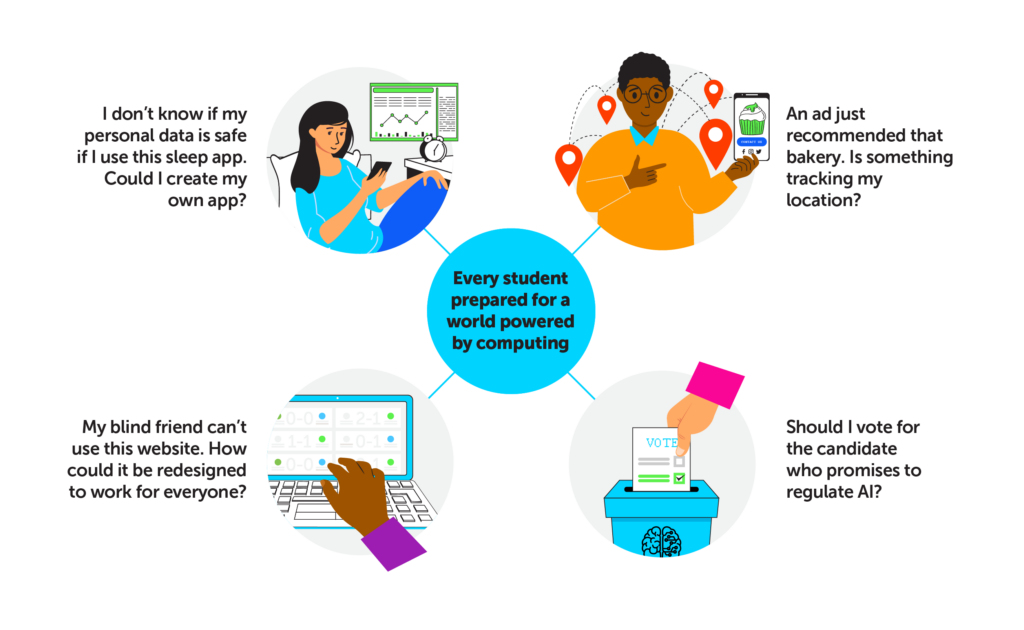
CS Standards Past & Present Enduring and Emerging Priorities
Download now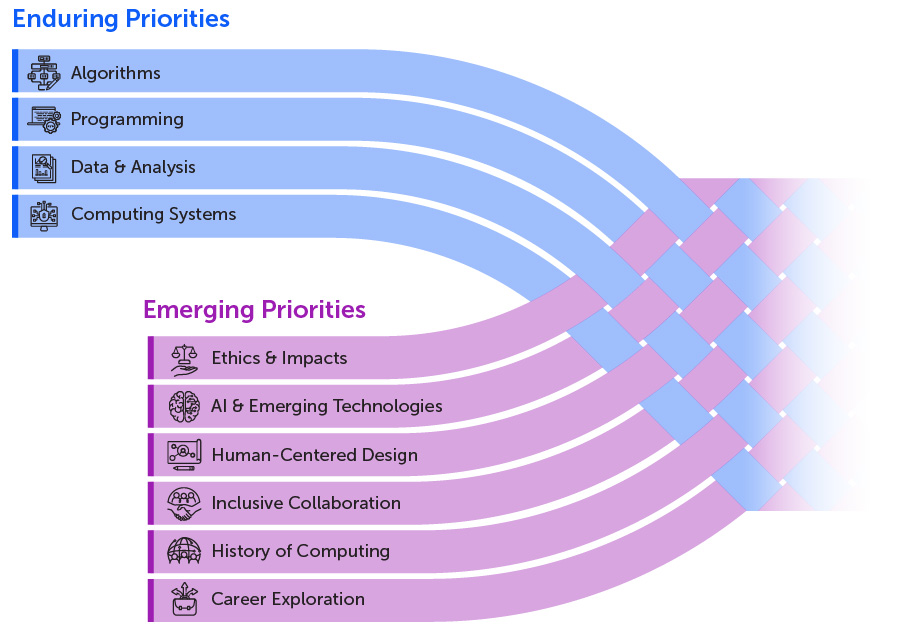
Foundational PK–12 Standards
Download now
High School Specialty Standards
Download now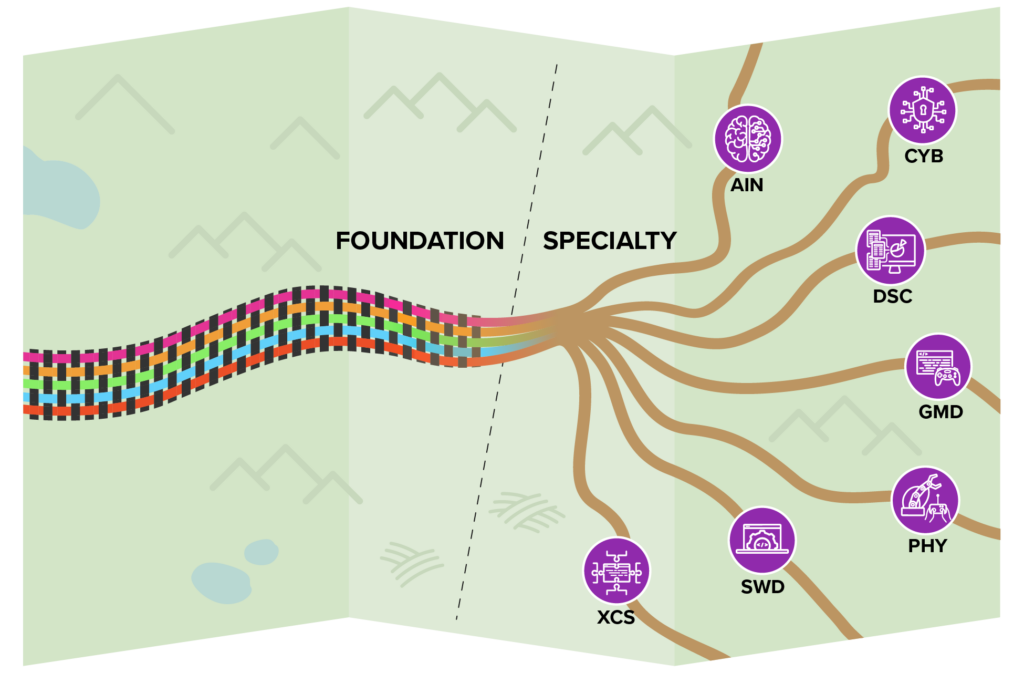
Artificial Intelligence in Computer Science
Download now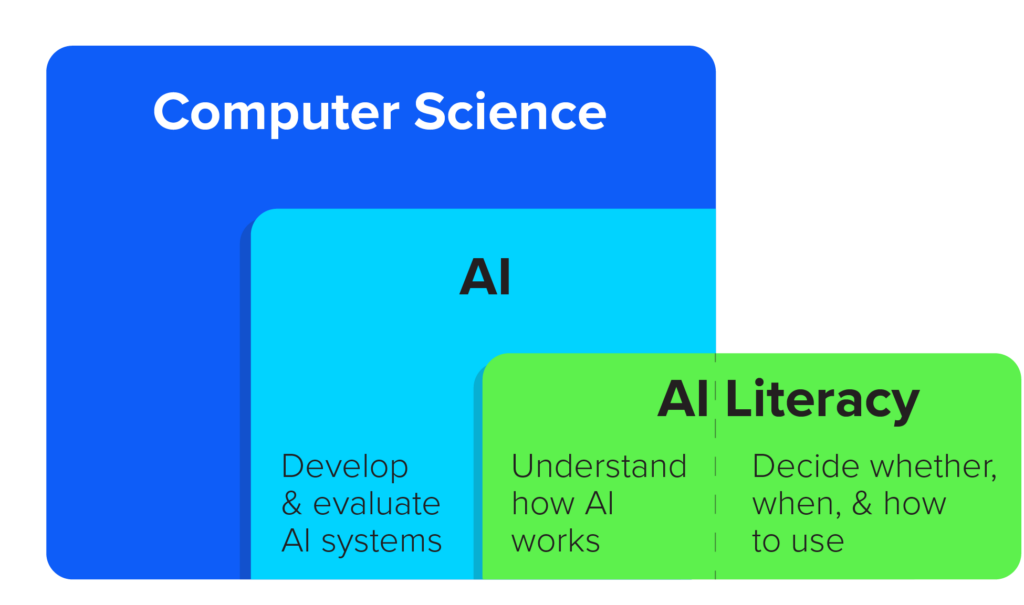
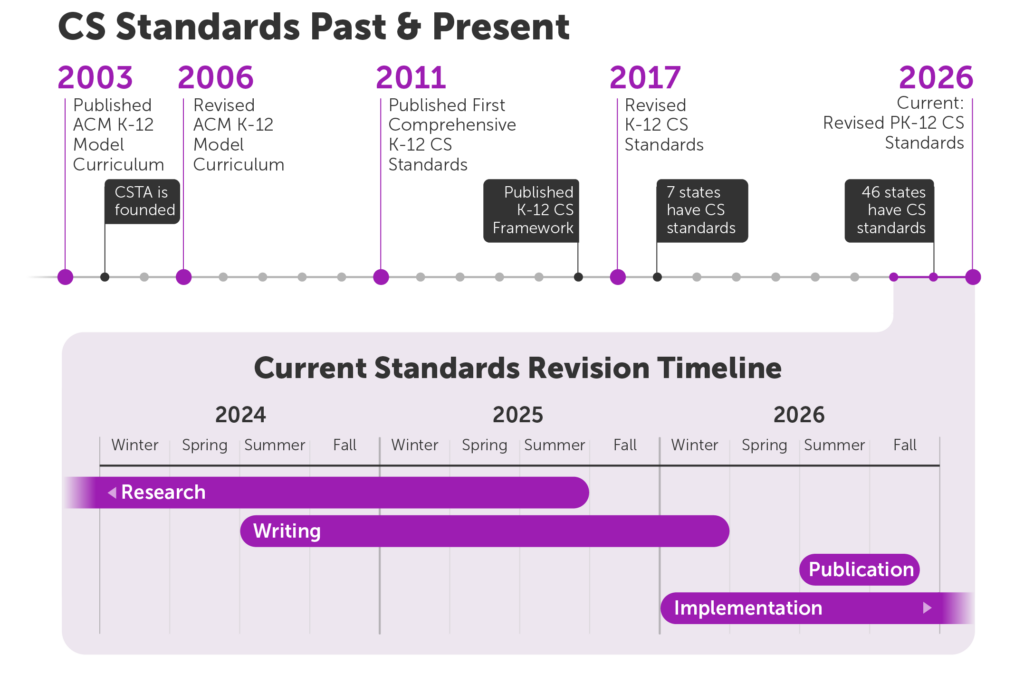
CS Standards Past & Present
Download now