
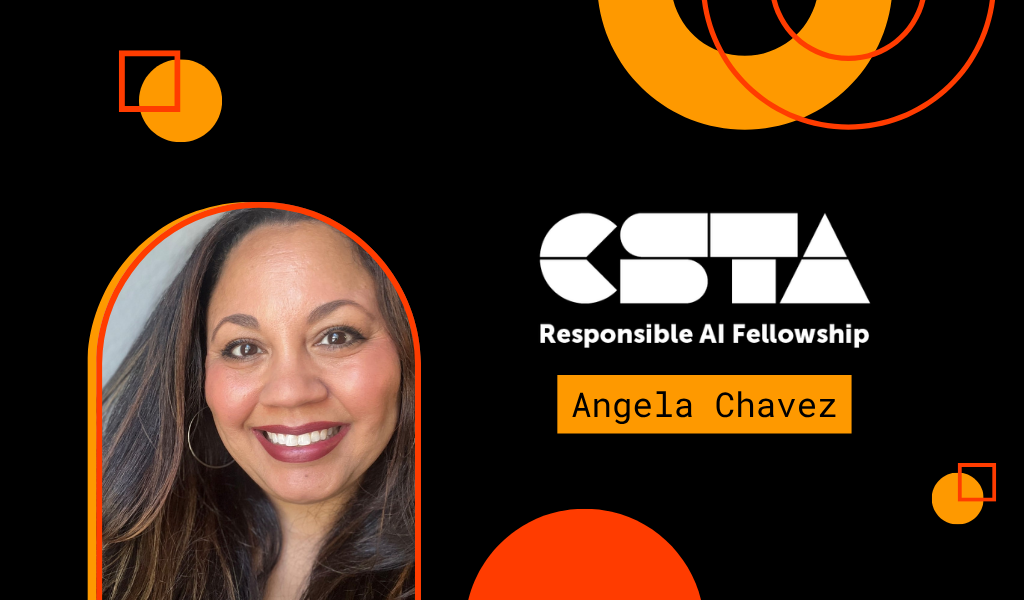
Angela Chavez teaches fifth grade at Computer Science Virtual Academy, where she also serves as a CS for Good Champion. She’s an advocate for expanding computer science access in elementary schools, and she recently began infusing her CS work with AI, focusing on access, responsible use, representation, and integration.
As Angela started teaching her students with (and about) AI, she has placed ethical usage at the forefront of her work. Her goal for her students, she says, is to “equip them with a deep understanding of both the benefits and the potential harms of AI, empowering them to make informed decisions.” While many educators resist AI tools, believing their harms to be more salient than their potential benefits, Angela believes that teachers like her have a responsibility to help students understand the increasingly AI-driven world in which they exist. When teachers fail to educate themselves on AI, Angela says, “we also miss the mark on empowering our students to counter AI’s negative and harmful aspects.”
When she first began using AI in the classroom, Angela simply intended to boost engagement and help her elementary students have fun. But as she engaged with AI tools more fully, her understanding of their potential to help or harm students continued to deepen. Angela doesn’t want to shy away from that potential. Instead, she crafts lessons to help students understand it. “My goal is to empower students to distinguish, in a kid-friendly way, when AI is a friend supporting our learning, and when it works against us, limiting our creativity and voice,” she says.
Angela instituted “AI Tuesdays” in her classroom, offering her students a weekly space to explore AI tools in a setting that emphasizes the ethical dimensions of AI use. Using familiar examples like Siri and self-driving cars, Angela has helped her students distinguish between automation and real AI. Once students possess this foundational understanding, the class can branch out into more complex topics along weekly themes, using tools like Adobe Express and Google Experiments. One autistic student emerged as a leader among his peers in crafting detailed AI prompts, and he used Adobe Express to communicate his process to his peers. To Angela, this student’s success was the perfect example of how AI tools can encourage and support students at all levels.
In one popular lesson, students used the Living Archive Arts Experiment, an AI choreography tool trained on body movements from choreographer Wayne McGregor’s archive. The class discussed how a machine learning tool can predict movement based on an existing dataset, then used the tool to create and perform eight-step dance sequences. Drawing on Code.org’s AI lessons, Angela discussed the training data, biases, and ethical considerations that go into making AI tools. This lesson combined plugged and unplugged elements and helped students see how an AI tool can help with—not replace—creative thinking.
Angela is excited to learn more about the possibilities of AI, as well as to share her knowledge with her fellow teachers. “I attribute my growing confidence in learning, sharing, and supporting my fellow teachers to my time as an IMPACT Fellow,” she says. Through that fellowship, she had the chance to lead professional learning and become a more involved citizen of the broader CS education community.
Over the last year, she has presented at several events relating to AI education, where she highlights her classroom experiences and the lessons she’s learned. She encourages fellow educators to start small with a single short AI activity, then continue to build confidence as they expand in their AI teaching. “Nothing gets me more excited than to share best practices, strategies, and lessons with my peers and the larger community!” says Angela.
Heading into her time as a Responsible AI Fellow, Angela hopes to have many such experiences of sharing strategies and building community. She looks forward to working with a cohort of educators who come from an array of different contexts—rural, urban, virtual, and more—each with their own unique challenges, each with their own perspective on how to incorporate AI tools into CS education. In her school, Angela has seen plenty of kids using ChatGPT as a way to avoid thinking, not assist with it, and she’s heard similar complaints from teachers in higher grades. This fellowship offers a special opportunity to plan projects that will offer needed guardrails on AI use, while still equipping students with the skills they’ll need in an increasingly AI-powered workforce.
“I want to grow as a leader who supports educators in navigating uncertainty with curiosity, confidence, and care,” says Angela. “To me, responsible AI is a call to reimagine how we teach, learn, and think.”