
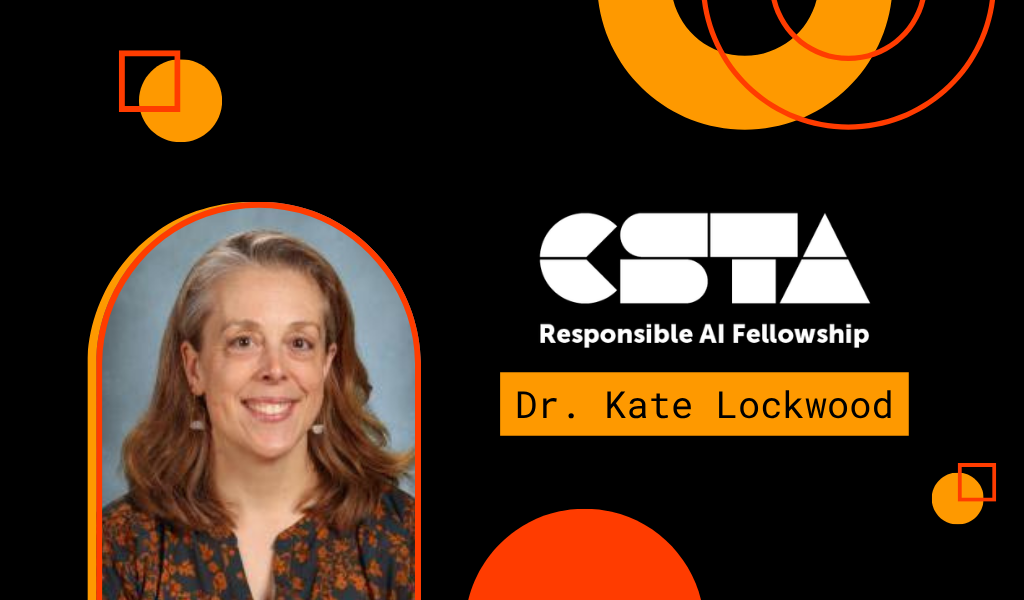
Dr. Kate Lockwood is in her tenth year of teaching high school computer science at St. Paul Academy in St. Paul, MN, after transitioning from higher education to K–12 teaching. Kate holds her bachelor’s and master’s degrees from the University of Michigan and her PhD in computer science from Northwestern University. As co-president of CSTA Minnesota, Kate advocates for expanded access to computer science education for all Minnesota students. Kate was part of the 9–12 grade band team of the AI4K12 project, and she is excited to continue her work to bring high-quality AI opportunities to K–12 students and teachers.
As excited as Kate is for the opportunities AI presents, it’s important to her to ensure that AI never replaces learning or critical thinking, and she encourages her students to be intentional and analytic when using AI tools. Rather than allowing AI to write an entire program, her students use AI with intention, examining specific pieces of the assignment to explore different ways of approaching the problem they want to solve. Next, students take an analytic eye to the AI’s outputs, meaning that they understand the AI response, why it produced that response, and the quality of the response. Kate’s approach to AI continues to evolve as the technology does, but her goal will remain the same: to center intentional, analytic student learning.
Kate’s PhD in AI puts her in a particularly strong position to understand its potential for K–12 learning. She was involved in both drafting the AIK12 standards and revising the CSTA standards to incorporate AI, and it’s been exciting to bring her academic background to bear on the future of CS and AI access for kids across the country. She’s interested in how AI can support learning in other subjects, and how teachers can encourage students to continuously evaluate the quality of an AI’s output and the appropriateness of using it in different ways. For example, in English class, students might use AI to define an unfamiliar word, or suggest grammar improvements, but they should be discouraged from allowing AI to write an entire essay. Teachers can also teach students to recognize when an AI-generated text fails to support its arguments or provides hallucinated sources.
In her AP CS A class at St. Paul Academy, Kate gave a lesson that delved deeply into AI’s uses in coding and encouraged her students to make use of AI supports while recognizing its limitations. As a group, they looked at code generated by AI to solve a specific class problem. Then the students used AI for specific, targeted tasks, such as writing the same code in a different way, explaining a line of code, and generating test cases. After trying out the different types of supports AI could provide, the students engaged in a class discussion about which uses enhanced their learning, and which ones were doing too much of the work for them. Kate found that AI could provide useful scaffolding to build students’ confidence, especially in taking risks and trying out tasks that they had previously found too intimidating to attempt.
As education adapts to an AI-powered world, Kate loves to spend time in settings where different teachers can share what works for them. She was part of a three-person team that developed AI guidelines at her school, and she deeply valued the other teachers’ perspectives on how to meet the needs of different teachers, divisions, and community members. Recently, Kate had the opportunity to participate in a CSTA knowledge exchange exploring how to teach AP CS A using generative AI alongside a cohort of other CS teachers. This experience strengthened her belief in the power of collaboration. “Through collective wisdom and collaboration,” she says, “we’ll all start to learn what works and to grow our confidence in utilizing AI effectively across a wide range of disciplines.”
In every setting where Kate has led, presented, and taught about AI, she’s had the opportunity to learn something new from her fellow educators and students. As valuable as those experiences have been, she knows that the Responsible AI Fellowship offers a unique opportunity to dive even deeper. “I hope to be challenged to reconsider many of my preconceptions about how CS should be taught,” she says, “and in particular pushed to consider how to most effectively integrate responsible and ethical AI into my pedagogy.”
She’s eager to develop resources and best practices for teaching AI-integrated programming, rather than treating AI as a discrete, blocked-off topic. She’d also like to learn more about AI’s potential to differentiate instruction and support students with learning differences. “I think that it’s imperative that CSTA lead the way in developing research-backed best practices for how to use AI with students to increase equity,” she says. Knowing how much she’s gotten out of her CSTA membership, she’s excited to create new resources to give back to the CS education community.
“AI is not going away. Pedagogy will have to adjust,” says Kate. “This will happen most quickly and effectively through the exchange of ideas among a broad range of educators.” She knows that the Responsible AI Fellowship will be the perfect space to realize that dream.