
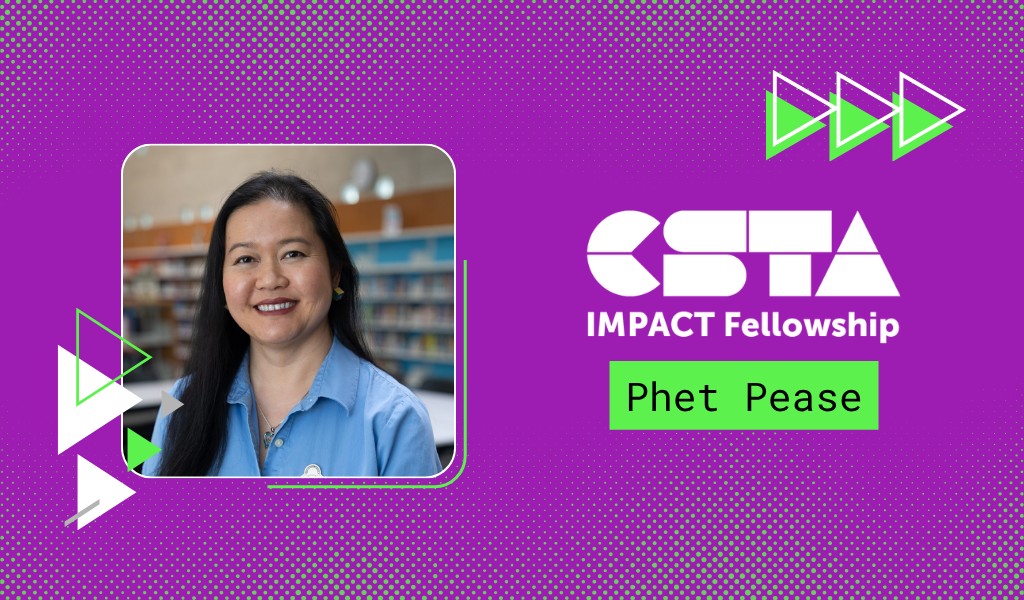
Khamphet “Phet” Pease is an award-winning STEM educator and robotics club advisor at Wilson Middle School in the San Diego Unified School District, where she has taught since 2005. With a career rooted in equity, creativity, and project-based learning, she leads nationally recognized initiatives that empower underrepresented students through robotics, coding, and engineering. She is a passionate advocate for expanding access to computer science, organizing international STEM tours, securing grants and sponsorships, and mentoring students in transformative, hands-on experiences. Her many accolades include the Presidential Award for Excellence in Mathematics and Science Teaching and the CSTA CS Teaching Excellence Award.
Phet works hard to eliminate barriers to entry to CS, so that students of all backgrounds can participate. This includes getting rid of prerequisites to her CS courses and energetically recruiting girls, multilingual learners, and other students from underrepresented backgrounds. Over the years, her student rosters have come to reflect her school’s diversity more fully.
Of her Title 1 school, where over 95% of students are eligible for free/reduced lunch, Phet says, “Many of my students enter middle school having never met a coder who looks like them or taken a CS class. I design my curriculum to change that narrative.” Her TurtleStitch coding and embroidery unit has been tremendously successful at inviting girls to develop their CS identity. In that unit, students write code to control a digital embroidery machine. “Students who once doubted their ability to code,” says Phet, “are now leading demonstrations, presenting at exhibitions, and sharing their work with the broader community.” Beyond her classrooms, Phet has worked hard to secure funding to allow her under-resourced students to join her robotics program and other afterschool activities.
Phet recognizes the importance of offering students multiple pathways into computer science. She uses choice-based project menus, allowing students to create public service announcements, apps, or physical prototypes as they answer the core research question: “How can technology help solve problems in our community?” That flexibility invites students to feel greater ownership over their work, because they bring their own identities and interests into the learning process. Phet also hosts FIRST Lego League scrimmages, open to schools across the county, to allow students to practice their coding skills in a competitive setting. Her students have had opportunities to present their CS work to the broader community through events hosted at the San Diego History Center.
In her afterschool robotics club, consisting of roughly 60 students per year, Phet has coached FLL and Botball competitions. One majority-girls team won the Innovation Project Award at regionals, after researching ways to reduce acid levels in the ocean by prototyping an electric boat to disperse aquatic plants. Another student, once disengaged from their schooling, gained enough confidence through the robotics club that they’re now hoping to pursue a career in engineering.
The IMPACT Fellowship offers Phet the chance to learn from peers across the country who share her interest in building CS equity at the systems level. Her experience so far has been confined to her school and district, and Phet’s now interested in expanding the scope of her work, developing her skill as a leader and change-maker, and contributing to a national movement for CS access. She hopes to learn more about data storytelling and CS integration into core subject areas, both of which will help her to improve in advocating for and implementing CS in all classrooms.
In pursuit of those goals, Phet envisions creating a toolkit of creative ways to integrate CS into other subject areas, drawing on her own curricular experience as well as those of her cohort. She’d also like to support peer mentorship for new CS teachers in school contexts that have historically lacked access to high-quality CS education, such as high-poverty and rural districts. No matter what projects her cohort pursues, Phet knows they will share the goal of creating systemic change in CS education, led by teachers and students in conversation and community.
Phet says, “I’d love to explore how we can bring creativity, joy, and cultural relevance into CS classrooms in ways that foster belonging and achievement for all students.”