
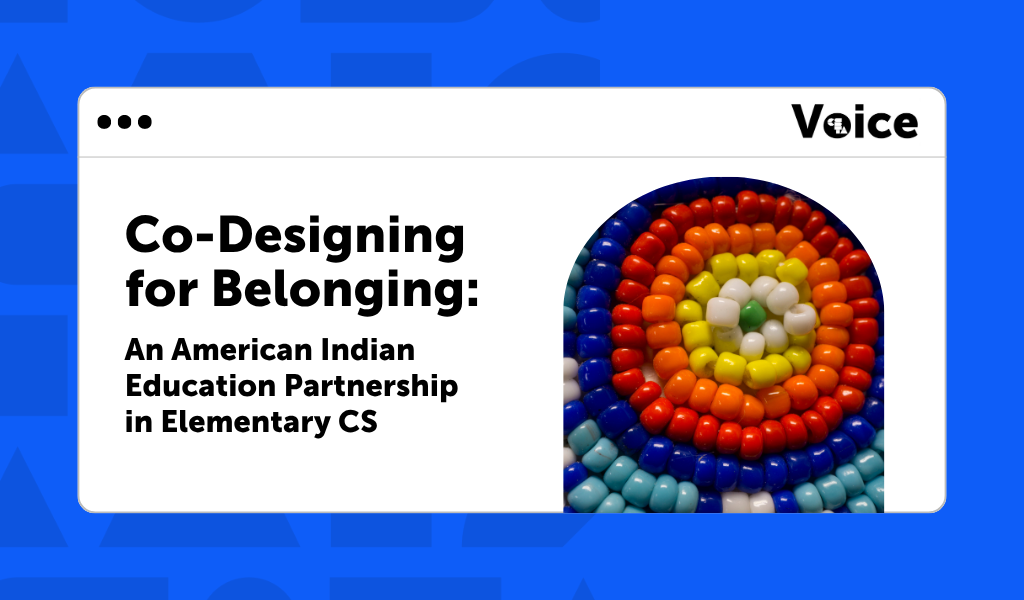
How a partnership grounded in Indigenous knowledge created richer CS learning—and how others can adapt the approach.
Written by Alexandra Holter, Whitney Determan, Emilee Vlasin Milde, Lee Nelson, Hiedi Hecker, Clarissa Seidl
Equity in computer science is often framed around access: devices, schedules, and staffing. Those things matter. But they aren’t the whole story. True equity isn’t just about who has a laptop; it’s about whose knowledge counts in computing spaces and whether students experience CS as a tool for expression, relationship, and community benefit.
In Bloomington Public Schools (MN), we recognized that in elementary school, students form early beliefs about who “belongs” in STEM. When learning is abstract or detached from community, many students, particularly those from groups historically marginalized in tech, decide early that computer science “isn’t for me.”
To challenge this narrative, our elementary CS team partnered with our American Indian Education (AIE) program. We didn’t just want a “more engaging” lesson; we wanted to move CS out of the vacuum and into the real world.
The Challenge: Beyond the “Checkbox”
Many CS educators have seen well-intentioned integration fall into a “heritage month” trap: a cultural reference added at the last minute or a single activity that treats culture as decoration.
Our AIE + CS work takes a different approach. It is grounded in the premise that American Indian knowledge systems naturally reflect patterns, systems, cycles, and cause-and-effect—the very “big ideas” that underpin computational thinking. By anchoring computing in these contexts, we do more than teach “coding steps”; we broaden the definition of who a scientist is.
Our Design Guardrails
To ensure this partnership was authentic, we established clear “Refusals” and “Commitments”:
| Refusals (What we stopped doing) | Commitments (What we started doing) |
| Adding Indigenous content after a lesson was written. | Co-designing from the very first brainstorm. |
| Treating AIE staff as “final reviewers” (a checkbox). | Accuracy review as a mandatory, iterative step. |
| Using culture as “decoration” for engagement. | Keeping CS goals rigorous: sequencing, debugging, and data representation. |
| Viewing CS as “culture-neutral.” | Teaching with responsibility: exploring the ethical impact of technology. |
How We Work: A Collaborative Approach
This model is adaptable. While our work is grounded in Minnesota standards, any district can anchor this partnership in their own local Indigenous standards and tribal nation priorities.
- September | Build Direction: We prioritize relational trust. Educators brainstorm and establish shared goals before touching a device.
- Fall | Deepen Content Knowledge: Our team immerses themselves in professional learning, including AISES conferences and Indigenous Science PLCs. We’ve learned that co-design requires more than meeting time; it requires learning time.
- November | Design Integrated Lessons: AIE staff provide foundational resources while CS specialists translate them into developmentally appropriate computing experiences.
- January & Beyond | Implementation: Classroom teachers lead instruction with real-time support. We treat lesson development like strong CS practice—draft, test, and revise.
The Pedagogy in Action: Examples of Rigorous CS, Grounded Contexts
Systems and Relationships (Kindergarten)
- CS Focus: Algorithms and Logic.
- The Depth: Students don’t just “move a robot.” They use Blue-Bots to model relationships to land and water. The coding is the language used to describe the logic of the natural world.
- Agency Move: Students identify “bugs” in their thinking, learning that debugging is an act of persistence and refinement in their communication.
Cycles and Decomposition (Second Grade)
- CS Focus: Breaking down complex systems.
- The Depth: Using Edison bots, students explore seasonal cycles. They decompose the complex task of survival and movement through a landscape into programmable steps.
- Agency Move: Students see traditional knowledge not as “history,” but as a sophisticated decision-making system that mirrors computational logic.
Representation and Sovereignty (Third Grade)
- CS Focus: User Interface (UI), Event-Driven Programming, and Data Representation.
- The Depth: Students build interactive maps of the 11 Tribal Nations of Minnesota using Scratch and Makey Makey.
- Agency Move: This isn’t just a map; it’s a study in representation. Students must decide: How do we represent a Sovereign Nation accurately? How does our design choice impact the user’s understanding?
Outcomes: Identity and Intellectual Authority
By grounding CS in the brilliance of American Indian knowledge, we saw a shift in classroom power dynamics:
- Native Students as Leaders: Indigenous students saw their ancestral knowledge valued as a high-level intellectual framework.
- Dismantling Stereotypes: All students began to see CS not as a “narrow tech skill,” but as a tool for community benefit and ethical stewardship.
- Broadening the “Who”: This approach removes the barriers created when CS is taught in a cultural vacuum. When the context is meaningful, the “logic” follows naturally.
Moving Forward
This collaboration reminds us that belonging isn’t a feeling; it’s a design choice. When we stop treating CS as a neutral set of skills and start treating it as a way to engage with the world’s most important stories and systems, we open the door for every student to become a creator, a thinker, and a leader.
About the Authors
Lee Nelson began his elementary teaching career in 1997 and holds an Ed Tech Master’s degree. He is proud to be one the Computer Science Specialists for Bloomington Public Schools, a team that has pioneered what it looks like to provide an immersive CS educational experience for K-5 students. Lee is passionate, both professionally and personally, about thriving in a rapidly changing digital world while also remaining grounded in the timeless values of a life “unplugged.”
Hiedi Hecker has worked in the field of American Indian Education for 30 years. Prior to that she was on the Ojibwe team that created the first American Indian language learning series through the Pimsleur Language Program.
Whitney Determan is an experienced elementary computer science teacher in Minnesota with 16 years of teaching experience and degrees from the University of Minnesota. Over the past six years, she has helped build Minnesota’s first elementary computer science immersion program, shaping innovative learning experiences for students. Whitney is passionate about helping students become creative problem solvers and believes computer science and computational thinking are essential skills in today’s technology-driven world.

Emilee Vlasin Milde is a passionate and driven educator with nine years of teaching experience in Bloomington Public Schools, including the last three years in computer science. She earned her degree from Minnesota State University, Mankato, and is committed to serving her students and community in thoughtful and creative ways. Through her work, Emilee truly exemplifies the belief that computer science is about building skills, advancing equity, and creating joy for students.
Clarissa Seidl is the American Indian Education Supervisor for Bloomington Public Schools. She brings 17 years of experience as an Indigenous youth worker and is currently a Ph.D. candidate at the University of Minnesota, where she is completing her doctorate in International and Comparative Education.