
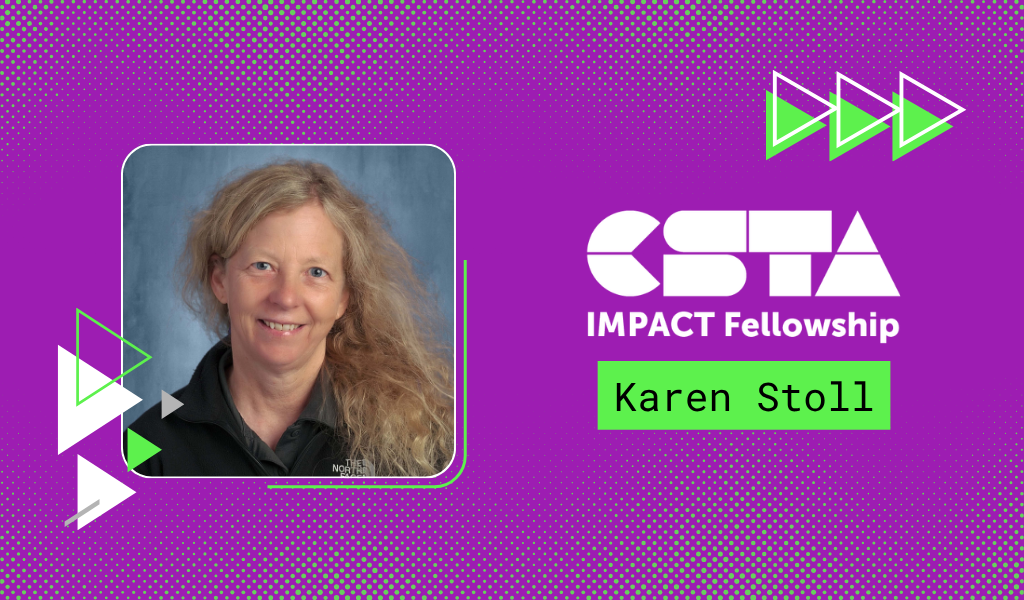
Karen Stoll has taught computer science at Blacksburg High School in Virginia for the last eight years. As co–head coach of FIRST Robotics Team 401, Karen has guided her team to multiple state awards and national qualifications. She has secured over $20,000 in STEM grants and helped launch robotics programs in Title 1 elementary schools. Their work in the classroom and beyond focuses on encouraging female and rural students to explore computer science and gain confidence in STEM fields.
For Karen, equity just doesn’t mean expanding access to CS, but expanding her students’ ideas about what CS entails. Many students think that computer science is just coding, but Karen is determined to help them understand that it’s so much more than that. “When you frame computer science as a field that involves teamwork, problem-solving, creativity and communication, rather than just sitting in front of a screen coding all day,” she says, “it becomes more accessible and appealing to a broader range of students.” Reframing CS to include a focus on soft skills helps students from underrepresented groups see the field as something that could belong to them, rather than a subject that’s limited to students who are good at math or already enjoy coding.
Karen says, “Solving big problems in CS requires collaboration across disciplines and diverse perspectives. Encouraging this mindset in K–12 education can help create a more inclusive and innovative future workforce.” To this end, her robotics team engages in a variety of recruitment and outreach activities, especially to girls and rural students, including Girl Scout badge camps and a weeklong STEM coding camp for underrepresented students. They’ve also offered hands-on programming activities at Virginia Tech’s annual Science Festival and their prestigious CRC Game Changer Innovation Showcase—among others.
“[These events] don’t just showcase technology,” Karen says. “They create authentic, hands-on learning moments that spark interest, break down barriers, and show students (and their families) that computer science is something they can be part of.” Her efforts, and those of her students, haven’t gone unnoticed. For the last four years running, Karen’s team has received the FIRST Robotics Club Impact Award, which recognizes the team that most embodies FRC’s mission to promote and invite more youth into STEM fields. In 2018, the AP Board recognized Karen’s recruitment and retention efforts with the Female Diversity Award for AP Computer Science.
Karen’s dedicated her career to finding, or creating, whatever resources are necessary to bring computer science to her students. While teaching robotics and AP Computer Science, Karen realized that her school didn’t offer any truly entry-level computer science classes. In response, she spearheaded the addition of an AP Computer Science Principles course, which is designed to welcome new students into computer science. She also became the founding mentor of the school’s first computer science club, where students can learn about CS in a low-stakes environment.
Above and beyond her classroom teaching, Karen proactively seeks out financial support and funding opportunities for her students. These include an Amazon Future Engineer curriculum grant for her school district and, most recently, a $40,000 AP CS Expansion microgrant from Virginia’s Department of Education.
As a CSTA IMPACT Fellow, Karen is excited to build on her current successes while learning new ideas for how to increase CS access for all. Her robotics team has done a great job of reaching out to underrepresented CS students, but she knows that there’s always more to learn from education professionals who are doing similar work. She says, “Collaborating with other IMPACT Fellows will give me fresh perspectives, new tools, and a network of like-minded educators to share resources and ideas with long after the fellowship ends.”
She’d love to work with her cohort on projects that can welcome new learners into computer science. In her experience, students feel like CS is “for them” when they can draw connections between coding and their real lives, so Karen would love to work on a repository of easy-to-use CS lessons that tie coding to art, music, history, science, and local issues faced by her students’ communities. She’d also like to put together a toolkit of lessons that work with screen readers, make use of assistive technology, and/or include unplugged activities (for classrooms with limited tech resources).
“My goal,” says Karen, “is for every student to leave feeling that CS is not just a subject for ‘some people,’ but a field where they belong and can thrive.”