
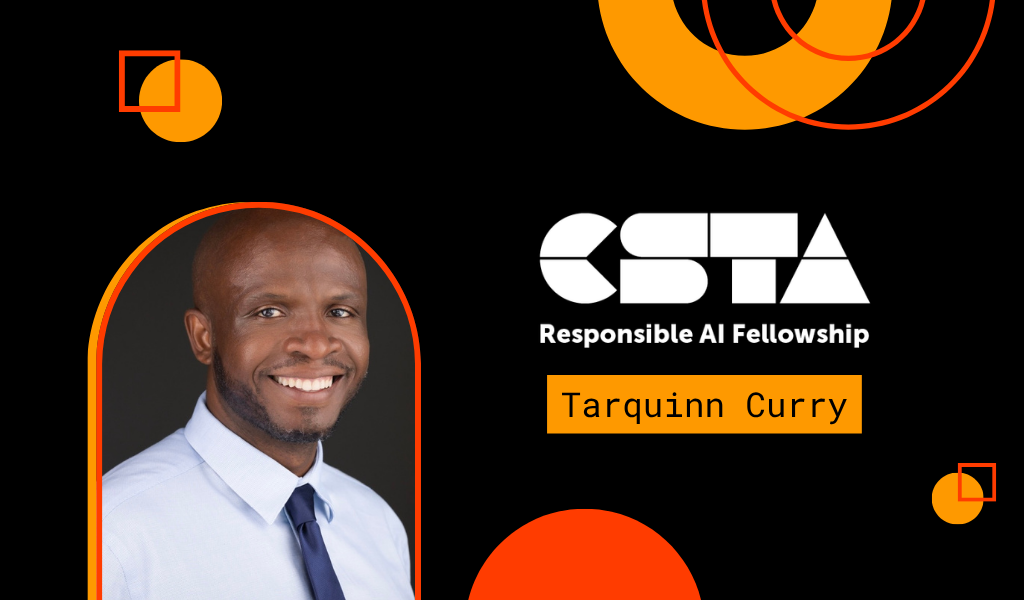
Tarquinn Curry is a veteran educator with 22 years of teaching experience in Long Beach Unified School District. He currently teaches film, robotics, and coding at Jefferson Leadership Academies and leads AI courses for BOSS, a nonprofit that empowers students of color through mentorship and technology. Tarquinn serves on AI task forces for both the state of California and the LBUSD, helping to shape equitable approaches to computer science and artificial intelligence in K–12 education. In 2025, he was recognized as an ASU+GSV AI Innovator for his leadership at the intersection of equity, technology, and learning. He holds a master’s degree in education and a preliminary administrative credential. Tarquinn also founded Silvereye Films LLC and Quinnsight, which blend media, education, and AI consulting to expand opportunities for students, families, and communities.
In a seventh- and eighth-grade robotics class last year, Tarquinn ran a week-long design sprint that used Teachable Machine to turn webcams into gesture detectors for student-built robots. He put his students in teams to capture 200+ images for three simple gestures, train models, and connect predictions to their VEX Brains. Then students tested their models on their classmates, logging mistakes on shared spreadsheets. They quickly noticed that most mistakes involved students with darker skin tones or in lower-light settings, so they added samples of each to their dataset, which made their accuracy skyrocket.
By the end of the week, student confidence and subject area understanding had soared. Their grasp of training data and bias sources felt powerful to them, because they got to see it in action and take steps to correct it. Tarquinn says, “Two previously hesitant girls became so energized they joined next year’s competition team: proof that accessible, equity-centered AI projects widen the talent pipeline.”
This experience reinforced Tarquin’s belief that the best AI lessons allow students to collaborate on solving real-world problems, a model that allows them to see themselves as AI creators and critics. As he teaches AI to his own students, he’s constantly mindful of how he can communicate lessons learned beyond his single classroom. The lesson that worked so well for his students is all the more valuable because of how easy it is to implement, running on free web tools and the webcams present in most Chromebooks. Though his students worked with robots, the same data could be used to train an on-screen character in Scratch instead, for classrooms with budget constraints.
Tarquinn seeks out ways to be an advocate for responsible, ethical AI education and policy by providing research-backed insights to help districts make informed decisions about AI use in their schools. As an ASU +GSV 2025 AI Innovator, he shared classroom results with AI tools and developed a presentation for CSTA 2025 that led teachers through Teachable Machine activities to spark AI learning with minimal equipment. He maintains an active website and YouTube channel of AI resources, including prompt libraries, demonstration videos, and troubleshooting resources. To further support his students, he mentors students of color in middle and high school through his nonprofit, BOSS, with biweekly AI courses and summer intensives.
But scaling AI education will require more than the efforts of individual teachers. Tarquinn serves on his school district’s AI task force, where he helps to develop guidelines and professional development opportunities to support schools and teachers as AI becomes a more central part of the educational experience. He was also appointed to California’s SB 1288 Statewide AI Workgroup, where his classroom and advocacy experiences can shape the growth of equitable, responsible AI education across the entire state.
Through the Responsible AI Fellowship, Tarquinn hopes to develop his skills as an advocate and leader on the district, state, and national levels. “The fellowship’s mentoring and national connections will help me move beyond being someone who runs individual training sessions to become a strategic advocate for change,” he says. He’s thrilled to have the opportunity to build curriculum in collaboration with teachers who come from very different educational contexts. Their experiences and shared wisdom will deepen his knowledge of AI tools, as they work together to develop flexible, scalable AI lessons that teachers of any experience level can implement in any school setting.
“The fellowship’s shared knowledge, ongoing feedback, and national platform are exactly what I need to transform my ideas from classroom experiments into lasting, widespread change,” says Tarquinn. He’s proud to be a Responsible AI Fellow, and excited to see where the fellowship takes him.