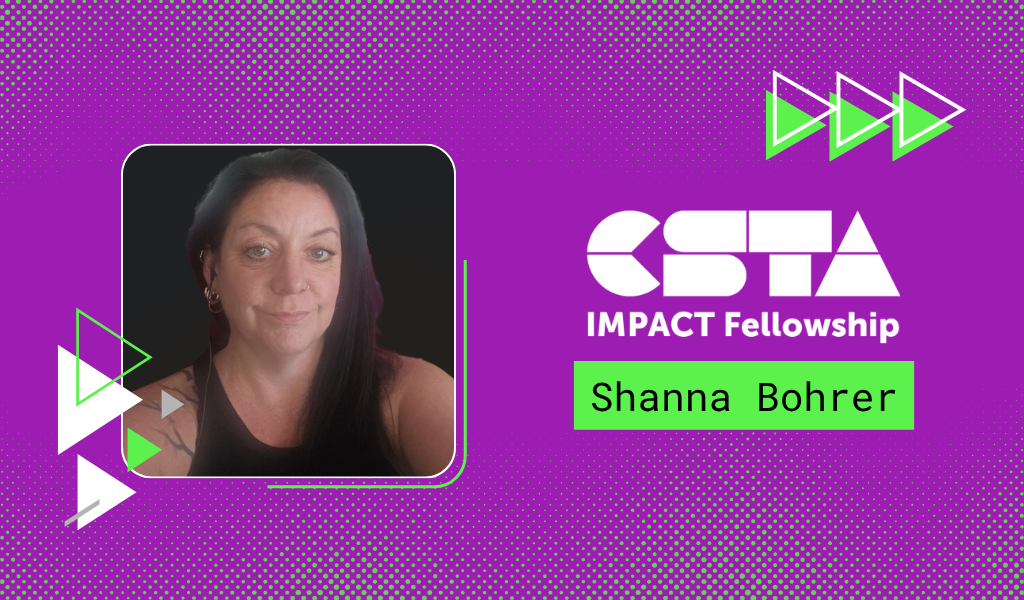
Shanna Bohrer is a CTE teacher at Alabama Virtual Academy in Eufaula, AL. Shanna began teaching science 15 years ago, then shifted into computer science after a decade in the classroom. That move led her to CSTA, where she first began to learn about equity in the education. As chapter president and now treasurer of CSTA Alabama, Shanna has worked hard to bring these ideas home. She introduced an equity-focused Coursera course to the Alabama chapter, recruited and coached an all-girls VEX Robotics team, and continues to advocate for students who have historically been overlooked. In 2024, Shanna’s realization that she has autism further deepened her commitment to equitable CS education, and especially to supporting neurodivergent students and girls who, like her, might otherwise go unseen or misunderstood.
Currently, Shanna serves on the CSTA Conference Committee and enjoys connecting with educators nationwide to build stronger, more inclusive communities. Outside of work, she’s married with two children, Trinity and Anaken, and she loves her black cat, Nox, who frequently joins Zoom calls.
As a gifted child whose autism wasn’t diagnosed until adulthood, Shanna is keenly aware of the challenges faced by her diverse group of students, particularly the neurodivergent students. “I build the kind of classroom I wish I’d had,” she says, “one that values difference, supports risk-taking, and sees every student as capable of brilliance on their own terms.” She’s intentional about her use of language, avoiding jargon until it’s been explicitly taught to the students, and she makes failure and iteration a part of the learning and grading process.
Recognizing the importance of finding different ways to connect with different students, Shanna builds relationships with other neurodivergent educators to share strategies for how to support neurodivergent kids in her classroom. “These are not the students traditional CS programs are built for, and that’s exactly why they’re the ones who need it most,” says Shanna.
Through CSTA, Shanna also helped put on the Super Southern Unconference, a free virtual event amplifying the voices of Southern educators. This event fostered discussions on culturally responsive computing, algorithmic bias, and community-driven projects, and Shanna brought everything she learned at the Unconference back to her own classroom and school district.
Shanna refuses, in her words, “to treat CS like it’s just about syntax and output. To me, it’s about power; who holds it, who’s left out, and how we can shift that balance.” While working in an affluent white district, she showed the documentary Coded Bias, launching deep conversations about identity, surveillance, and systemic injustice, and helping her students see the connections between these topics and computer science. At her current school, where over 75% of students qualify for free or reduced lunch, she offers project-based lessons and trauma-informed teaching, encouraging students to work on projects with real relevance to their lives, like designing apps to help teens with anxiety, or auditing facial recognition datasets for bias.
“Not every student connects to computer science through code alone,” says Shanna—and her classroom reflects that. While she does evaluate her students for technical proficiency, she also tracks and rewards the myriad other ways they grow as computer scientists and as humans. She encourages her students to be advocates for themselves and each other, and nothing makes her as proud as seeing them collaborate to debug difficult problems rather than giving up. One student started the semester insisting that she wasn’t good at computer science. By semester’s end, she was building a website for Future Business Leaders of America and competing in the University of Alabama’s annual cybersecurity competition. “That’s impact,” Shanna says.
Shanna hopes to spend her IMPACT Fellowship year learning new ways to center the students who have historically been overlooked in CS, especially students who are neurodivergent, living in rural areas, and economically marginalized. She wants to work with her cohort to find community-centered, large-scale solutions to the problems of access in computer science. “I’ve done a lot of work on the ground to expand access in virtual and rural settings,” says Shanna, “and now I’m ready to learn how to scale that work beyond my own classroom and school.”
Her dream project for the fellowship year is a peer-led “CS from the Margins” professional learning series, which would create and share modules focused on helping CS teachers reach marginalized student populations. She’d also love to find ways to help students share their voices and experiences with the national CS community, via videos, podcasts, and blogs. Regardless of what projects she undertakes as an IMPACT Fellow, Shanna says, “This fellowship represents an opportunity to think bigger, act bolder, and help shape a future where CS belongs to everyone.”