
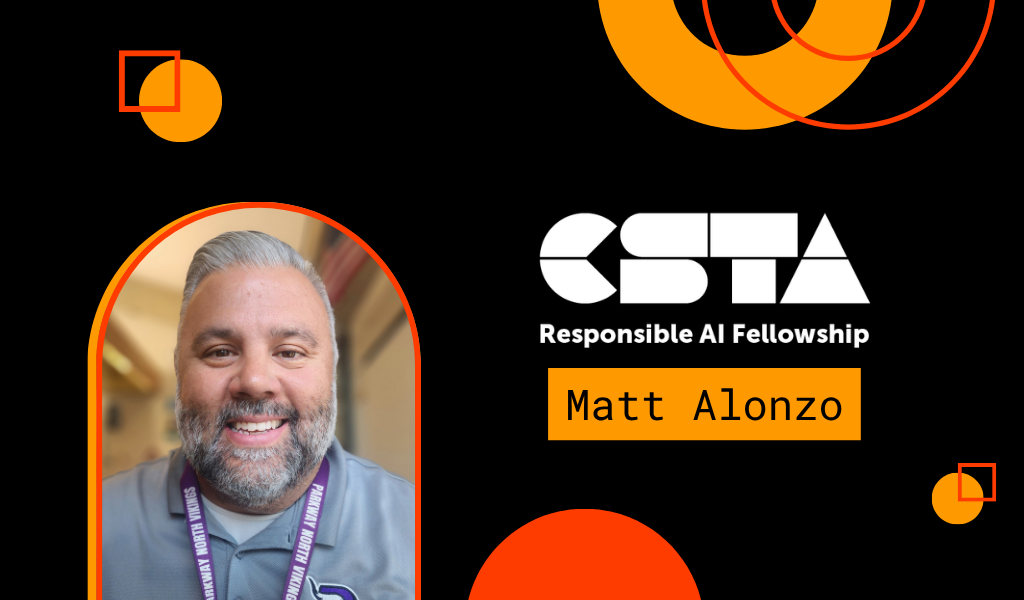
Matt Alonzo is a veteran mathematics teacher and has been teaching computer science at Parkway North High School in St. Louis, MO since 2010. During his time as a CSTA IMPACT Fellow, Matt gained a deeper understanding of the potential harms AI can pose to students, particularly those from underrepresented backgrounds. This experience drives his excitement for the CSTA Responsible AI Fellowship, where he hopes to shape how AI is used in education. Matt serves as equity chair of CSTA Missouri, received the 2023 CS Teaching Excellence Award from CSTA/Infosys, and was named Parkway North’s 2022–23 Teacher of the Year. Matt has also served on his local school board since 2017, where he currently serves as president.
Matt firmly believes that before teachers can help their students become ethical users of AI, they must first have a thorough understanding of AI tools themselves—which in turn requires robust training and ongoing support. As a CSTA IMPACT Fellow, Matt designed and presented a session for the national CSTA conference in which attendees learned about AI safety and privacy, shared practical strategies to integrate AI tools in the classroom, and maintained ongoing dialogue about ethics and equity in AI education.
As school board president, Matt has had the unique opportunity to implement AI learning responsibly throughout his district. He guides policymaking on AI use by staff and students, always emphasizing the importance of privacy protections, equitable access, and project-based learning models. Armed with these policies and supports, teachers can feel confident that they’re shaping their students into ethical AI users, while preparing them for an AI-powered future.
In his own introductory CS course, Matt created a project where students used Python to train image recognition models and connect them to Finch or Hummingbird robots. Robots could “see” through a webcam or recorded images, and they had to interpret and make decisions on that basis. Recognizing that students in the class were starting from different places, he intentionally scaffolded the lesson to allow beginners to focus on training models and decision logic, while more advanced students explored model customization and algorithm tuning.
By all measures, the project was a tremendous success. Students got a hands-on glimpse at the potential—and potential pitfalls—of AI tools and learning models. No matter their prior experience in CS, every student produced a working AI program, and nearly everyone exceeded the assigned requirements for the project. They gained a working knowledge of how bias and training data affects AI outputs, and their technical skills advanced, too. Matt says that his students left the lesson “with a deeper understanding of how AI learns, where bias emerges, and how these tools can address real-world challenges.”
Matt has developed a three-tiered model for implementation of AI strategies: teacher empowerment, scalable curriculum design, and systemic support. Through CSTA and his work as school board president, he aims to impact all three. He led professional developments in collaboration with his math colleagues to develop project-based activities that connect AI to the math curriculum. This peer-led work reminded Matt of the crucial role CSTA can play in developing AI-integrated education, as impact is multiplied through the shared work of teacher networks and professional learning communities. “Sharing curriculum resources, lesson plans, and project examples amplifies impact, enabling more students nationwide to experience hands-on, ethical AI learning,” he says.
Matt says, “I hope this fellowship will equip me to be a stronger advocate and mentor, helping more educators prepare students to be thoughtful, creative, and responsible AI practitioners.” In collaboration with his cohort, he’d love to develop professional AI learning, including lesson plans and project examples, for teachers at every grade level. Building on his collaborative work with math teachers in his district, he’d also like to build a collection of interdisciplinary AI projects that would apply to different subject areas, thereby promoting teacher confidence in AI while fostering interdepartmental collaboration.
“I am motivated to embrace AI in education because it is reshaping the world students will enter,” says Matt. “I’m excited to help educators lead this transformation.”