
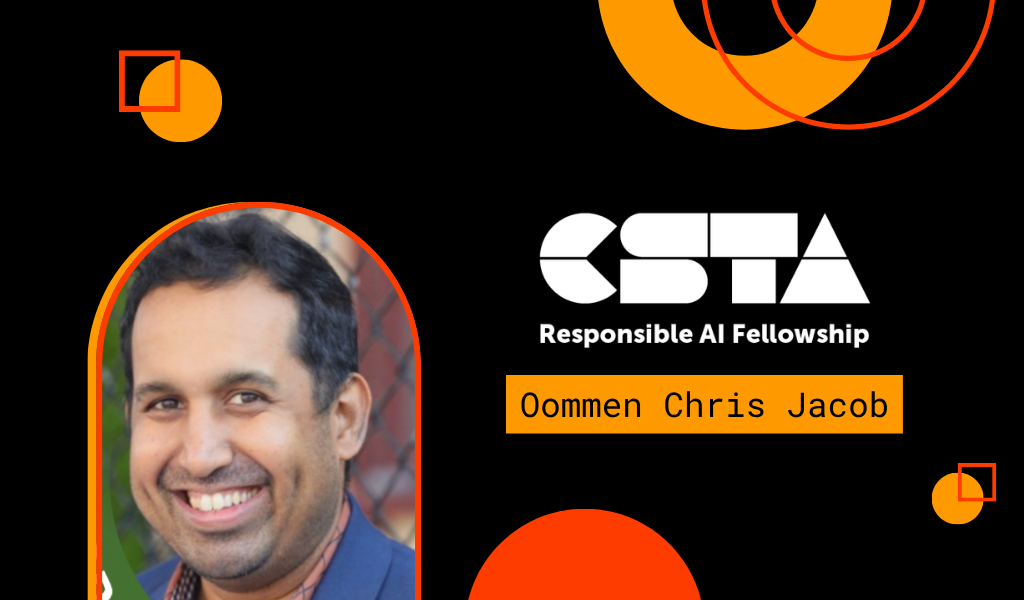
Oommen Chris Jacob is an accomplished leader, educator, and instructional technologist with over 17 years of experience in the New York City Department of Education. He currently serves as technology coordinator, computer science department head, and Future Ready NYC Coordinator at Pathways College Preparatory School, where he established and leads the CS department. Chris teaches multiple college-level courses, mentors teachers, and drives initiatives to prepare students for careers in computer science, data science, and emerging fields. He is pursuing a Doctorate in Leadership with a focus on Educational Technology at the American College of Education. His research examines K–12 educators’ lived experiences with the integration of artificial intelligence in instructional practices, with particular attention to teacher self-efficacy in public school settings in the Northeastern United States.
Chris sees three elements as crucial for CS educators to embed AI learning into their classrooms: equity, real-world applicability, and systems thinking. By focusing on these core factors, educators across a range of educational contexts can find a path forward in AI education that suits their students, schools, and districts.
What does this look like in practice? Lessons and curricula should be designed with Black, Latino, disabled, multilingual, and otherwise marginalized students in mind, with scaffolded support for learners at different levels and an emphasis on free or open-source tools. Teachers should take care to anchor their lessons to real-world issues, ideally ones that the students can see in their own communities, to give a strong sense of how tech applies to their lives. Finally, to ensure sustainability, CS educators should cultivate communities of learning, seek out professional development opportunities, and advocate for equitable, thoughtful policies around AI learning.
When teaching cloud computing and cybersecurity through Ed Equity Lab, Chris witnessed firsthand how the right supports can allow students from underserved backgrounds to see themselves in tech and take on college-level work. He aims to provide similar scaffolds to teach responsible AI engagement. Through his school’s Future Ready NYC program, Chris designed and taught a Data Science and AI course that balances technical skill-building with broader discussions of privacy, bias, and AI equity.
In this course, students use free, web-based tools such as Google Colab and Teachable Machine, and their work draws on real-world datasets that address issues relevant to them, such as housing inequality and climate change. More than 60 students participated, achieving a near-perfect pass rate, and the class helped several of its students to secure competitive internships at tech companies like Microsoft and Google. Chris designed the course to work for schools with varying levels of access to tech and teachers’ coding knowledge. He says, “This content is modular and generalizable for either middle or high school, blended with any core content areas or as collected elective pathways.”
Recognizing the potential for his work to reach far beyond the classroom, Chris always seeks ways to share his AI insights with other educators. He runs professional development sessions to help teachers in other content areas incorporate AI in their own classrooms. He’s an active member of CSTA and the CS4All NYC community, where he supports teacher collaboration via professional development, instructional coaching, and communities of practice. The same systems mindset informs his work with Future Ready NYC to establish a mentorship pipeline to connect underserved students with AI and cybersecurity professionals. Through this model, tech professionals have the opportunity to give back to their community, while students receive crucial support to advance into tech careers.
As a Responsible AI Fellow, Chris is excited to learn from the diverse community of educators in his cohort, and especially to see how they’re applying AI research to their teaching practice. “I am excited to develop further my understanding of tools, pedagogies, and ethical perspectives that foster equitable and inclusive teaching practices,” he says. He’d love to establish a toolkit of AI lessons that align with CSTA standards and his core principles of equity, real-world application, and systems thinking. He’d also like to find ways to advance collaboration among AI teachers and to develop the student mentorship pipeline model he’s established at his school.
“As an educator and doctoral researcher, I believe AI will transform learning over the next five years,” says Chris. “We must prepare students not just to use AI, but to question, improve, and shape it responsibly. This fellowship offers the chance to lead that effort at scale.”