
The Brookings Report
In January 2025, the Brookings Institution released “The Disengagement Gap” (Winthrop et al.), a study in K-12 education that reveals a disparity between parental perceptions of school quality and the actual learning experiences reported by students. While parents often rely on traditional indicators like grades and attendance, they are frequently in the dark about their children’s true levels of engagement, largely because schools fail to provide in-depth information regarding the quality of the learning environment.
Figure 1 The Perceptual Disengagement Gap and the High School Age Cliff
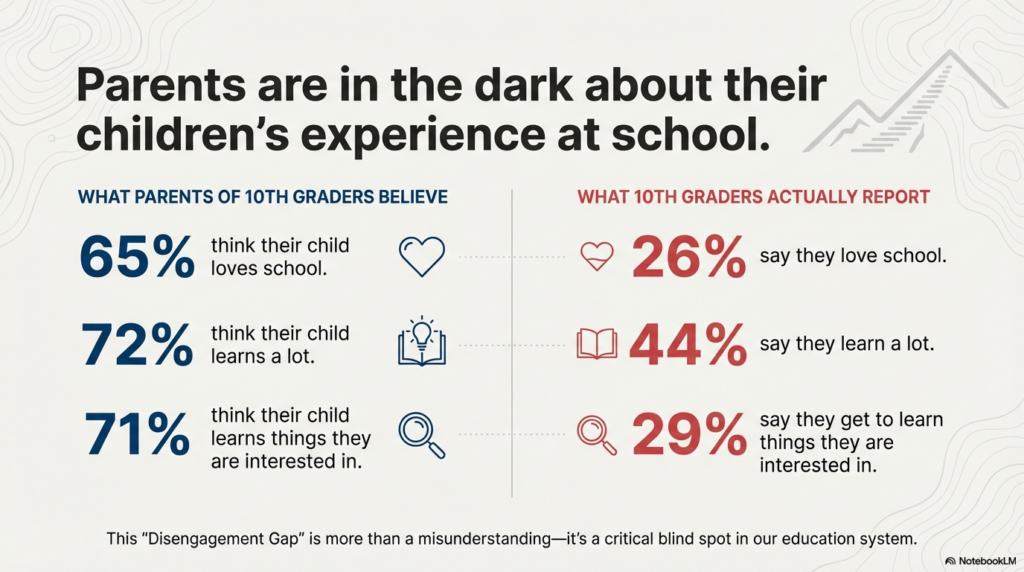
For instance, while 65 percent of parents of 10th graders believe their child loves school, only 26 percent of students agree with this perception. Furthermore, only 29 percent of 10th graders report that they get to learn things they are interested in and find high school largely irrelevant in preparing them for the future.
This disparity is most acute in high school according to the study, where 43 percent of students report being in “passenger mode”—coasting through classes and doing the bare minimum—while less than seven percent reach “explorer mode,” the pinnacle of engagement characterized by relevance, proactivity and deep meaning. As a whole, the data reveals that as students progress from the early grades to high school, they lose interest in school thereby creating an “age cliff” (Winthrop et al., 2025) where learning drops off.
The “Four Modes of Engagement,” coined by journalist Jenny Anderson and education expert Rebecca Winthrop in their book, The Disengaged Teen, represent a language model needed in education to convey what students actually do, think, and feel about their learning experiences in K-12 classrooms. Overall, the study revealed that as student agency increases, so does engagement.
Figure 2 Mapping the Four Modes of Engagement to Computer Science Student Profiles
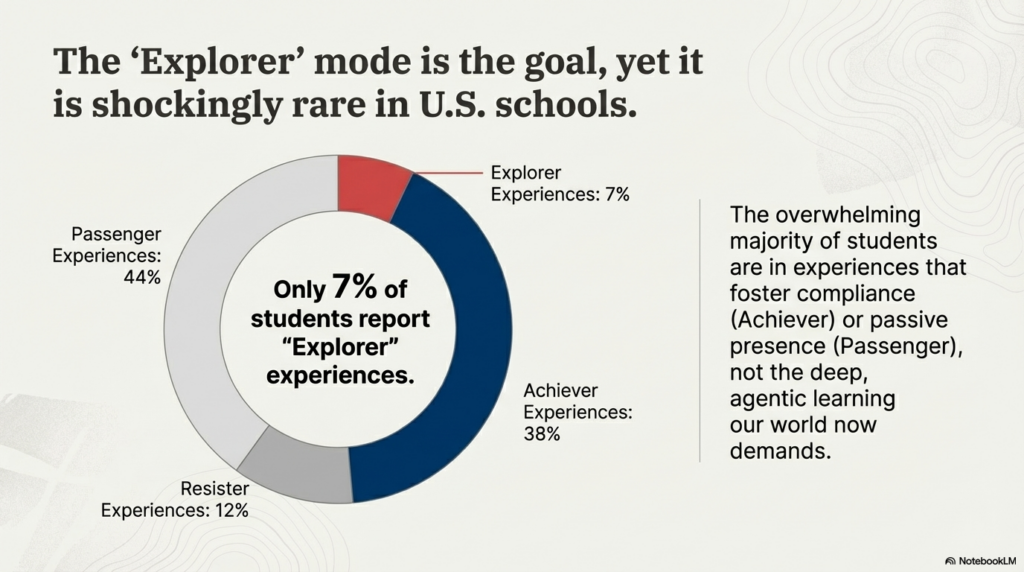
Their findings reveal the following percentages as reported by students across the K-12 grade bands applied to the Four Modes of Engagement:
- Passenger Mode: 43–44%. These students are characterized as “coasting in low gear, showing up, doing the bare minimum” (Winthrop et al., 2025) and showing little interest in what is taught.
- Achiever Mode: 38%. These students are highly motivated by marks and energy, yet they are often risk-averse and focused more on the destination (grades) than the learning journey.
- Resister Mode: 12%. Students in this mode avoid or disrupt learning, often as a way to signal that school is not working for them.
- Explorer Mode: 7%. This is the pinnacle of engagement, where students are deeply involved, resilient, and take initiative to make their learning relevant.
Alongside engagement, agency is one of the two primary dimensions used to categorize student behavior into the Four Modes of Engagement. With only seven percent of students reaching the ultimate goal of engagement, Explorer Mode, it can be said that the “Disengagement Gap” has revealed a critical blind spot in our education system.
CS as a Platform for Agentic Engagement
For computer science education, these findings suggest a vital need to move beyond rote instruction where students use thinking skills rather than just memorizing information. Because computer science is foundational for navigating an evolving AI world, the subject provides a unique platform to bridge this gap by fostering student agency and engagement, allowing students to take initiative, develop original ideas, and connect their learning to life outside the classroom.
We need to go beyond the CS core curriculum in teaching students how to code and include opportunities for them to become explorers as they engage in their own learning. The data implies that subjects must be taught through interest-driven, project-based models to prevent them from becoming another joyless experience for disengaged adolescents.
To move students into Explorer Mode and combat the age cliff, CS curriculum should transition from passive participation to “agentic engagement” (Reeve, 2013), where students take the initiative to bend what they are learning to fit their personal interests. This suggests that CS education must undergo key shifts to move students from being passive Passengers or grade-obsessed Achievers into Explorers.
From Achievers to Explorers: The Power of Un-Tutorials and Coding Portfolios
Student agency is the empowerment of learners to move from being passive consumers of information to active, self-directed creators who have control over their own learning paths. It is characterized by a shift in responsibility where students, rather than just following instructions, make critical decisions about their projects and problem-solving processes.
Un-tutorials and student portfolios serve as a critical bridge for transitioning students from the Achiever mindset—where they are often fragile and strictly focused on grades—to the Explorer mode, characterized by high agency and a genuine joy in the learning journey. Un-tutorials can facilitate this shift through a few key mechanisms that transfer the responsibility of learning back onto the student.
In addition to teacher-led coding examples like building a calculator, an un-tutorial provides a broad objective, such as “build a tool that automates a decision.” This forces students to move beyond rote memorization and the simple task of following instructions towards solving open-ended problems with coding.
Figure 3 Instructional Design Pathways for Fostering Agentic Engagement in Programming
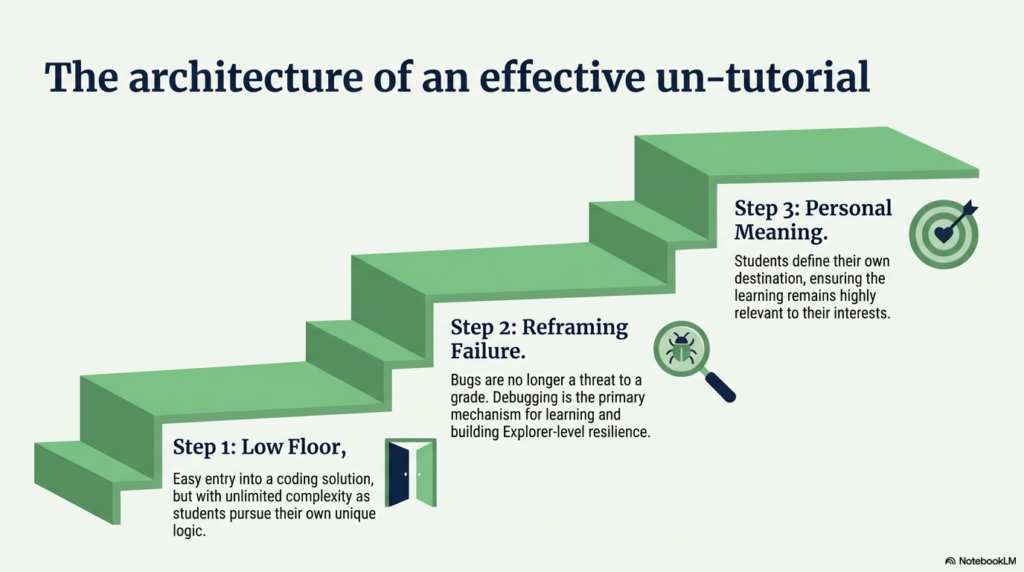
Step 1: Utilizing “Low Floor, High Ceiling” Resources
Un-tutorials provide resources that allow students to enter a coding solution easily but offer unlimited complexity as they pursue their own unique logic. This autonomy is what moves a student from being a passive Passenger or a grade-focused Achiever into a self-directed Explorer. We stop feeding syntax to students exactly when they need it. Instead, we provide a Technical Menu—a one-page reference sheet containing coding bricks for specific coding concepts like conditionals or loops. The technical menu should provide enough bricks for students to build out the system they are trying to solve in their design.
Step 2: Reframe Failure as a Learning Tool
In a traditional Achiever environment, a bug in student-developed code might be seen as a failure that threatens a grade. Students can take ownership of their learning by persevering through complex debugging processes independently or in peer groups, rather than relying on immediate teacher intervention. In an un-tutorial framework, debugging is treated as the primary mechanism for learning, which builds Explorer-level resilience and shifts the student’s focus from the final output to the process of discovery.
Step 3: Encouraging Personal Meaning
By allowing students to define the destination of their project, un-tutorials make the learning personally meaningful. This helps combat the age cliff of disengagement where many students feel they aren’t learning things they are actually interested in.
Un-tutorials align with agency-based grading, where success is defined by the student’s own metrics rather than just a high-stakes exam. This prevents computer science from becoming a rote learning experience and allows students to showcase their evolution through their coding portfolios in addition to syntax memorization found within the core curriculum.
Avoiding Academic Gatekeeping via Student Agency
Achievers are often thought of as fragile because they focus strictly on grades. The Disengagement Gap research warns against limiting enrichment opportunities based on academic performance, noting that taking away these activities can fuel further disengagement for struggling students. To foster true engagement, grading must reward the process and the exercise of agency.
Figure 4 Assessment Paradigm Shift: Traditional Standardized Exams Versus Authentic Code Portfolios
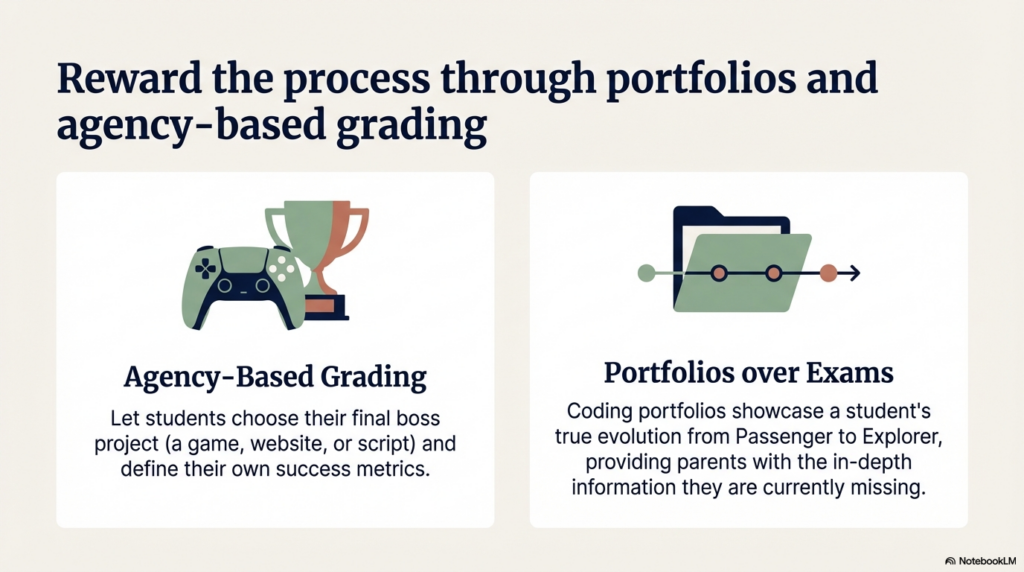
Agency-Based Grading
Allow students to choose their final boss project. If a student wants to build a game, a website, or a data script, let them define their own success metrics. This prevents CS from becoming a learning without joy experience.
Portfolios Over Exams
Lower the impact of high-stakes testing—which often favors Achievers who memorize syntax—with portfolios that showcase a student’s evolution from Passenger to Explorer. This provides teachers with in-depth information parents are currently missing regarding the quality of the learning environment.
Conclusion
Teaching computer science in the current high school climate is like handing a teenager a set of car keys when they have spent years as a bored passenger. The data suggests that if you only let them sit in the driveway and memorize the owner’s manual (Passenger/Achiever mode), they will stay disengaged; however, if you let them take the wheel and choose the destination (Explorer mode), they finally discover the power of the engine they are operating.
About the Author

Anthony Barba is a 26-year teaching veteran and in his 6th year of teaching computer science at East Valley High in Yakima, Washington. He grew up in Whittier, California and his interest in computer science began at age 11, when he learned to code by copying programs from his father’s SoftSide magazine subscription on an Apple II+ machine. After earning his B.A. and M.Ed. in mathematics at the University of California, Santa Cruz, he moved to Walla Walla, Washington to begin his teaching career. He was one of the original teachers at Lincoln Alternative High School whose focus on ACEs research and trauma was featured in the documentary film, Paper Tigers. Barba started the computer science program at East Valley High School in 2019 which includes an after-school Esports program. He serves on the CSTA Washington chapter and is a council member for the Washington State Scholastic Esports Association.
Works Cited
Winthrop, R., Shoukry, Y., & Nitkin, D. (2025, January). The disengagement gap: Why student engagement isn’t what parents expect. Center for Universal Education at Brookings; Transcend. https://www.brookings.edu/articles/the-disengagement-gap/
Reeve, J. (2013). How students create motivationally supportive learning environments for themselves: The concept of agentic engagement. Journal of Educational Psychology, 105(3), 579–595. https://doi.org/10.1037/a0032690