
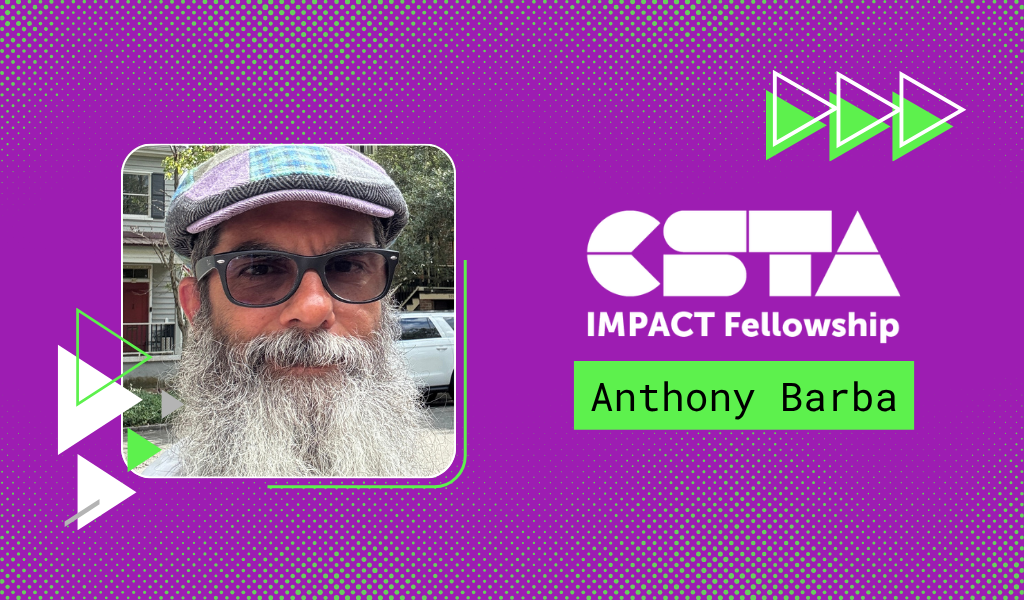
Anthony Barba’s interest in computer science began when he learned to code at age eleven, copying programs from his father’s SoftSide magazine on an Apple II+ machine. A veteran teacher with 26 years of experience, Anthony teaches at East Valley High School in Yakima, WA, and received his BA and M.Ed. in math at University of California, Santa Cruz. He was one of the original teachers at Lincoln Alternative High School, whose focus on ACEs research and trauma was featured in the documentary film Paper Tigers. In 2019, Anthony started East Valley High’s computer science program and afterschool esports program. He is involved with CSTA Washington and serves as a council member for the Washington State Scholastic Esports Association.
Adaptability has been the hallmark of Anthony’s career as an educator. After teaching math for 17 years, Anthony says, “I jumped at the chance to become our school’s computer science teacher,” when computer science classes became mandatory for Washington high school students. Thanks to Anthony’s efforts, computer science offerings at East Valley High have expanded from a single class to a robust program that includes AP and IB course offerings and a thriving afterschool esports program.
Building the program was no easy feat. Anthony raised $400,000 to support the creation of one of the state’s top computer and esports labs, and he considers the lab itself to be one of his best recruitment tools for CS students. “The classroom attracts a lot of attention,” he says. “Hard to ignore the lighting and décor.” Early on, mostly male students signed up for his CS courses, but Anthony’s sustained efforts—and the wow factor of his classroom—have begun to bear fruit, with an average of 25% female students in his classes. When his esports program needed volunteers to run, Anthony developed partnerships with local colleges and the US military that would allow volunteers to receive internship credit for teaching Anthony’s students after school.
Because his classes include a large population of special education students, Anthony’s deeply aware of the importance of shaping his lessons to be accessible to students at every experience and ability level. With the help of the learning platform JuiceMind, he creates interactive course materials to guide his students, and he encourages them to develop their own problem-solving and digital literacy skills to address challenges they may face in their work. By implementing a project-based curriculum, Anthony helps students develop soft skills like collaboration and communication, which in turn strengthens their technical knowledge as they learn from each other. “Seeing my students graduate from high school and have the confidence to pursue their CS careers has been a reward,” Anthony says.
Anthony puts a premium on career readiness and real-world applicability in his CS program. All of his courses are dual-credit, and students can elect to pursue industry certification in Unity and Java; Anthony’s currently working to add a third certification to his repertoire, this time in AI. He takes care to incorporate industry-standard tools like Unity, Netbeans, and VS Code, as well as project management tools used in CS industry settings, to ensure that students are as prepared as they can be to pursue jobs in the tech field.
Anthony’s afterschool esports program helps students make even more connections between CS learning and the real world. He holds district-wide Fortnite events for parents, staff, and students in his school district—which, for many students, is their first point of contact with Anthony’s work. From there, he can introduce them to CS career pathways like game design and programming, connecting those industry options to the students’ existing love of video games. Through the esports program, students get to learn 3D design, pursue programming certifications, and compete in esports at the state and national levels.
As a CSTA IMPACT Fellow, Anthony is eager to bring lessons from CS programs all around the country back to his own community—and vice versa. His CSTA chapter is in a period of transition, and he’d like to find ways to support his growing chapter, develop recruitment strategies, and assist Washington schools and teachers meet the still-new CS requirements for high schools. Anthony currently supports more than twenty school districts to implement esports programs like his, and he hopes, as part of his IMPACT Fellowship, to find avenues to provide similar support for computer science teachers across the country.
Anthony is excited to leverage his own experiences to help other school districts design student-centered programming, mirroring the successful initiatives he has implemented within his own community. His goal is to move beyond passive instruction and toward a model where students take the lead in their own growth.
“We really need to meet students where they are,” Anthony says. “By giving them the agency to own their learning, we aren’t just fixing engagement—we’re preparing them to be self-driven leaders in their own lives.”