


About the Standards
Defining Computer Science
Computer science is the study and human-centered practice of using data, algorithms, and computing systems to solve problems, make discoveries, and express ideas.
Computer science integrates scientific reasoning with creative expression. It helps people understand and shape a world powered by computing. As a discipline, computer science brings together algorithms, data, systems, and design to help people ask questions, explore patterns, model complex ideas, and build solutions that matter in their communities. It is both a scientific and a creative discipline: a field grounded in computational thinking and driven by human curiosity, imagination, and purpose.
Computer science continues to evolve as new technologies, applications, and societal challenges emerge. Foundational ideas such as algorithms, programming, and systems remain central while also enabling rapidly growing areas of computing such as artificial intelligence, data science, cybersecurity, and physical computing. These developments increasingly raise questions about how computing shapes society, including issues of ethics, equity, and sustainability.
Computer Science Is:
- a scientific and creative discipline focused on understanding and designing algorithms, data, and computing systems.
- the application of computational thinking to develop both rules-based and data-driven solutions across a variety of disciplines and contexts.
- a collaborative discipline in which learners plan, communicate, test, and refine ideas to design solutions that serve diverse people and communities.
- an ethical, responsible, and human-centered practice, in which it is critical to examine impacts, identify potential harms and benefits, and design responsibly.
Computer Science Is Not:
- using technology tools like word processors, slide decks, or generative AI tools. These appear in CS and in every other subject too.
- limited to coding or programming. Programming is an essential part of CS, but CS is far broader.
- tied to one career path. CS has applications across every field and industry.
- being replaced by AI. CS is what powers AI.
The CSTA PK–12 Computer Science Standards make this vision concrete by organizing learning around core concepts supported by crosscutting practices. Together, these elements emphasize that computer science is not only about understanding how technologies work but also about how people design, build, evaluate, and use computing technologies to solve problems, make discoveries, and express ideas across a variety of disciplines and contexts.
When these concepts and practices are intentionally integrated, high-quality CS instruction fosters dispositions (habits of mind) that support lifelong learning and creative work with computing. Through these experiences, students come to see computer science not only as a powerful medium for expression and innovation, but also as a shared responsibility for shaping communities. In a world powered by computing, CS education empowers students to become critical consumers, responsible creators, and informed participants in society.
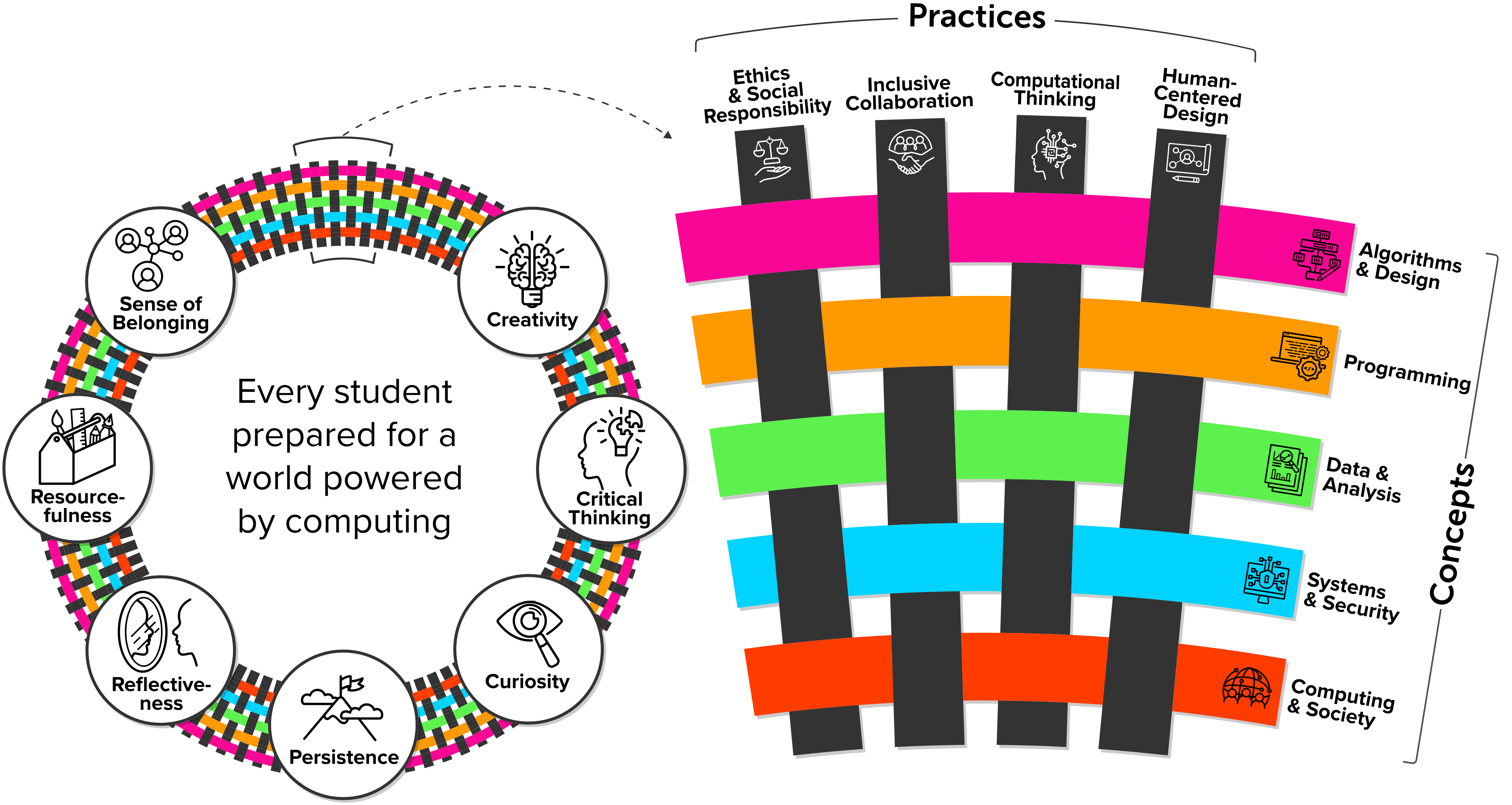
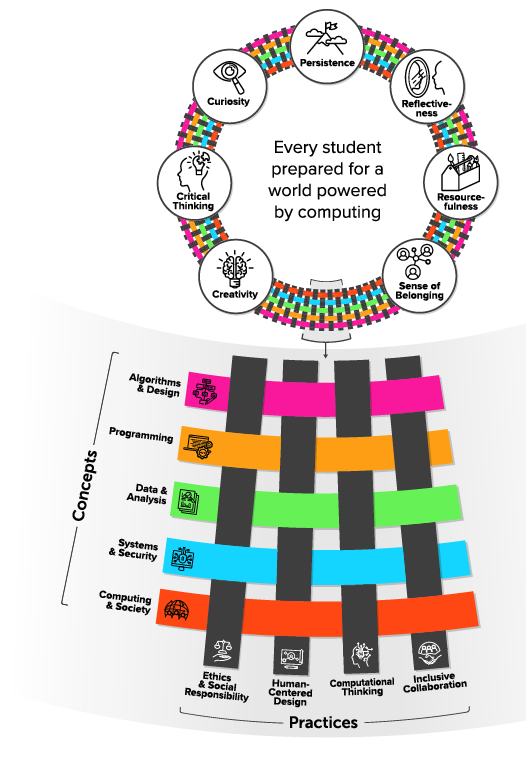
Concepts
Concepts define the core content areas of computer science and serve as the primary organizational structure of the Standards. Together, they represent the foundational knowledge students develop as they progress across grade levels.
Algorithms & Design
Algorithms & Design focuses on how problems can be represented and solved through precise, step-by-step processes. Students design, analyze, and refine algorithms that transform inputs into desired outputs using both rule-based approaches and data-driven approaches informed by patterns in data. They consider the efficiency, correctness, and limitations of algorithms, as well as how design choices influence outcomes, developing the ability to create and evaluate computing technologies in real-world contexts.
Subconcepts:- Algorithmic Problem Solving
- Machine Learning
- Impacts of Algorithms & Design
Programming
Programming controls all computing systems, empowering people to communicate with the world in new ways and solve compelling problems. Developing meaningful and efficient programs involves selecting and organizing information, breaking problems into manageable parts, recombining existing solutions, and evaluating alternative approaches.
Subconcepts:- Program Development
- Variables & Data Storage
- Reading & Documenting
- Testing & Refining
Data & Analysis
Data & Analysis focuses on how data is collected, represented, analyzed, and used to understand the world and make decisions. Computing systems enable people to gather, store, and process large amounts of data, but meaningful use of data depends on the questions people ask, the ways data is organized and visualized, and how results are interpreted. As the amount of digital data generated continues to grow rapidly, the ability to work effectively with data becomes increasingly important. Across grade levels, students learn to pose questions, work with different types of data, and use computational tools to analyze and represent information. They identify patterns, draw conclusions, and examine how data is used in real-world contexts, including issues of accuracy, bias, privacy, and impact.
Subconcepts:- Data Collection & Preparation
- Data Investigation
- Impacts of Data Science
Systems & Security
Systems & Security includes the broad categories of hardware and software, networks, and cybersecurity. The physical components (hardware) and instructions (software) that make up a computing system communicate and process information in digital form. Networks connect computing devices to share information and resources. Greater connectivity in the computing world has also led to an increased need for security to protect the information being transmitted.
Subconcepts:- Hardware & Software
- Security
- Networks
- Impacts of Computing Systems
Computing & Society
Computing shapes and is shaped by individuals, communities, and cultures from around the world. Computing transforms daily life, economies, governments, and global systems in ways that offer both great promise and significant challenges. The impacts of computing are complex, encompassing advances that improve lives alongside harms that deepen inequities and raise ethical concerns. Students learn to critically and responsibly navigate these social implications, considering issues of equity, access, and accountability, while also exploring computing's potential to promote social good. By examining the evolving relationship among computing, culture, and society, students are empowered to contribute thoughtfully and responsibly to a digital future.
Subconcepts:- History of Computing
- Emerging Technologies
- Humans & Computing
- Career Exploration
Practices
Practices describe the skills, behaviors, and ways of thinking that students with a strong foundation in computer science use to fully engage in a world powered by computing. Organized into four categories, practices reflect target outcomes for students by the end of high school and, as such, are recurring across grade levels and are developed through repeated exposure. Each standard is intended to reflect content from a given concept, as well as one or more practices.
Inclusive Collaboration (IC)
Inclusive Collaboration practices help students develop productive collaborations with diverse groups of people. These practices address communication skills, project management skills, and personal conduct when working with others. They were synthesized from the Standards for Technological and Engineering Literacy (ITEEA, 2020), the Social Justice Standards (Learning for Justice, n.d.), the Framework for 21st Century Learning (Partnership for 21st Century Skills, 2009), and the K–12 CS Framework (2016).
-
3. Communicate effectively about computing.
- Share technical ideas and explain computing concepts clearly to different audiences.
- Give and actively listen to others' input and constructive feedback. Consider diverse perspectives and multiple solutions to technical challenges.
-
4. Manage computing projects.
- Establish shared goals, break the work into discrete tasks, and set development milestones.
- Document code and development processes.
-
5. Act responsibly in computing collaborations.
- Cultivate working relationships with individuals possessing diverse perspectives, skills, and personalities.
- Participate reliably in computing teamwork, share responsibility for project outcomes, and meet development deadlines.
- Reflect on contributions to computing projects, including technical decisions and team interactions, to improve technical and collaboration skills.
Computational Thinking (CT)
Computational thinking is a way of thinking about problems and formulating problems and solutions so that an information-processing agent, e.g. a computer, can help to solve them. Computational Thinking practices connect students' CS learning with the engineering design process, in which students identify and define computational problems, develop computing technologies that serve as solutions, and iteratively test, refine, and optimize those solutions. These practices are largely based on the original Computational Thinking practices from the K–12 CS Framework (2016), but also incorporate ideas from the Next Generation Science Standards (NGSS Lead States, 2013) and Computational Thinking 2.0 (Tedre et al., 2021).
-
6. Define computational problems.
- Identify real-world problems that can be solved computationally using rule-based approaches, data-driven approaches, e.g., machine learning, or a combination of these approaches.
- Clearly state criteria for success and identify constraints.
- Decompose complex problems into manageable subproblems.
-
7. Develop and use abstractions.
- Extract common features and patterns from data, processes, or phenomena to create general methods and algorithms.
- Create reusable modules and procedures that can apply to multiple situations to reduce complexity.
- Model phenomena and develop simulations, using rule-based and data-driven approaches, to understand and evaluate potential outcomes.
-
8. Create computing technologies.
- Generate and evaluate multiple approaches to solving a problem. Determine which solution best meets the defined criteria given the constraints.
- Plan the development of computational solutions.
- Implement solutions by developing or modifying technologies through traditional programming, model training, or a combination of these approaches.
-
9. Test and refine computing technologies.
- Test, debug, and troubleshoot computing technologies systematically using appropriate methods, such as generating test cases for rule-based programs and accuracy evaluation for machine learning models.
- Iteratively refine and optimize technologies to meet criteria for success.
Human-Centered Design (HCD)
Human-centered design is critical to the responsible development of computing technologies. It draws on principles of human–computer interaction to understand user needs and iteratively design systems that support and empower people. The following practices are drawn from a variety of well-known sources on human-centered design, including the National Institute of Standards and Technology (NIST, 2021), the Interaction Design Foundation (IDF, n.d.), and the UX Design Institute (Vinney, 2023), as well as the K–12 CS Framework (2016).
-
10. Understand and involve diverse users in design decisions.
- Learn about different people's experiences with computing technologies, including those with different abilities, backgrounds, and needs.
- Gather input and feedback from diverse users throughout the design and development process to help create positive user experiences.
-
11. Use iterative design processes.
- Start with simple prototypes and continuously test and refine computing technologies to ensure usability and accessibility.
-
12. Design computing technologies that empower and inform users.
- Respect users' autonomy. Be transparent about how computing technologies make decisions that affect users. Give users control over how they interact with technologies rather than leveraging human limitations to serve creators' interests over users' interests.
- Consider the benefits and harms of human-like behaviors in computing technologies, e.g., conversational AI, and how they influence user perceptions and actions.
Dispositions
Dispositions are the habits of mind, attitudes, and approaches that shape how students engage with computer science. They influence how students think, persist, collaborate, and reflect beyond what they can code or recall. In CS, dispositions guide how students navigate challenges, debug with purpose, and build confidence in problem solving. Fostering these dispositions helps students develop not only technical skills, but also the capacity to learn independently, stay motivated, and persist through complexity.


