
By Jacqueline Edwards High School CS & CTE Instructor, Louisiana | CSTA IMPACT Fellow
Periods of rapid technological change have always required education to adapt. After the Industrial Revolution, schools responded to a world where machines outperformed humans in physical labor by expanding literacy to include systems thinking and efficiency. When I began drafting this article, I found myself leaning on generative AI to help structure those historical parallels. It immediately suggested the Industrial Revolution analogy—a high-probability, polished response that made me pause. It was a meta-moment: I was using the very tool I was trying to analyze, and I had to decide whether its suggestion reflected my own thinking or simply its training.
This is the challenge we face today with cognitive labor. Writing code or drafting explanations can now be completed almost instantly. This efficiency is empowering—especially for students—but it raises a quieter and more challenging question: if machines can generate correct output so easily, what does it mean for a student to demonstrate understanding?
As a teacher, I began asking a different question: what am I actually measuring if output is no longer a reliable signal of learning? This tension becomes most visible in moments that initially look like success. Recently, a student submitted a programming assignment that ran flawlessly on the first attempt, using logic we had not yet covered. When I asked him to explain a key decision, he admitted he had asked an AI tool to “clean it up.” The code worked, but he could not explain why it worked.
I realized then that my assignment had accidentally rewarded the polished product rather than the thinking behind it. As I began to look more closely at student submissions, I started noticing what I call the “AI Accent”—a diagnostic signal about task design rather than a marker of student misuse, and one that shifted my attention from detection to design. I don’t see this as a failure of integrity. Instead, I see it as information: the task itself made it possible to succeed without making reasoning visible.
In these moments, the work appeared successful on the surface, but the underlying judgment was harder to access. The presence of an AI Accent didn’t point me toward better detection strategies; it pointed me back to my instructional design. It asked a different question—not Did a student use AI? but What did my assignment make possible to outsource?
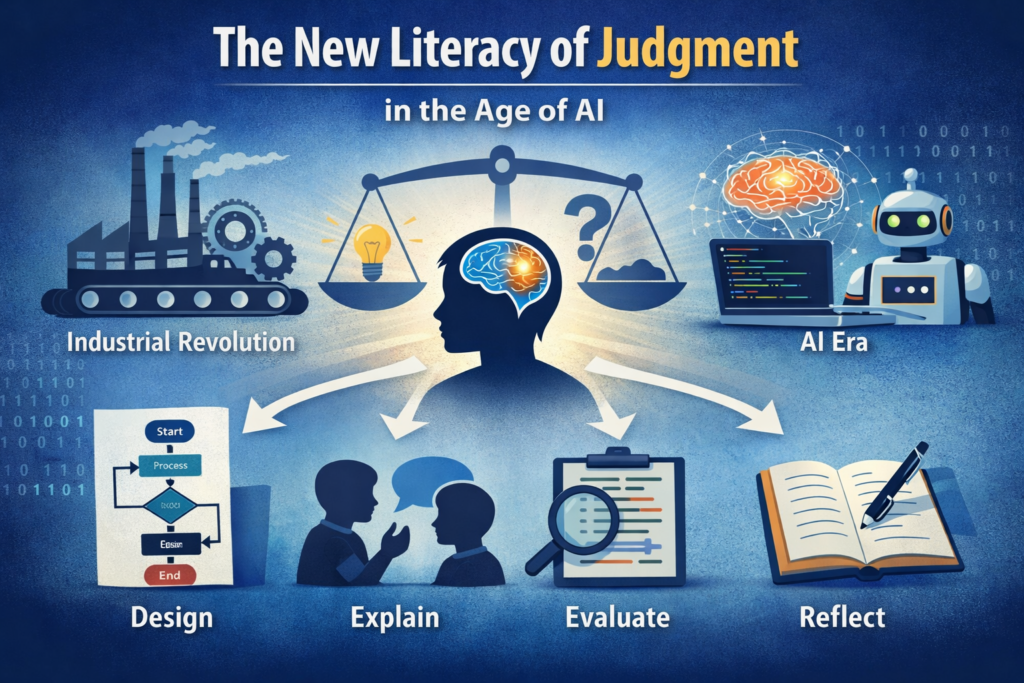
Figure 1. The New Literacy of Judgment
Judgment-Centered Instructional Design
In this article, experience is treated not as a learner outcome, but as a teacher-facing diagnostic lens. The focus is not on how students feel during an activity, but on what instructional choices make judgment necessary—or allow it to be bypassed. When students succeed without being able to explain, justify, or adapt their work, that outcome is not incidental; it is the result of design. This stance centers the teacher as the architect of conditions under which judgment must be exercised and made visible. Experience, in this sense, guides instructional shifts by revealing which tasks surface reasoning and which quietly reward polished output alone.
Sidebar: Naming the Work—Judgment-Centered Instructional Design
As I worked through these lessons alongside my students, I began to notice a pattern. The moments that led to deeper understanding were not tied to faster answers or more polished outputs, but to how clearly the learning experience itself was designed. When students could follow the structure, anticipate what came next, and make decisions without unnecessary friction, their thinking became more visible—and more independent.
Over time, I’ve come to think of this approach as Judgment-Centered Instructional Design: a way of designing instruction that uses experience as feedback on task design rather than as a measure of engagement. Teachers first step into the learner role—not to optimize enjoyment, but to notice where clarity supports reasoning and where barriers quietly interfere—before stepping back to examine the design choices that shaped that experience. In this way, accessibility and Universal Design for Learning are not added after the fact, but emerge naturally from thoughtful instructional design that supports judgment, reflection, and learning that lasts.
Understanding is no longer measured by getting the correct output, but by the judgment used in the work. In the industrial era, value shifted from physical execution to oversight and quality control. In the computer science classroom, I believe value is shifting in much the same way.
Rather than trying to outrun or restrict AI tools, I’ve started redesigning my instruction to slow the process down—or at least make the thinking unavoidable. Students submit pseudocode before code. We spend time tracing logic on paper. Reflection and explanation are treated as evidence of learning, not add-ons.
The goal is not to eliminate the AI Accent, but to design learning experiences where judgment, reasoning, and decision-making cannot be outsourced.
AI excels at speed, but it cannot replace judgment—the ability to weigh context, consider impact, and make intentional choices. Those are skills that develop slowly through reflection and revision.
The challenge is not whether AI belongs in computer science education; it clearly does. The challenge is whether our instructional design evolves quickly enough to meet it. The new literacy is not automation or efficiency—it is judgment.
Figure 2. Instructional Design Makes Thinking Visible
A simplified view of how instructional design choices shape whether student judgment or mere output becomes visible.
Design Focus:
- Polished Output
- Speed
- Final Product
What Becomes Visible:
✔ Working Code
✘ Hidden Reasoning
Design choices
————————>
Design Focus:
- Process
- Decisions
- Constraints
What Becomes Visible:
✔ Judgment
✔ Reasoning
✔ Intentional Choices
Resource: The Student “Judgment” Checklist
I provide this to my students as a sidebar for every major project.
- The “Voice” Check: If I read this out loud, does it sound like me—or a robotic textbook?
(Avoid: delve, crucial, tapestry.) - The “Library Leap” Check: Can I explain every import statement in this code? Could I rewrite this using only the concepts we’ve learned in class?
- The “Why” Check: Can I explain why this solution works, or am I just happy that it didn’t throw an error?
- The “Scars” Check: Is this code too clean? Does it show the history of my debugging and failed attempts?
References & Resources
- Halcoussis, D., & Halcoussis, M. (2025). Differentiating Between Human-Written and AI-Generated Texts. MDPI Research. (Focuses on identifying the “nominal loading” and mechanical rhythms of AI).
- Lau, S., et al. (2025). Generative AI in Computer Science Education. Cambridge University Press. (Discusses the risk of “cognitive debt” in automated coding).
- CSTA IMPACT Fellowship. CSTA Website. (The framework supporting student-centered, inclusive CS design).
- Long, D., & Magerko, B. (2020). What is AI Literacy? ACM Digital Library. (Foundation for defining “judgment” as a core competency).
About the Author

Jacqueline Edwards is a high school computer science and CTE instructor in Louisiana and a CSTA IMPACT Fellow. She serves as a state computer science standards reviewer and focuses on instructional design approaches that foreground student reasoning, judgment, and ethical decision-making in AI-supported classrooms.
“This article reflects my classroom experience navigating AI in computer science education and the instructional design shifts it prompted. Rather than focusing on detection or restriction, the piece reframes AI as a diagnostic lens that surfaces how task design makes student judgment visible. I hope it contributes useful language and perspective for educators facing similar questions.”