
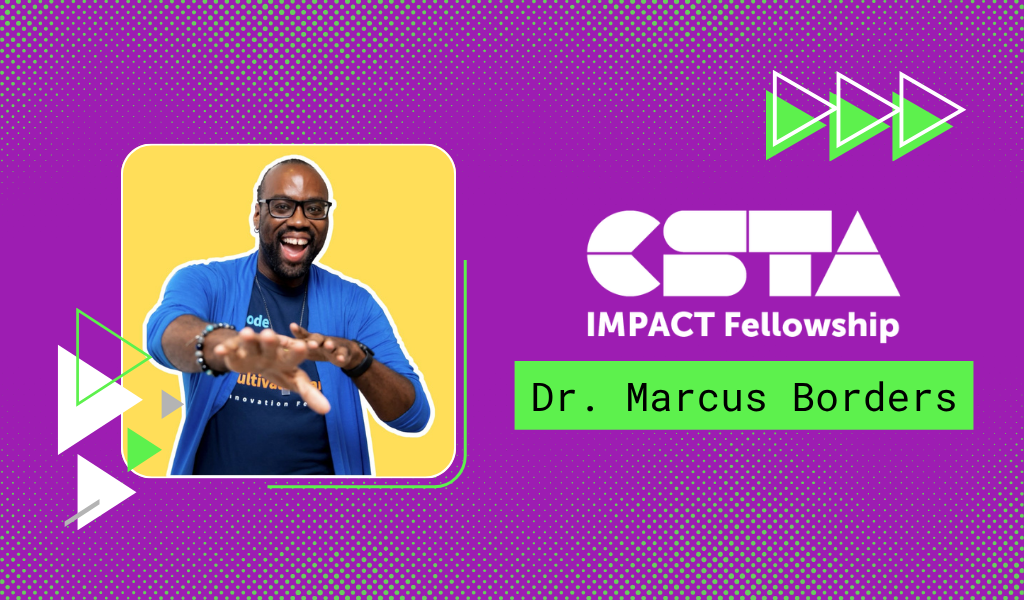
Dr. Marcus Borders is a learning innovation specialist with Ed Farm, where he supports educators and administrators with blended learning experiences, personalized coaching, coding, and computer science experiences in K–12 environments. Although Marcus has experience with K–12 and higher education, he is also passionate about working with elementary educators, students, and adult learners. Marcus received his Ed.D. and Ed.S. in instructional technology from Kennesaw State University, and his MS in urban teacher leadership and BS in early childhood education from Georgia State University. His doctoral research focused on innovative technology coaching for parents of elementary learners. Marcus is a native and resident of Atlanta, GA.
In his work at Ed Farm, Marcus aims to close the digital achievement gap by inviting new learners into computer science. He works with schools across the southeast to ensure that students have access to the devices, software, and curriculum resources they need. Through personalized coaching, he helps teachers integrate coding and computational thinking into their classrooms in ways that speak directly to students’ cultural backgrounds and experience levels. Marcus says, “My work spans large cities like Atlanta and rural areas like Perry County, adapting resources to meet each community’s needs and ensuring equitable experiences regardless of geography or funding.”
Marcus believes that computer science education should include every student, not just the ones who happened to get placed in CS elective courses. To this end, he supports Ed Farm’s Student Fellows Program, a semester-long, in-school course that introduces coding, design thinking, and problem-solving to all students. By embedding computer science directly into the school schedule, he creates opportunities for students to learn the basics of CS, build their CS identities, and make informed decisions about whether to continue pursuing it. Marcus also provides mentorship to teachers via the year-long Teacher Fellowship program, which coaches teachers on how to integrate CS into their classroom practice.
One of the best ways to cultivate a passion for computer science is by connecting it back to real-world contexts. Marcus has supported Ed Farm Spaces like the InnoLab in Warner Robins, Ga. and the South Hampton Innovation Library, which provides cutting-edge STEM opportunities for students and teachers and gives learners at every level access to mixed-reality, multimedia, and Apple technology. “These spaces extend learning beyond the classroom, inspiring creativity, exploration, and ownership,” says Marcus.
As he looks ahead to his time as an IMPACT Fellow, Marcus hopes to learn how to create CS learning experiences that can be expanded and scaled across a diverse range of education contexts. “My work as a learning innovation specialist has shown me the transformative power of equitable CS education,” he says, “but it has also revealed the systemic barriers—especially in underrepresented and rural communities—that require sustained, collective solutions.” Together with his cohort, he is eager to find those solutions, as well as the best strategies to measure and communicate their impact.
Recognizing the importance of community in supporting CS education, Marcus would love to work on initiatives that invite parents, caregivers, and community members into computer science. He hopes to draw on his doctoral research to equip parents with foundational digital skills and a better awareness of the CS learning opportunities available in their community. He says, “I hope to become not only a more effective practitioner but also a stronger advocate for ensuring that every student—regardless of zip code—has access to engaging, high-quality CS learning opportunities.”