

The landscape of K-12 STEM education has encountered a significant resource bottleneck. Historically, initiatives targeting systemic equity and advanced technological literacy relied heavily on targeted grant frameworks, such as dedicated National Science Foundation (NSF) equity funds. However, with those specific funding pipelines largely depleted or restructured, secondary science and computer science educators are forced to run a diagnostic on alternative capital streams. The most robust, fully funded vehicle remaining in the public education infrastructure is Career and Technical Education (CTE) funding.
To maximize these resources, we must pivot away from traditional, isolated computer lab models and integrate advanced technology into the physical environment. By deploying CTE funds to engineer artificial intelligence (AI)-driven agricultural habitats (“AI Gardens”), schools can simultaneously address workforce development, data literacy, local ecological toxicity, and basic human biological regulation. This approach is particularly urgent for Title I schools operating within industrial food deserts, providing a crucial intervention for both virtual and brick-and-mortar students and teachers.
The Systemic Overload: Food Deserts and Industrial Toxicity
Many Title I communities operate inside high-friction environments characterized by intersecting systemic stressors: severe economic divestment, limited access to unrefined nutritional inputs (food deserts), and proximity to industrial manufacturing byproducts. For students and educators living in these zones, the external environment presents a continuous, uncompressed dataset of physical stressors, including elevated localized heavy metal footprints in local soil and air.
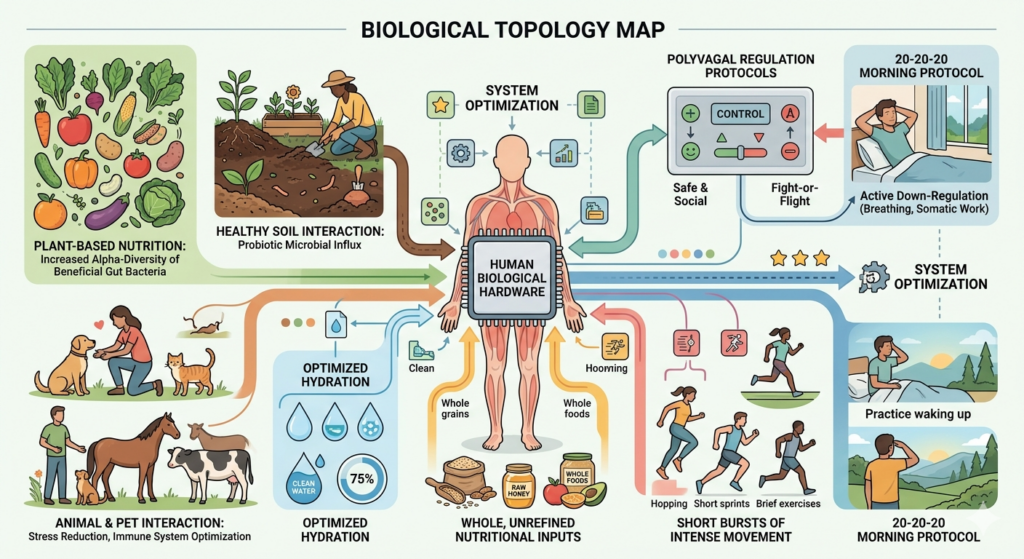
When individuals subsist within a food desert, their biological infrastructure lacks the clean fuel necessary for optimal cognitive processing overhead. Neurological regulation does not occur in an abstract vacuum; it is a bottom-up biological process heavily mediated by the enteric nervous system. Peer-reviewed microbiological research consistently demonstrates that increasing the quantity and variety of fresh fruits and vegetables directly expands the alpha-diversity of beneficial gut bacteria in humans. This gut microbiome diversity regulates systemic inflammation, neurochemical production, and overall cognitive bandwidth.
An AI Garden funded through CTE provides a literal and figurative buffer space. By utilizing controlled-environment agriculture (CEA)—such as automated hydroponic, aeroponic, or aquaponic vertical arrays—schools can bypass contaminated local soil entirely. These systems produce hyper-localized, nutrient-dense fresh food for Title I students and teachers, directly modifying the biological baseline of the community.
The CTE Alignment: Machine Learning as a Workforce Paradigm
To access CTE capital, an educational initiative must explicitly map to high-wage, high-demand workforce sectors and industry-recognized credentials. Modern agriculture is no longer an analog, manual-labor sector; it is a highly digitized, information-dense frontier driven by machine learning, automated robotics, and real-time systems topology.
An AI Garden functions as a physical, living computer science laboratory. Instead of interacting with abstract, pre-compiled datasets on a screen, students are tasked with engineering and maintaining the operational firmware of a complex ecosystem. The workforce competencies mapped within this environment are directly transferable to enterprise-level data science and automation:
- Edge Computing and Sensor Arrays: Students deploy and calibrate hardware meshes tracking ambient variables such as pH levels, electrical conductivity (EC), dissolved oxygen, lumens, temperature, and relative humidity.
- Predictive AI and Computer Vision: Students train convolutional neural networks (CNNs) using image datasets of plant foliage to detect early signs of nutrient deficiencies, systemic rot, or pest vectors before the crop stalls.
- Automated Resource Optimization: Students write and optimize machine learning algorithms that analyze real-time input data to dynamically modulate automated lighting arrays, nutrient dosing pumps, and water cycling, maximizing output while minimizing resource consumption.
This is high-fidelity workforce development. Students graduate not merely as consumers of AI tools, but as systems engineers capable of deploying machine learning architectures to solve critical, real-world resource constraints.
Interfacing with Virtual Spaces: Somatic Regulation and Polyvagal Checks
The necessity of this agricultural infrastructure is amplified in virtual learning environments. Virtual instruction frequently strips away natural somatic regulation (movement, proprioceptive anchors, and sensory decompression) forcing students and virtual teachers to handle massive amounts of uncompressed blue-light and cognitive input with zero physical buffer space. The result is a persistent hardware-level pipeline stall: chronic anxiety, sensory gating failure, and executive dysfunction.
To counteract this digital saturation, the operational framework of an AI Garden project must mandate systematic polyvagal check-ins and structured movement protocols, especially for virtual learners. The human operating system is hardwired to require physical, spatial transitions to down-regulate the sympathetic nervous system (“fight-or-flight”) and engage the parasympathetic state (“safe and social”).
The Biophilic System Override
When a student’s or teacher’s internal system redlines from prolonged screen throughput, the AI Garden acts as a physical ejection seat. If the local outdoor environment is verified as safe from acute localized pollution, students must be directed to step outside, alter their focal distance, and ground their proprioceptive system.
For virtual students, the home-scale or community-hub-scale iteration of an AI garden provides an immediate tactical anchor. Interacting with living agricultural hardware requires physical manipulation; pruning, testing water chemistry, and harvesting. These activities act as non-speech, bottom-up regulation mechanisms. Integrating brief, mandatory polyvagal self-assessments (tracking heart rate variation, breathing depth, and jaw tension) into the computer science or data-logging curriculum teaches students to treat their own biological hardware with the same diagnostic precision they apply to an automated server array.
Community Outreach and Local Mutual Aid
A sustainable CTE program must build iterative feedback loops with its local ecosystem. The output of an AI Garden extends far beyond classroom walls; it functions as an engine for community mutual aid and localized food sovereignty.
Title I school communities can establish distributed distribution nodes, routing the fresh, uncompressed nutritional output of the arrays directly to families and community elders living deep within local food deserts. Students running the project don’t just write code for a grade; they manage a live supply-chain infrastructure that provides tangible biological support to their neighbors.
Furthermore, this model transforms the school into a center for technological and environmental literacy. Students can host community workshops, demonstrating how to compile low-cost, open-source automated growth buckets using basic microcontrollers (such as Raspberry Pi or Arduino devices) and recycled materials. This bridges the generational gap, showing the community that artificial intelligence is not an extractive, corporate mechanism designed to automate human agency, but an accessible, open-source tool leveraged to reclaim local health and ecological autonomy.
Conclusion: Rewriting the Educational Blueprint
We must stop treating student anxiety, teacher burnout, and systemic nutritional deficits as isolated behavioral or character issues. From a high-fidelity systems perspective, these are predictable, hardware-level failures caused by unbuffered, toxic, and resource-starved environments.
By strategically routing CTE funding into AI-driven agricultural gardens, we achieve a profound convergence of solutions. We replace missing equity grants with sustainable, workforce-aligned capital. We replace abstract, unoptimized screen-time with high-demand computer science competencies. Most importantly, we provide the physical and biological buffer spaces that human systems require to thrive. It is time to dismantle the old factory-model classroom, drop the unoptimized compliance structures, and build a high-bandwidth, bottom-up educational architecture that feeds both the mind and the machine.
About the Author

Shanna Bohrer began teaching science 15 years ago because she knew science class could be better. After a decade in the classroom, she shifted into Computer Science, driven by her love of learning new things. That move led her to the Computer Science Teachers Association (CSTA), where she first began exploring equity in education. Growing up in the South, equity wasn’t often part of the conversation, but through CSTA she learned what authentic equity work looks like.
As chapter president and now treasurer of CSTA Alabama, Shanna has worked to bring these ideas home. She introduced an equity-focused Coursera course to the Alabama chapter, recruited and coached an all-girls VEX robotics team, and continues to advocate for students who have historically been overlooked. The realization that she has of autism in 2024 deepened this commitment, especially in supporting neurodivergent students and girls who, like her, might otherwise go unseen or misunderstood.
Currently, she serves on the CSTA Conference Committee and enjoys connecting with educators nationwide to build stronger, more inclusive communities. Outside of work, she’s married with two children, Trinity and Anaken, and loves her black cat, Nox, who frequently joins Zoom calls.