
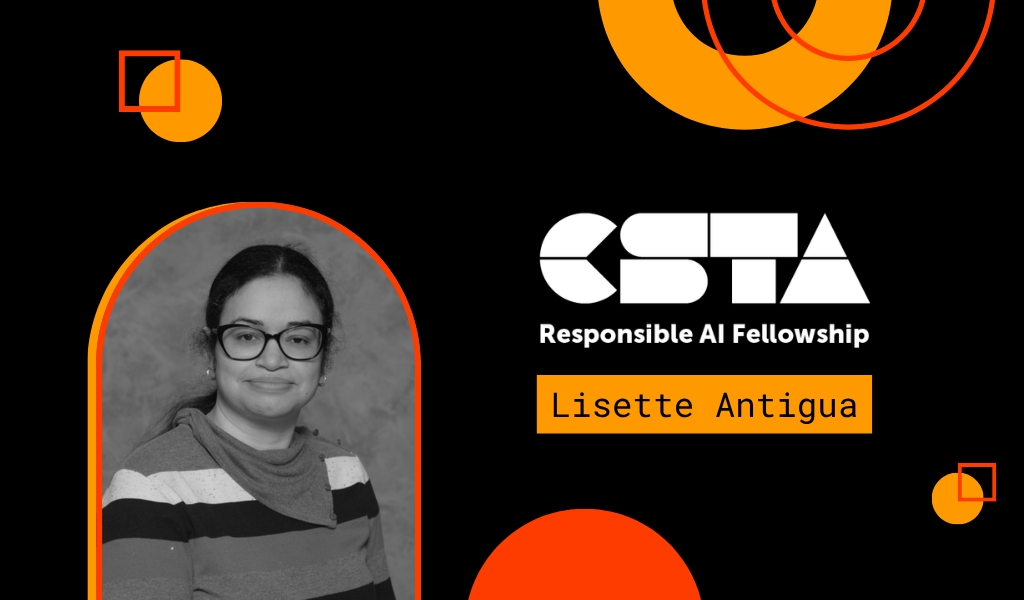
Lisette Antigua teaches high school computer science at STEM Innovation Academy in South Orange, NJ. She holds a bachelor’s degree in computer science and an MA in human–computer interaction from State University of New York at Oswego, and an MA in instructional technology and media from Teachers College, Columbia University. A computer science teacher for the last ten years, Lisette finds her greatest sense of accomplishment in seeing students pursue a computer science degree once they leave high school.
Lisette introduced AI tools into her computer science classes as a way to help her students with senior capstone projects, as she saw that they were intimidated at the prospect of building a real app from scratch. In past years, many students made the simplest apps possible, to ensure that they wouldn’t get overwhelmed or attempt something beyond their abilities.
But when they used tools like ChatGPT and Claude as “coding buddies,” confidence soared. The tools helped them get unstuck, offered code examples, and suggested ideas for debugging. At every step, Lisette discussed how to be responsible with AI by screening output for mistakes, tracking the role AI tools played in the process, and crafting original code for the most important elements of the project.
“And the projects they produced?” Lisette says. “Truly, they amazed me.” Projects included an app to track school events, a tracker for game and health statistics, and a social app to connect students with same-age peers. With the support of AI tools, students learned to trust themselves and make more ambitious attempts in their work. They tried out new coding features they had previously believed were too advanced for them. They didn’t panic when something went wrong, but tried getting AI feedback first—a lower lift than reaching out to peers or Lisette for support. One student said of the experience, “I never thought I could develop an app as real as this.”
To Lisette, students’ growing belief in themselves has been an even more powerful marker of success than the leap in project quality. Lisette believes in helping her students make informed decisions about the role AI plays in their work. AI tools are just that—tools—and Lisette has seen firsthand how valuable they can be in building up student confidence and encouraging risk-taking. With the support of AI, they were willing to take bigger swings, and more often than not, those bold attempts paid off. “Students did not just create better apps,” says Lisette. “They began believing that they actually could get this done.”
Beyond the success of the capstone projects, Lisette is proactive in seeking out other opportunities to teach students about AI tools and improve her own AI teaching practice. She launched and helps run her school’s coding club, open to students of any skill level, where students can explore basic programming and AI concepts. She also joined the “Games for Change” professional learning community, in which educators share their experiences of using game design as a vehicle for teaching coding and AI. In 2024 and again in 2025, she received the NCWIT Aspirations in Computing Educator Award, in recognition of her efforts to build supportive, inclusive CS classrooms.
As she looks ahead to her time as a Responsible AI Fellow, Lisette is eager to expand her knowledge base when it comes to AI. “I’m still figuring out how to deal with the tough stuff—ethics, bias, and fairness—so it doesn’t just seem like a bunch of abstract concepts,” says Lisette. “This fellowship is the perfect opportunity to learn from other educators who are asking the same questions, and to discuss what’s working in actual classrooms.” She’d like to get better at talking about AI to other stakeholders, from parents to school administration, so that she can build support, advocate for responsible AI use, and open doors for her students.
Alongside her cohort, Lisette hopes to work on developing an AI curriculum that aligns with CSTA standards, ideally featuring lessons that could be broadly applicable across subject areas. Lisette knows that many teachers are reluctant to engage with AI tools at all, due to fears of cheating and misuse, and she’d love to be part of the solution by providing flexible resources that teachers can use without needing to be experts. Similarly, she’d like to work on curating a teacher-led platform for research-backed, classroom-tested AI resources, case studies, and project ideas.
“My passion for using AI in education comes from witnessing its potential,” says Lisette. “I have seen my seniors grow as programmers with AI, and I am committed to ensuring that all students can become responsible users.”